Home > Stories by TimeLine Auctions
Stories by TimeLine Auctions
The Boy King's Last Secret: How Howard Carter Found the Only Intact Royal Burial in Egypt
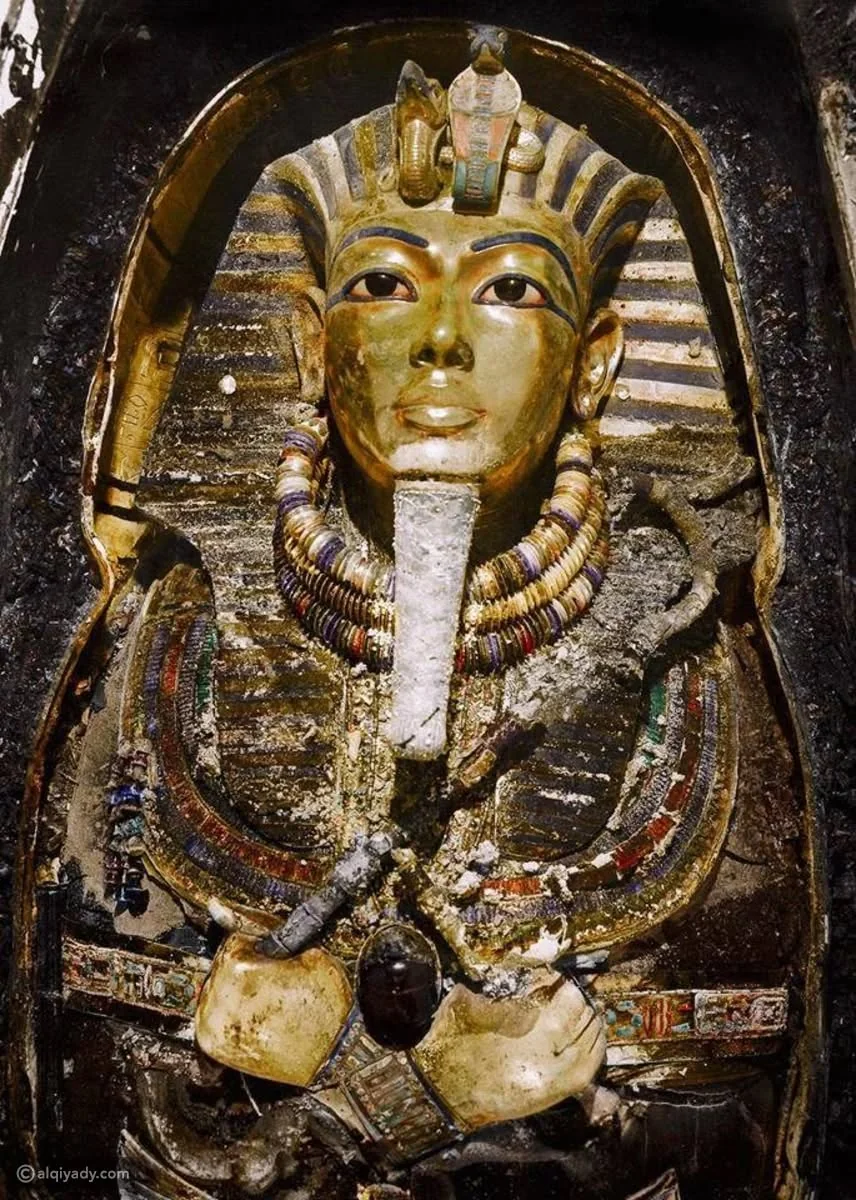
On the morning of November 4th, 1922, an unusual silence fell over the worksite. Howard Carter, walking towards his crew in the Valley of the Kings, knew at once that something had changed. The men had stopped singing. In sixteen years of digging through Egyptian rubble, Carter had learned to read that particular quiet. It meant they had found something.
Beneath the very first workman's hut they had dismantled that morning, cut into the bedrock thirteen feet below the entrance to the tomb of Rameses VI, was a step carved in the rock.
Six Seasons of Dust
To appreciate what happened next, you need to understand what Carter had endured to reach that step. He and his patron, the fifth Earl of Carnarvon, had been excavating in the Valley since 1917, and the results had been dismal. Season after season, nothing. They cleared thousands of tons of debris from the triangle of ground between the tombs of Rameses II, Mer-en-Ptah, and Rameses VI, working on the theory (Carter's, really, and a stubborn one) that the tomb of a particular Eighteenth Dynasty pharaoh lay somewhere in that area.
The evidence was thin but real. Theodore Davis, who held the Valley concession before them, had found a faience cup bearing the name of Tutankhamun under a rock. Nearby, in a small pit-tomb, fragments of gold foil showed the names of Tutankhamun and his queen. And in 1907, a cache of pottery jars turned up containing clay seals with the same royal name, linen head-shawls, floral collars, and other objects that looked as though they had been gathered up after a funeral and stored away. Three separate pieces of evidence, all pointing to the same forgotten king, all found within a small radius.
But by the autumn of 1922, Lord Carnarvon had nearly lost patience. They agreed on one final season in the Valley. If nothing came of it, they would try elsewhere.
It took five days.
Sixteen Steps Down
By the afternoon of November 5th, Carter's men had cleared enough rubble to see the full outline of a sunken stairway, the kind of entrance common to tombs in the Valley. At the level of the twelfth step, they hit the upper portion of a doorway, blocked with stones, plastered, and stamped with seals.
Carter searched the plaster for a name but found only the impression of the royal necropolis seal: a jackal above nine bound captives, the mark of the cemetery authorities. Two things were immediately clear. First, the tomb belonged to someone of high standing. Second, the sealed door had been completely buried beneath workmen's huts dating from the Twentieth Dynasty, which meant no one had entered since at least that period, roughly 1100 BC.
He made a small hole in the upper corner of the blocked doorway, shone a torch inside, and saw that the passage beyond was packed solid with rubble from floor to ceiling. Then he stopped.
Lord Carnarvon was in England. Carter sent his cable: "At last have made wonderful discovery in Valley; a magnificent tomb with seals intact; re-covered same for your arrival; congratulations." He filled the excavation back in, rolled the heavy flint boulders from the workmen's huts on top, and waited. The tomb vanished. For the next two and a half weeks, Carter sometimes wondered if the whole thing had been a dream.
"Yes, Wonderful Things"
Carnarvon arrived in Luxor on November 23rd with his daughter, Lady Evelyn Herbert. By the afternoon of the 24th, the full staircase was exposed: sixteen steps in all. Now, with the entire doorway visible, Carter could read the seal impressions on the lower portion clearly. There, unmistakable, was the name he had spent six years searching for: Tutankhamun.
But a closer look brought anxiety. The doorway showed evidence of having been opened and resealed twice. The original seals of Tutankhamun covered the untouched portion; the necropolis seal had been applied over the patched sections. Tomb robbers had been there before them.
On November 25th, Carter's team removed the blocking of the outer doorway and began clearing the descending passage beyond. Mixed with the rubble they found broken potsherds, jar sealings, and fragments of smaller objects, all signs that thieves had passed through. Thirty feet in, on the afternoon of November 26th, they hit a second sealed doorway. This one also showed evidence of ancient break-ins and repairs.
Carter made a tiny hole in the upper left corner. Hot air rushed out, causing his candle flame to gutter. Then, as his eyes adjusted, the shapes in the room beyond slowly came into focus.
"Can you see anything?" Carnarvon asked from behind him.
"Yes, wonderful things."
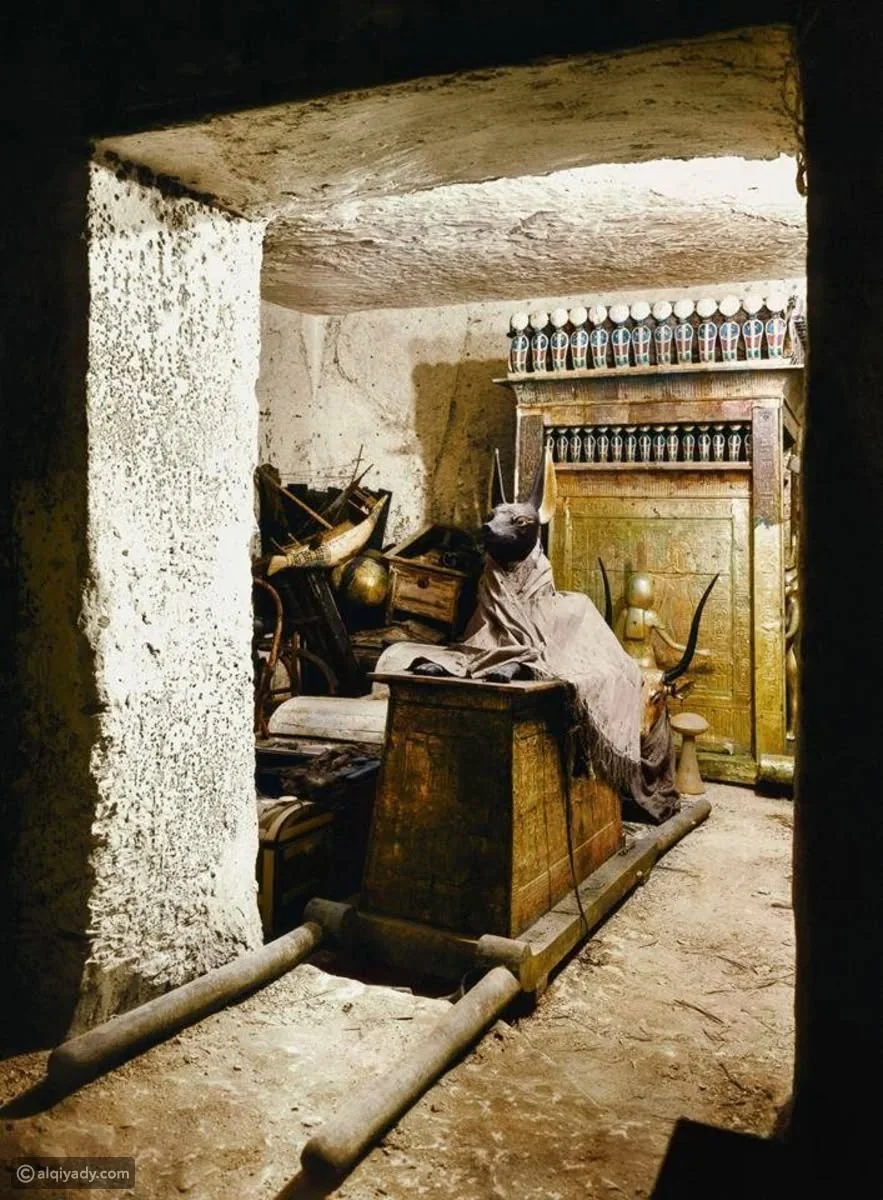
A Room Like No Other
What Carter saw by the light of that single candle, and then by the beam of an electric torch, was the contents of an entire royal household compressed into a room twenty-six feet long and twelve feet wide.
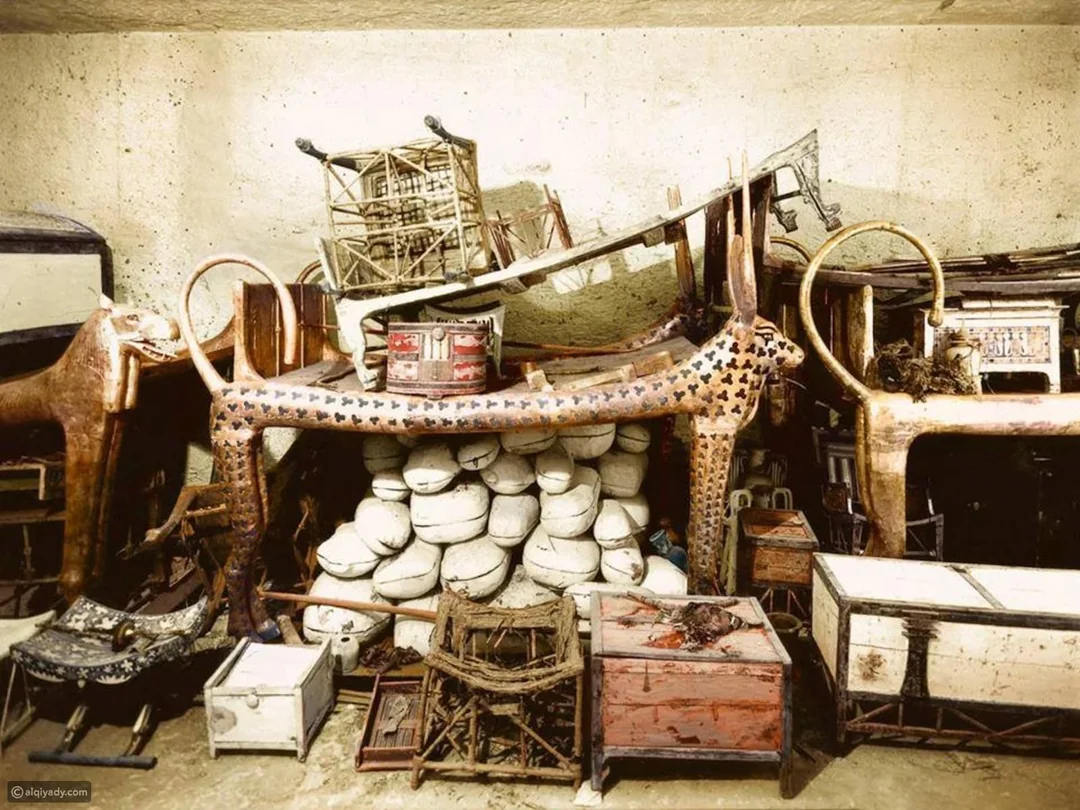
Three great gilt couches dominated the space, their sides carved in the forms of animals: a lion, a cow, and a composite beast that was half hippopotamus, half crocodile. Their gilded surfaces, picked out of the darkness by the torchlight, threw distorted shadows on the walls behind them. Between and around and on top of these couches, objects were stacked in what Carter described as seemingly endless profusion.
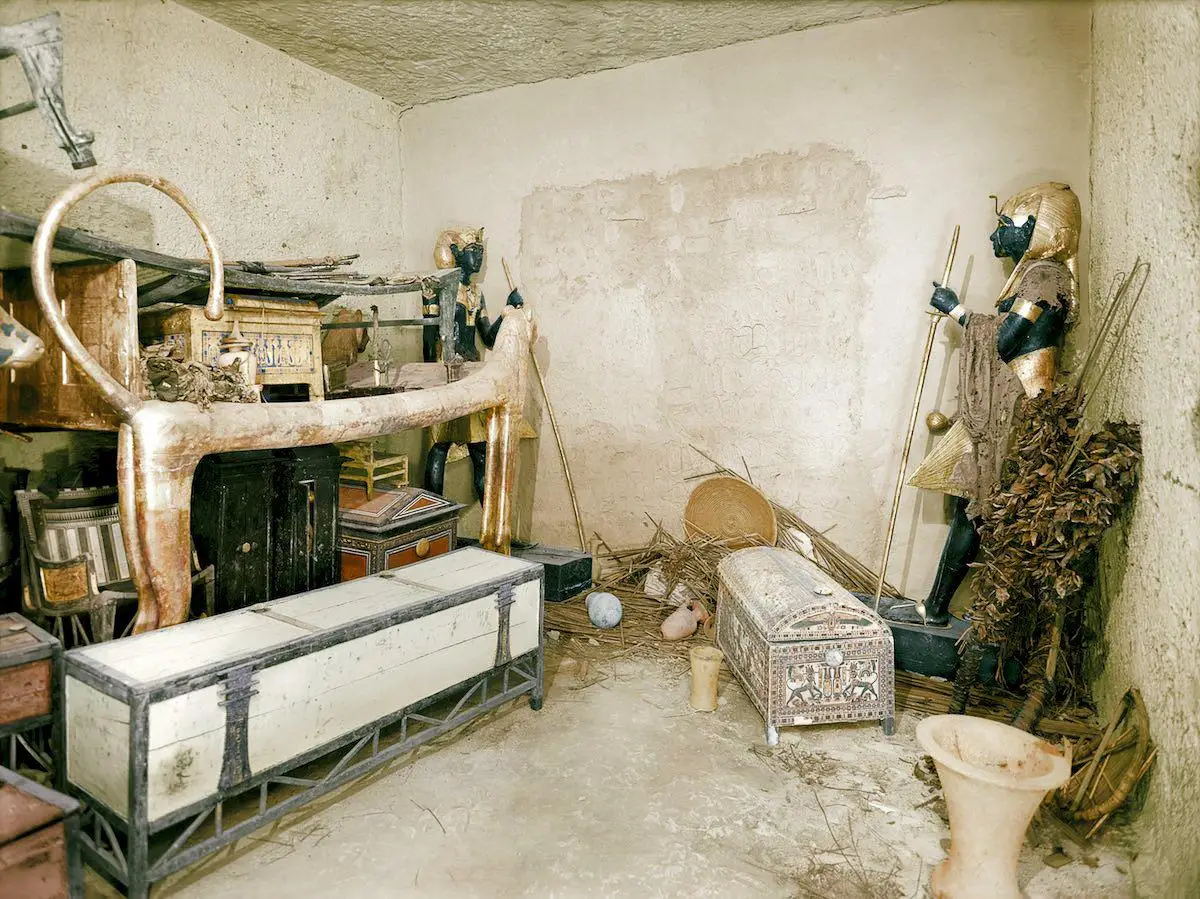
There were painted and inlaid caskets. Alabaster vases, some carved in openwork. Strange black shrines, from one of which a gilt snake peered through the open door. Bouquets of flowers. Beds. A golden throne. On the threshold of the chamber itself, a translucent alabaster cup in the shape of a lotus. And on the left, a confused heap of overturned chariots, their gold and inlay catching the light.
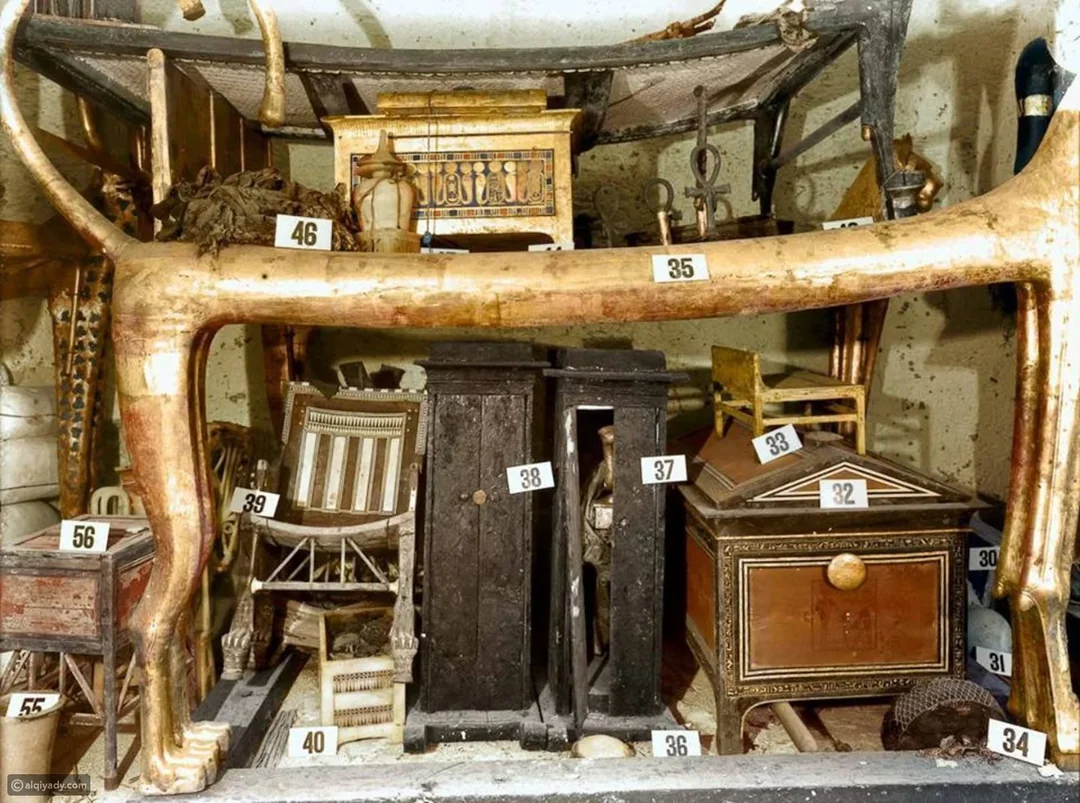
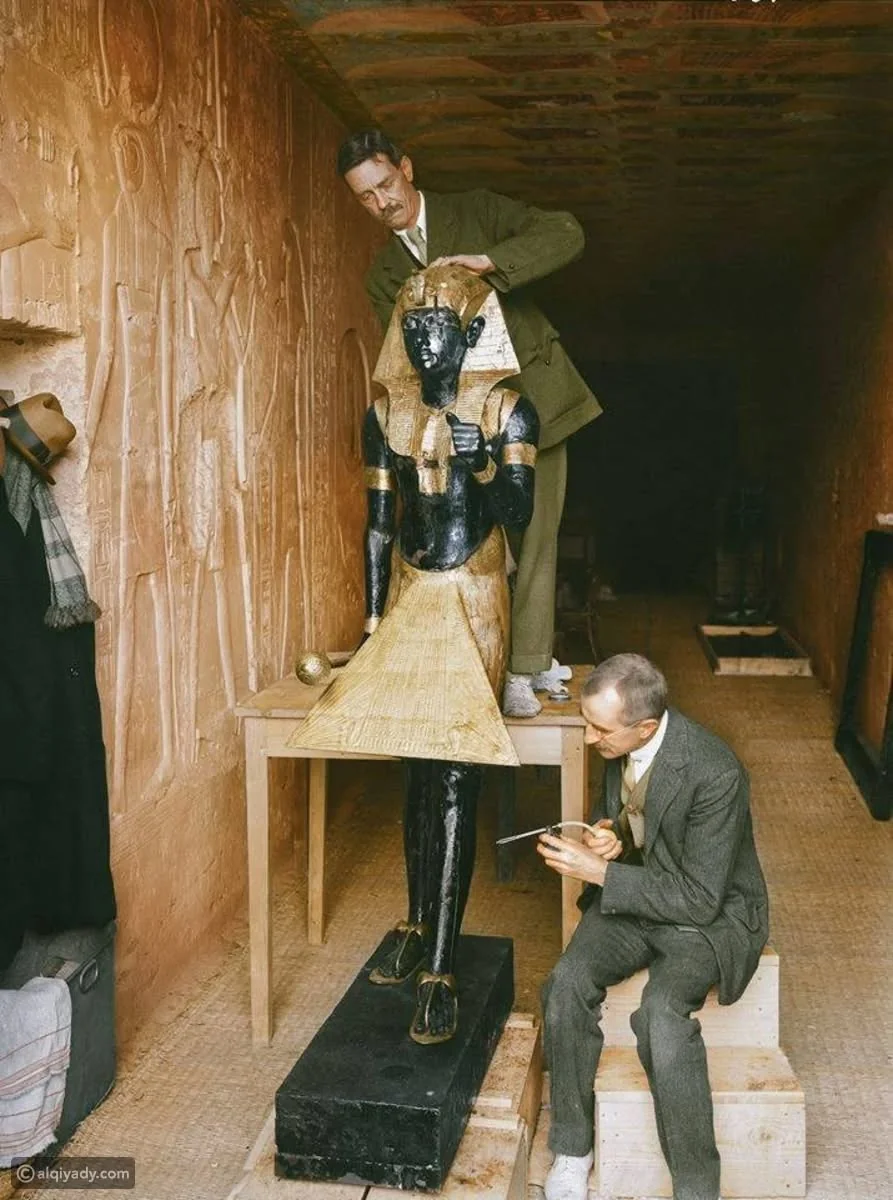
Two objects anchored the far end of the room. Standing on either side of a sealed doorway were life-sized wooden statues of the king, painted black, wearing gold kilts and gold sandals, each armed with a mace and staff, the sacred cobra on their foreheads. They faced each other like sentinels. Behind them, they guarded what Carter realized must be the entrance to the burial chamber itself.
There was no coffin in this room. No mummy. What they were looking at was only the antechamber.
The Painted Casket and the Golden Throne
Among the hundreds of objects in that first room, two stand out in Carter's account for the quality of their workmanship. The painted casket (No. 21 in his register) was covered entirely with gesso, upon which hunting and battle scenes had been painted in miniature with a fineness that, Carter wrote, surpassed anything Egypt had yet produced. The details required a magnifying glass to appreciate: the stippling on lions' coats, the decoration of horse trappings. The scenes reminded him of Persian miniatures, and he noted a curious floating quality that he compared, unexpectedly, to the work of Benozzo Gozzoli.
The golden throne was the other treasure. Overlaid with gold from top to bottom, inlaid with glass, faience, and stone, its legs were fashioned as feline forms surmounted by lions' heads. The back panel depicted a scene in the intimate style of the Tell el Amarna period: the young king sitting casually on a cushioned throne while his queen, Ankh-es-en-Amen, anoints his shoulder with perfume. The sun above them sends down rays ending in small hands, the characteristic image of the Aten religion that Tutankhamun's father-in-law had championed and that the boy king himself had been forced to abandon.
The throne told a political story. Some of its cartouches still bore the Aten form of the king's name, while others had been altered to the Amen form. Carter noted that remnants of a linen wrapping had been found over this particular panel, as though someone had tried to hide the heretical imagery before placing it in the tomb. Tutankhamun's return to the old religion, it seemed, was not entirely a matter of conviction.
What the Thieves Left Behind
As Carter's team began the painstaking work of clearing the antechamber (it took seven weeks), a picture of the ancient robberies emerged.
The plunderers had entered at least twice, both times within a few years of the burial. They tunnelled through the passage filling and broke through the inner door, then ransacked the room. Every box was dragged to the centre and its contents dumped on the floor. Gold was their target, but it had to be portable. Gilded wood they threw aside in disgust. The metal points had been snapped off all the arrows. One box that should have contained sticks, bows, and arrows was found half-stuffed with the king's underlinen, clearly crammed in during a hasty tidy-up.
The most telling piece of evidence was a handful of solid gold rings, tied in a fold of cloth. The method was exactly how an Egyptian worker would secure coins in his head-shawl: a loose fold, twisted round to form a bag, held with a knot. The thief had used one of the king's own scarves. But the bundle was still in the tomb. Carter was almost certain the thieves had been caught, either trapped inside or overtaken in flight. How else to explain why a man would leave behind a bundle of gold rings light enough to carry at a run?
After the robbery, officials came to repair the damage. Their work was sloppy. They swept up the smaller objects and jammed them back into whichever boxes were nearest, with no regard for what belonged where. On the lid of one box, docket labels listed seventeen objects of lapis-lazuli blue; inside were sixteen faience libation vases, with the seventeenth found across the room. The corslet, a complex garment of gold, faience, and inlay, was found scattered across four separate boxes and the floor. The Annexe, a small side chamber, they did not even bother to touch: it remained in the state the thieves had left it, every inch of floor covered with ransacked objects.
Behind the Sealed Door
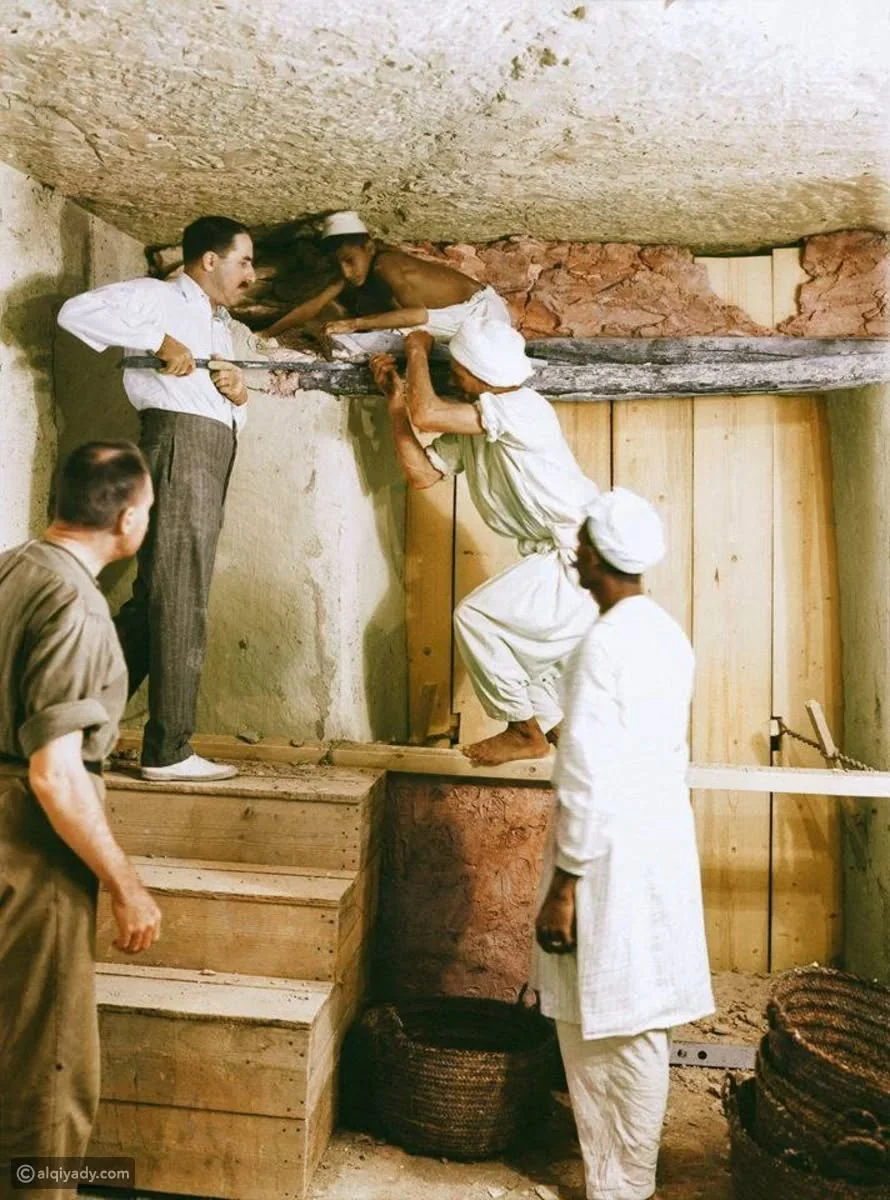
On February 17th, 1923, Carter opened the sealed doorway between the sentinel statues. About twenty people were present, including Lord Carnarvon, Lady Evelyn, the Director-General of Antiquities, and a handful of Egyptologists. They filed down the passage in their shirt sleeves.
Carter worked from the top down, chipping away plaster and picking out the rough stones of the blocking one by one. After ten minutes he had a hole large enough to insert a torch. What he saw, within a yard of the doorway, was what appeared to be a solid wall of gold.
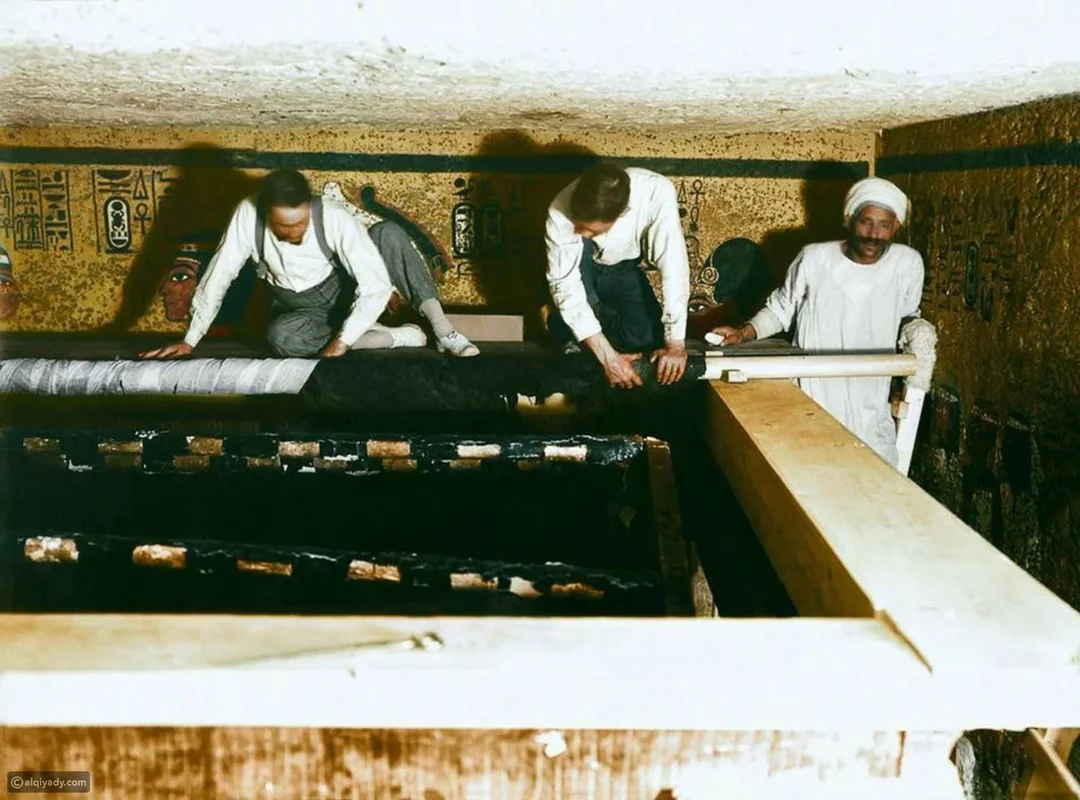
It was the side of an immense gilt shrine, seventeen feet long, eleven feet wide, and nine feet high, built to enclose the sarcophagus. It filled the burial chamber almost entirely, with barely two feet of clearance to the walls on any side. Its surface was overlaid with gold and inlaid with panels of blue faience bearing protective symbols. Seven magic oars, which the king would need to cross the waters of the underworld, rested on the ground at its northern end.
Two hours of careful work to clear the blocking. At one point near the bottom, they had to stop and collect scattered beads from a necklace the ancient thieves had dropped on the threshold. Then Carter lowered himself into the chamber (its floor was four feet below the antechamber) and edged along the narrow gap between shrine and wall.
At the eastern end of the shrine, great folding doors stood closed and bolted but unsealed. He drew the bolts and swung them open. Inside was a second shrine, also with bolted doors. On these bolts, a seal. Intact.
They did not break it. Carter wrote that a feeling of intrusion had come over them, heightened by a linen pall decorated with golden rosettes that drooped above the inner shrine. They closed the doors again and moved on.
The Innermost Room
A low door at the far end of the burial chamber opened into a smaller room, and Carter described what he saw there as the most beautiful monument he had ever encountered. A large shrine-shaped chest, entirely overlaid with gold and crowned with a cornice of sacred cobras, stood at the far wall. Around it, free-standing, were statues of the four tutelary goddesses of the dead. Their arms were outstretched in protection. The two at the front and back looked directly at the shrine. The two at the sides had their heads turned, looking back over their shoulders toward the entrance, as though watching for intruders.
Carter admitted the sight brought a lump to his throat.
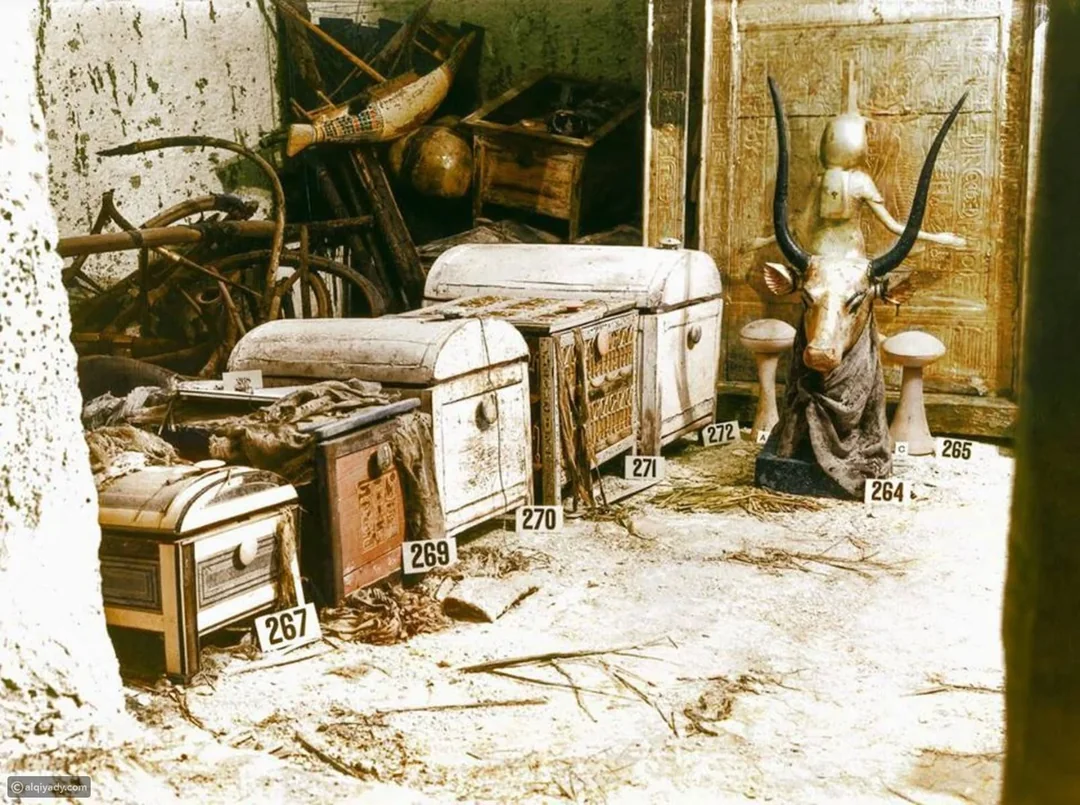
The room also contained the figure of Anubis upon his shrine, a bull's head on a stand, rows of black shrine-shaped boxes (one with open doors revealing statuettes of the king standing on black leopards), miniature gilded coffins, ivory and wood caskets inlaid with gold and blue faience, model boats with intact sails and rigging, and, in one casket whose lid they raised, an ostrich-feather fan with an ivory handle that looked as fresh as the day it was made.
Most of these objects still had their seals intact. The thieves had entered this room but had barely touched it.
The Faces Behind the Work
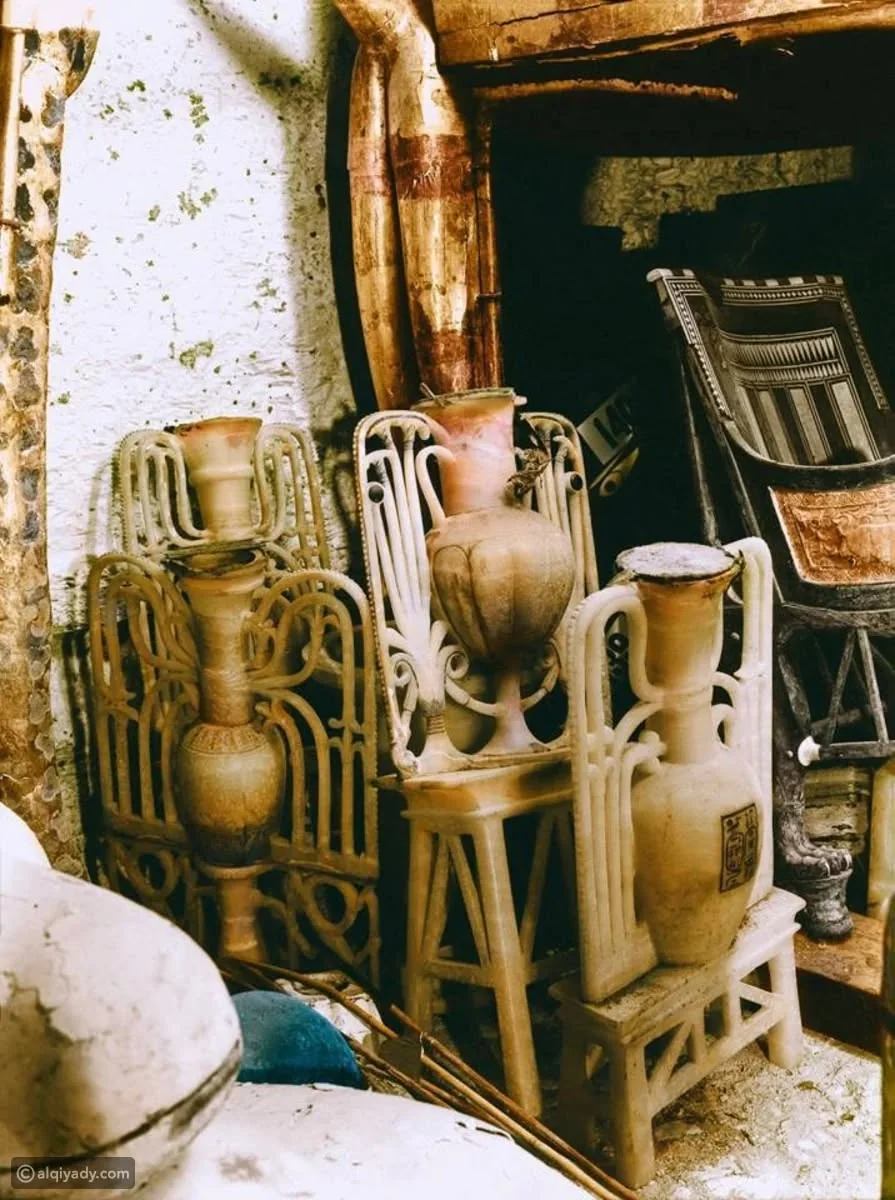
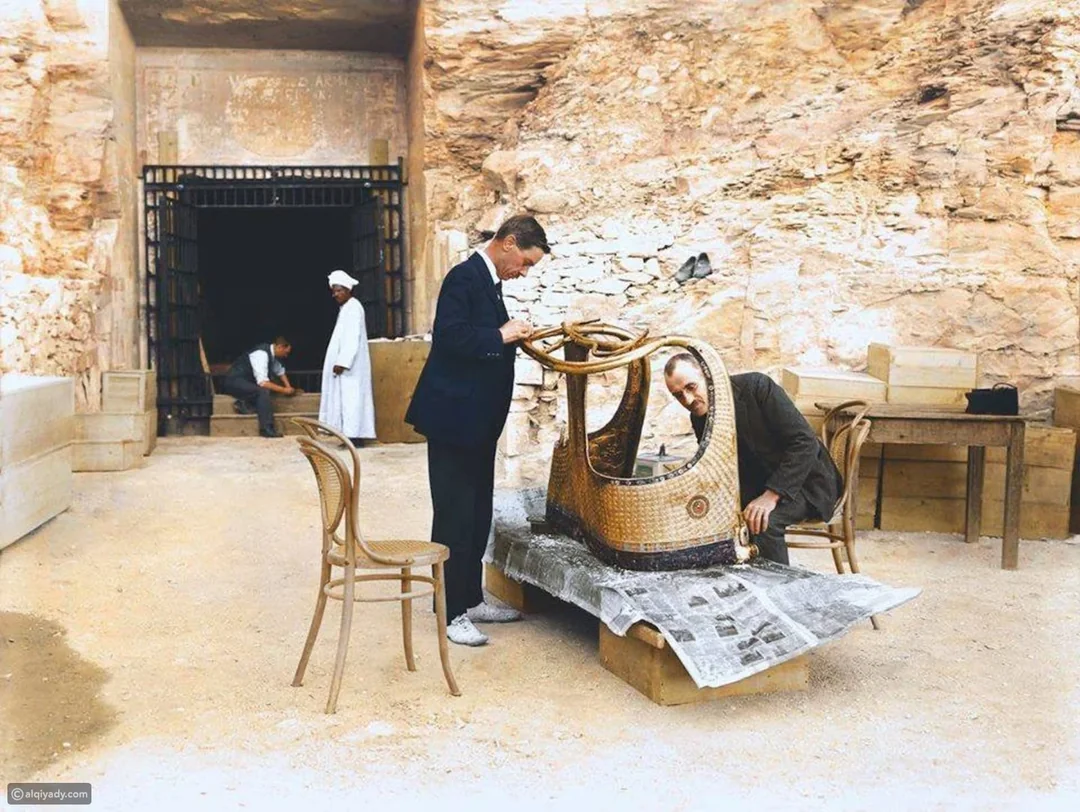
The photographs from the excavation show something that Carter's published account only hints at: the sheer physical intimacy of the work. Men in suits and shirtsleeves, crouching in chambers barely large enough to turn around in, handling objects that had not been touched by human hands in over three thousand years. Carter and his colleague Arthur Mace spent weeks unpacking a single box, using brushes and bellows to clear dust from collapsed necklaces, hour after hour, recording every bead's position before it could be moved. The painted casket alone took three weeks to empty.
The laboratory they used was the tomb of Seti II, tucked away at the far end of the Valley where tourists rarely ventured. A one-and-a-half-ton steel gate secured the entrance. Objects arrived on padded wooden stretchers, carried up the Valley path by workmen while tourists photographed them from the walls above. Carter noted drily that a piece of old mummy cloth, sent to the lab for experimental purposes, was photographed eight times before it arrived.
The objects themselves were fragile in ways that were not always obvious. Sandals of patterned bead-work looked perfectly solid until you tried to pick one up; the threading had rotted, and the whole thing crumbled into a handful of loose, meaningless beads. Paraffin wax, heated until nearly boiling and applied to the surface, could save such an object. The funerary bouquets needed several sprayings of celluloid solution before they could be moved. And the garments, crushed and bundled together by the ancient officials, presented a cruel choice: you could save the cloth or you could save the bead decoration that covered it, but rarely both. Carter chose the decoration. Later, in the museum, new garments could be made and the original ornamentation applied to them. It was the right decision, but not an easy one.
One detail in the boxes told Carter something unexpected about the king himself. Many of the decorated robes were too small for an adult. They were a child's clothes. But they bore the royal cartouche. Tutankhamun had worn them after becoming king. On the lid of another box, a docket read: "The King's side-lock as a boy." Whatever else remained unknown about this pharaoh, his youth at accession was becoming harder to deny.
The Weight of It
By mid-May 1923, eighty-nine boxes of antiquities had been packed into thirty-four heavy cases. Transport to the Nile was by Decauville railway, the tracks laid and relaid in a continuous chain as the flat cars inched forward across five and a half miles of rough road. Fifty labourers worked the line, and the whole distance was covered in fifteen hours under a shade temperature well above a hundred degrees, the metal rails almost too hot to touch. A week later the cases reached Cairo by barge.
Lord Carnarvon did not live to see the sarcophagus opened. A mosquito bite became infected, and after three weeks of illness he died in Cairo on April 6th, 1923, five months after the discovery. He was buried on the summit of Beacon Hill, overlooking his estate at Highclere, with no organ or choir, only the larks.
Carter worked in the tomb for another decade. The antechamber, with its six or seven hundred objects, represented perhaps a quarter of the total contents, and, as Carter acknowledged, probably the least important quarter. The shrines in the burial chamber, nested one inside the other, took years to dismantle. The Annexe, with its earthquake of jumbled objects, required a further season.
What made the discovery extraordinary was not simply the gold, though there was gold enough to stagger the imagination. It was the completeness. Every other royal tomb in the Valley had been stripped bare. Here, for the first time, was the full equipment of an Egyptian king's burial, from the great gilt shrines down to a pair of leather slippers with gold ornamentation, from ceremonial bows inlaid with coloured stone down to a linen glove. A whole world packed into four small rooms, sealed up in the dark for thirty-two centuries, waiting.
The material culture of ancient Egypt, from alabaster vessels to faience amulets and gilded wood, survives in greater quantities than many collectors realise. While the treasures of Tutankhamun's tomb belong to the Egyptian nation, objects of the same periods, the same workshops, and the same traditions of craftsmanship appear regularly on the market. [INSERT REFERENCE TO TIMELINE AUCTIONS EGYPTIAN ANTIQUITIES CATEGORY / CURRENT CATALOGUE]. For those drawn to the Eighteenth Dynasty and the world Carter spent his life uncovering, the opportunity to hold a piece of that world is more accessible than you might think.
TimeLine Auctions, 12th May 2026