Home > Stories by TimeLine Auctions
Stories by TimeLine Auctions
The Cloak That Gave Us the Word 'Chapel' and Three Other Ways to Read a Saint
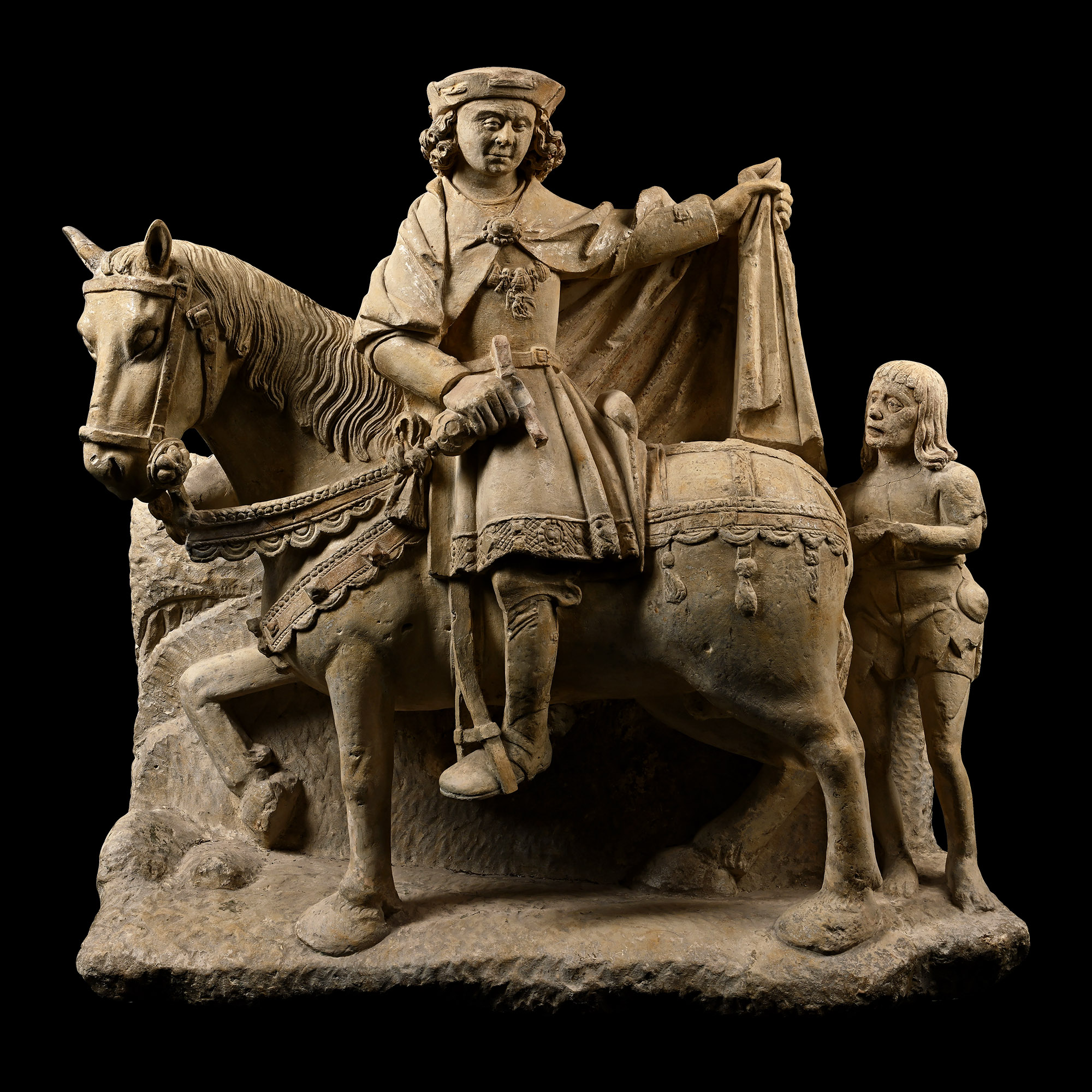
A soldier on horseback, cut in creamy limestone and just over three-quarters of a metre tall, has his sword drawn and his cloak already half divided. The blade is broken off now, a pale stub above his fist with a fleck of old red paint at the break, but the gesture reads at once: he is halving his own cloak to give one part to the near-naked beggar kneeling at the horse's feet, hands pressed together. The rider is St Martin of Tours, and the act carved here, a young cavalryman dividing his cloak at a city gate in a hard frost, is the reason English has the word "chapel."
Martin kept one half and wrapped himself in it; that half became a relic, and by tradition it is the reason for the word. The chain is already in a seventh-century Frankish royal formulary, and Du Cange fixed it later: the kings kept the cloak, the cappa, in a palace oratory and carried it to war; the oratory took its name from the cloak, cappella; the clergy who guarded it were the capellani. From cappella came Old French chapele and English chapel, and from capellanus, chaplain. That much is secure. Whether the relic was the very half Martin cut is softer: Sulpicius Severus, writing around 397, calls the divided garment a chlamys, a soldier's cloak, never a cappa, and says nothing of the half he kept being preserved as a relic. The word is Martin's; the tie to that one winter night is a later medieval association laid over an older treasure.
The book of those who could not read
Four objects in the sale of 8 September belong to the same devotional world, roughly 1450 to 1520, and together they teach how that world was read. A medieval worshipper recognised a saint by a fixed attribute rather than any written label: the instrument of his martyrdom, the sign of a famous deed, or the dress of his office. A cut cloak is Martin; a lance, Longinus; a medicine flask, a physician saint; a cross with hollow compartments, the wood of the Passion. The idea came from Gregory the Great, who around the year 600 defended church images against a bishop who had smashed his own: what writing offers the literate, a picture offers those who cannot read, for in it "they read who do not know letters." Images always did more than teach, as Michael Camille and others note; they were prayed to as much as read. But the rule held. To look was to read.
Martin in the wrong armour
The carving gives Martin plate armour, a sword, a soft civilian cap in place of a helmet, and a richly caparisoned warhorse: a fourth-century Roman cavalryman dressed as a fifteenth-century knight, which is how late-medieval carvers updated the past. The armour dates the carving, nothing more. The horse is the sharper point. The earliest images of the cloak-division, in tenth-century manuscripts from Tours and Fulda, show Martin on foot, the Martin of Sulpicius who threw down his arms with the words "it is not lawful for me to fight." The mounted holy warrior took firm root only in the late eleventh century, in the age of the Crusades. Lot 306 belongs to that later fashion: it makes a mounted knight of the man whose famous act was giving up the sword.
The catalogue calls the stone Flemish, and the label is worth a second look. Medieval figural limestone is quarry-tied to France and the Paris basin; fifteenth-century Flanders and Brabant carved in oak and alabaster, not stone; and every stone equestrian St Martin the comparison turns up is French. The closest, a 1531 limestone group from the Loire now in the Gulbenkian in Lisbon, matches this one almost point for point: the horse in contrapposto with a foreleg raised, the ornamental trapper, the emaciated beggar reaching up. A limestone Martin on horseback reads more naturally as northern-French or Franco-Flemish border work than as comfortably Flemish. The back keeps traces of its old fixing to a wall; this was architecture once, painted in the blues and reds whose ghosts still cling to the harness.
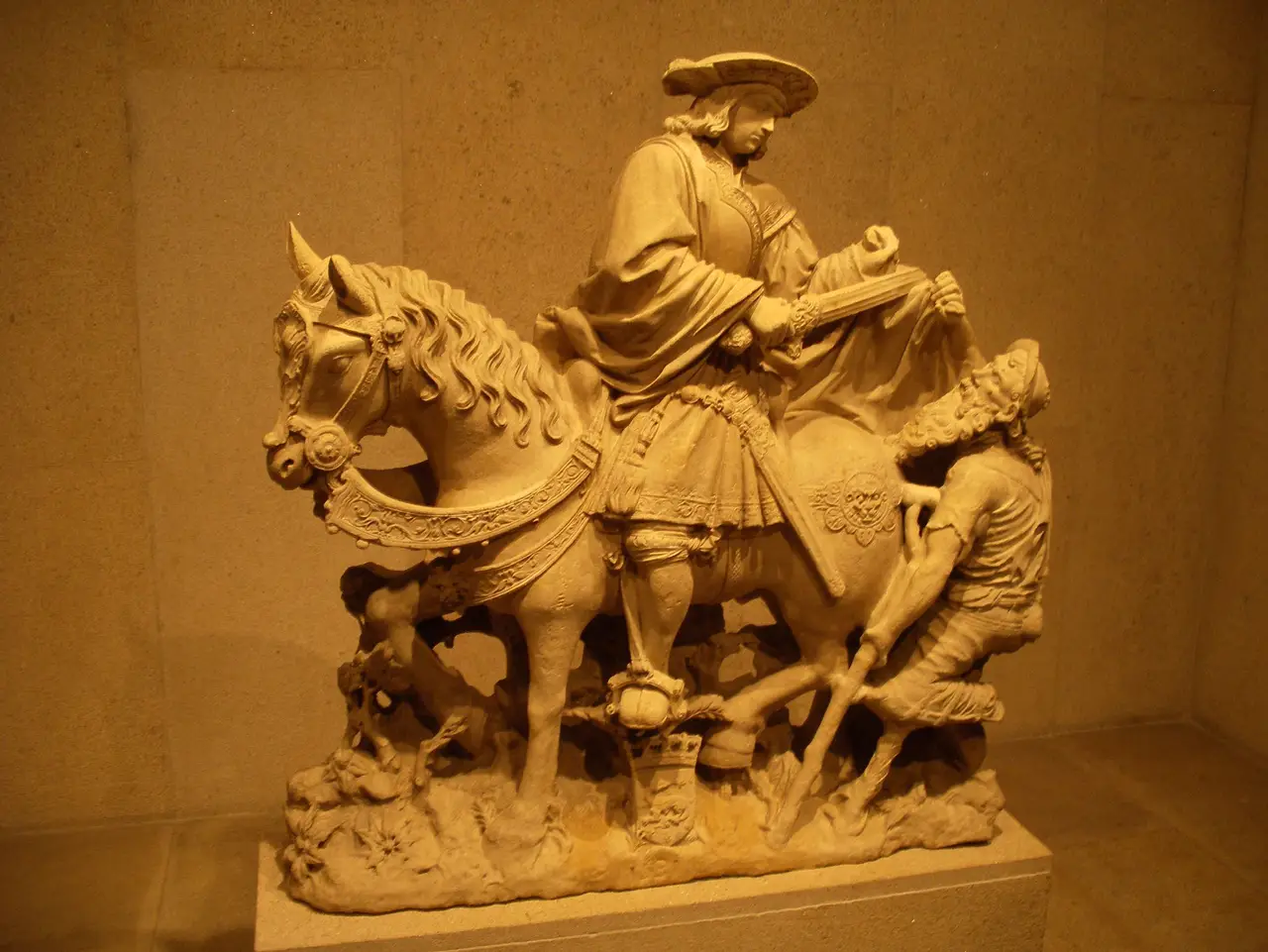 A French limestone St Martin from the Loire, dated 1531, in the Calouste Gulbenkian Museum, Lisbon: almost the same composition as the carving in the sale, and firmly French. Photo: shadowgate, CC BY 2.0, via Wikimedia Commons.
The physicians without silver
Martin clothing the beggar is one of the Seven Corporal Works of Mercy, the acts of charity Christ names at the Last Judgement. A second of them, tending the sick, belongs to the pair on the humblest object in the sale: a Spanish tile of Saints Cosmas and Damian. The tile is a socarrat, and the word matters, because it invites confusion with Valencia's famous golden lustreware. A socarrat is not glazed. It is a buff terracotta ceiling tile painted in iron-red and manganese-black on a white lime slip and fired once, matte and porous; the name is from the Valencian socarrar, to scorch. Made at Paterna and Manises in the fourteenth and fifteenth centuries, socarrats were set face-down between the beams of a wealthy household's ceiling. This one shows the twins facing each other in the striped skirts and hats of their day, haloed, a block of Gothic blackletter naming them down the centre. One holds up a tall flask and a small box: the uroscopy flask, the urine-glass that was the medieval badge of the physician, and the pyxis that held his medicines.
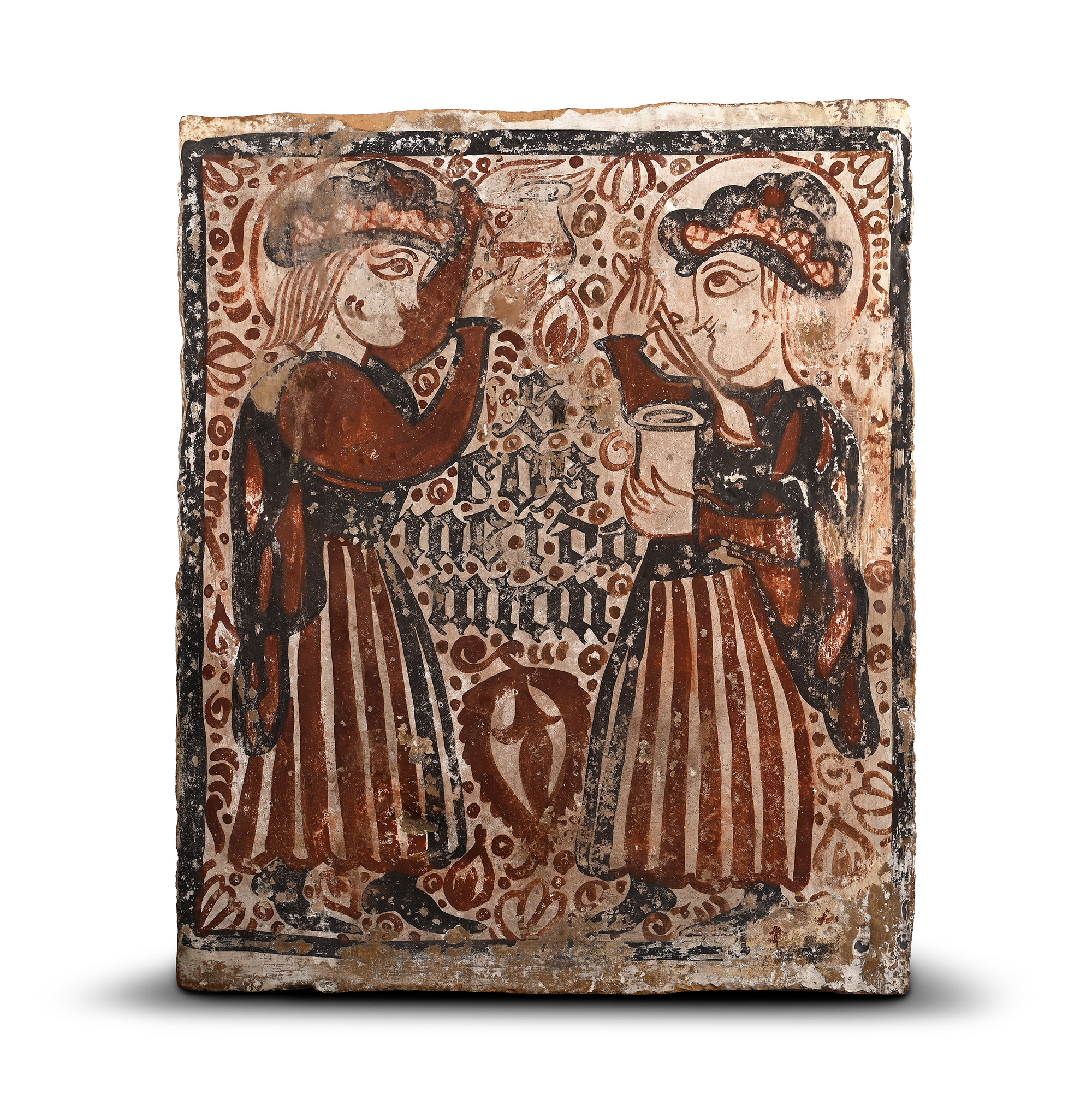
Cosmas and Damian were twin physicians, remembered as Arab-born or, in another tradition, Cilician, martyred in Roman Syria around the year 300. They are near-impossible to tell apart, which is the point of them: the attributes fix a type, the physician-saint pair, and telling one twin from the other was never the aim. What they were known for is how they worked. They took no fee. In Greek they are the Anargyroi, the silverless, healing the poor for nothing in obedience to the gospel line "freely you have received, freely give." The famous legend of the black leg, the two grafting a dead man's limb onto a living patient, comes from the thirteenth-century Golden Legend, a thousand years after they lived; the modern habit of calling them patrons of transplant surgery is later still. Socarrats are dated by eye, from style and context, and are still made in Valencia today, which is why an undocumented tile earns the catalogue's honest "or later."
The saint whose name is his weapon
A small oak figure in the sale collapses attribute and name into one. He is an older bearded man in a broad-brimmed kettle-hat helmet and a short belted tunic, head bowed, both hands closed around a vertical shaft. The shaft is a lance, though only a stub survives; the head is lost. A soldier at the foot of the Cross with a spear is, by convention, the man who pierced Christ's side, whom tradition names Longinus. The name is the joke and the lesson at once. The soldier in John's gospel is anonymous; "Longinus" looks coined from the Greek lonche, "lance," just as the centurion at the tomb was later christened Petronius from petra, "rock." Tradition welded this spearman to the centurion who looked up and said "truly this was the Son of God," and the Golden Legend made him near-blind until Christ's blood ran down the shaft and cured his eyes. A saint known almost wholly by the thing he holds, whose name is that thing.
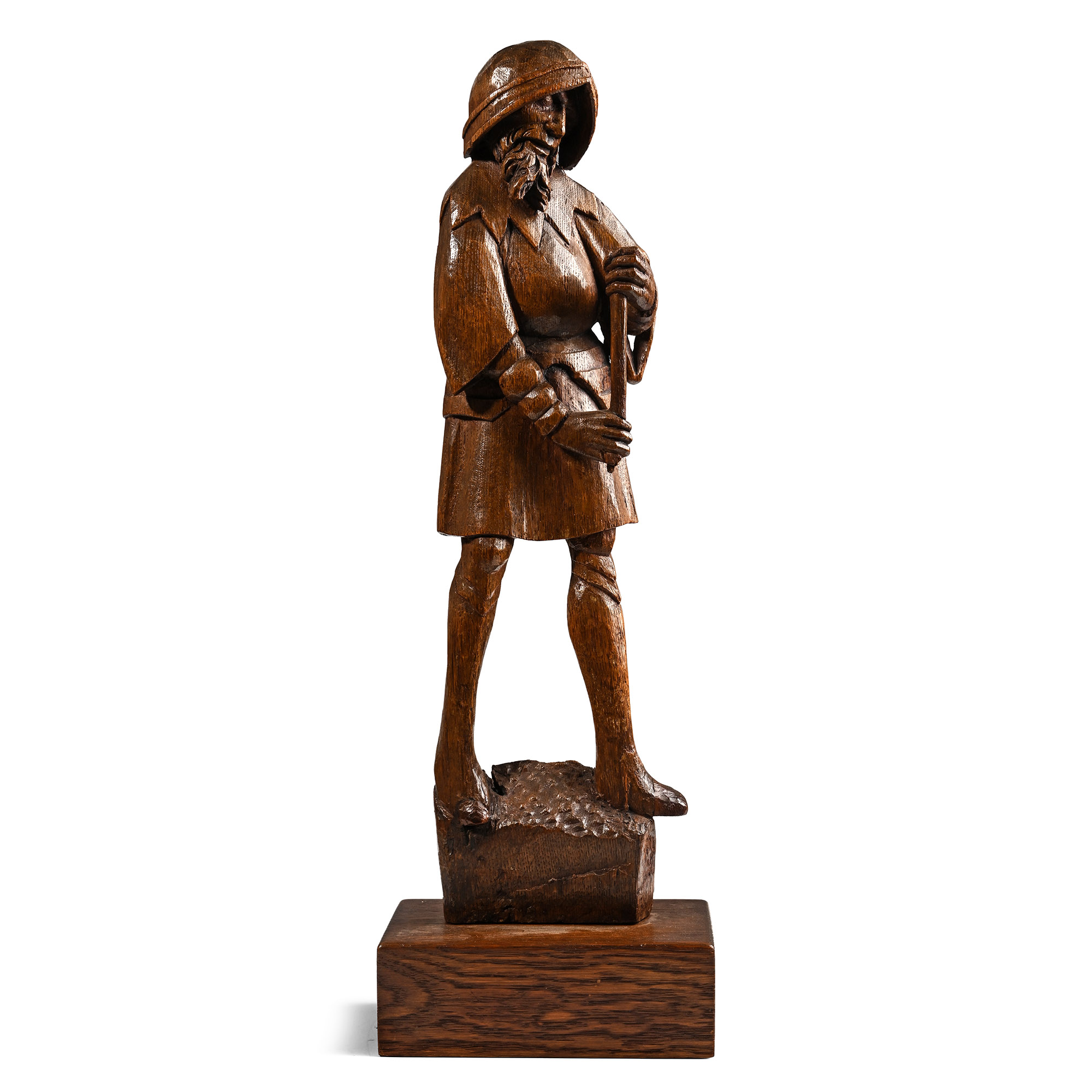
Whether this figure is Longinus at all the object no longer lets anyone say. A lance, a helmet and a short tunic are generic Roman-soldier kit, worn as readily by the guards at the arrest or the escorts to Calvary, and the figure has none of Longinus's tells: no hand raised to a healed eye, no vessel of blood. His downcast eyes even point the wrong way, since Longinus is usually shown looking up in recognition. He is most likely one figure broken from a larger carved Passion, a nameless soldier out of a crowded Calvary.
That retable came from a near-industrial trade. Between about 1380 and 1550 the Brabantine towns of Antwerp, Brussels and Mechelen turned out carved oak altarpieces for an open market, what the art historian Lynn Jacobs calls serial manufacture from a catalogue of standard parts. The oak came quarter-sawn from the Baltic; the workshops branded their output like a trademark, Brussels with a mallet, Antwerp with a small severed hand burned into the wood with a hot iron. The mark guaranteed the material, and claimed nothing for the artistry. These saints were an export good, shipped from the Baltic to Iberia, and the Swedish churches that hold some forty of them, as Hannah De Moor has shown, largely bought and paid for them rather than seizing them as loot. Longinus's lance is itself one of the Arma Christi, the Instruments of the Passion, a short step from reading a saint's weapon to reading Christ's.
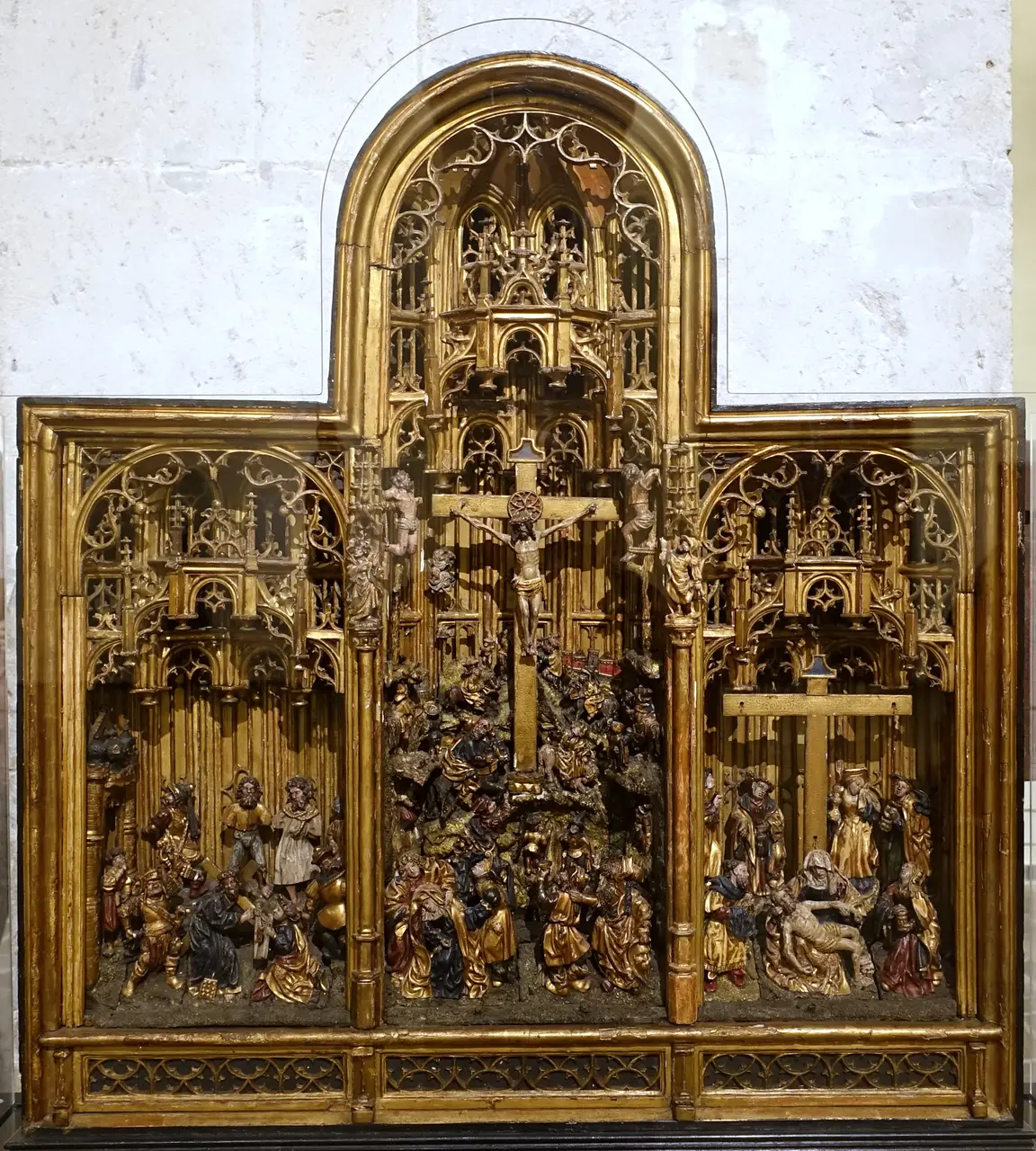 A carved and gilded oak retable of the Passion, Brussels, about 1520, now in the Museum Schnütgen, Cologne. Its central panel is a Calvary crowded with soldiers and mourners under Gothic canopies. Photo: Daderot, CC0, via Wikimedia Commons.
The wood of the Cross
The fourth object turns from the saint to Christ: a walnut panel, two kneeling figures flanking a Latin cross, once part of something larger, with sockets on the reverse where separately carved wings, now lost, were fixed. The cross is the reason to look. Its shaft and arms are hollowed into open channels with traces of red inside, which the catalogue reads as compartments for slivers of the True Cross. They may be. Fragments of the Cross were often housed just so, the bare wood left visible in a cavity at a panel's centre with adoring angels around it, the Passion made present on the altar. But the only physical evidence is that red pigment, and red in a recess is as likely to be bole, the ground laid under gold leaf, as the backing of a relic. No relic, seal or label survives, so the reliquary reading is plausible but unproven. The figures are unsteady too: the left, an open hand reaching to the cross, reads as an angel; the right, veiled and praying, reads closer to a mourning Virgin, and calling both angels rests on those empty sockets.
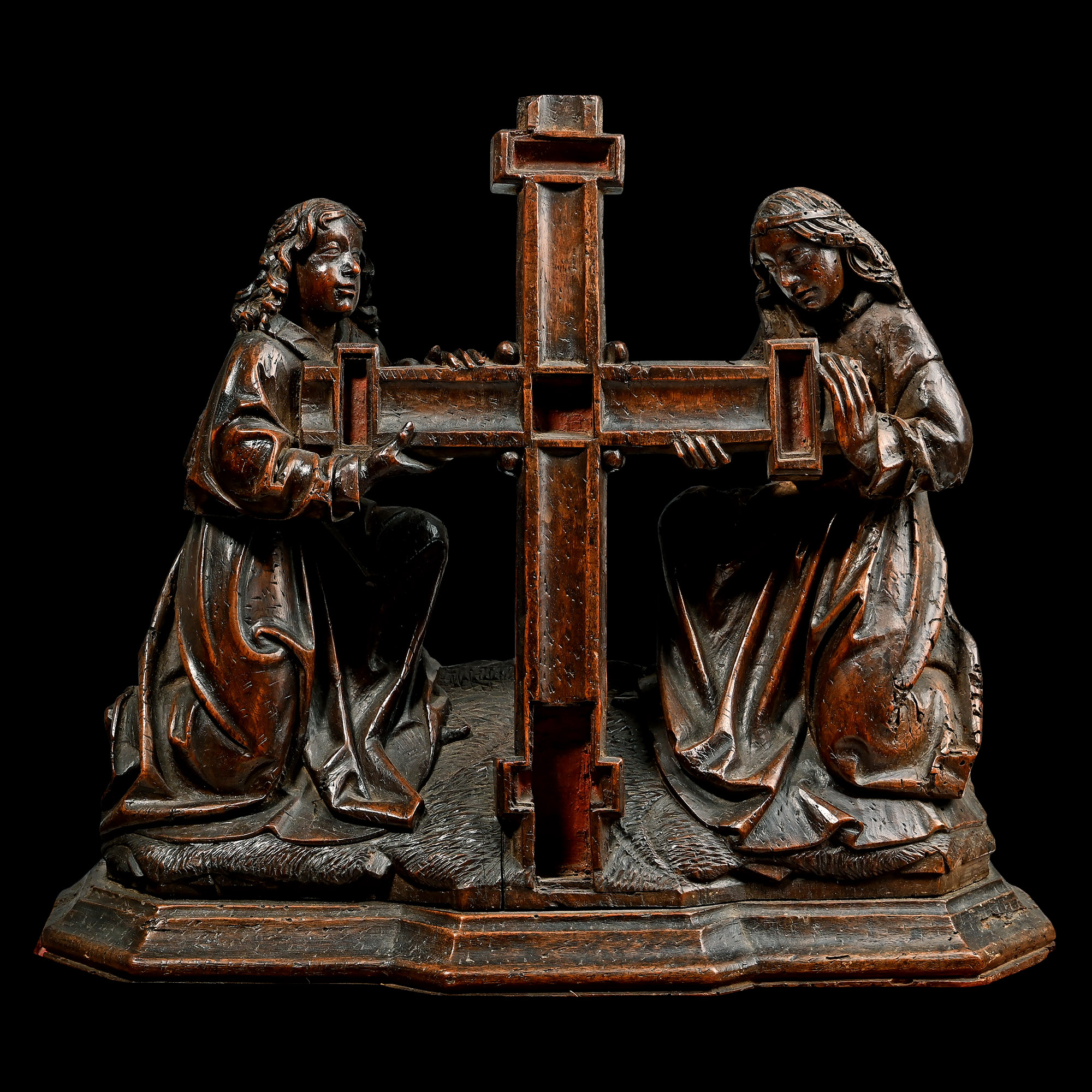
The walnut is itself a clue. Netherlandish carvers worked mostly in oak and, to a lesser degree, walnut, the material of the small devotional statuettes of Mechelen, so the wood nudges this panel toward Mechelen, or perhaps further south, rather than a Brussels oak retable. Whatever it framed, it belonged to the vast medieval traffic in relics of the Cross, fragments numerous enough that Calvin, in a 1543 pamphlet, jeered that the surviving pieces would fill a ship's hold. He was scoring a polemical point, not measuring, but the fragments really did run into the hundreds.
Four painted, gilded church furnishings reach a saleroom as bare wood and stone by a long process of loss. The colour went first: some in the Protestant image-breaking of the sixteenth century, more in later cleaning and church restoration, most in the nineteenth-century antiques trade that emptied churches for collectors. What comes to market now is the stripped carving, its polychromy a memory of blue on a harness or red in a fold of cloak. That such things survive at all, and can still be held and owned, is the quiet fact under every lot in the sale.
Cosmas and Damian, on their scorched tile, are the Anargyroi, the silverless, the twins who refused a fee. The objects around them were made to be prayed to; now they are stripped of their gilding and priced for sale, the silverless saints' exact opposite number. A saleroom is a candid place to notice it.
TimeLine Auctions, 17th August 2026