Home > Stories by TimeLine Auctions
Stories by TimeLine Auctions
The Consul Who Dug Up Cyprus: How a Head Left the Met and Came Back to the Saleroom
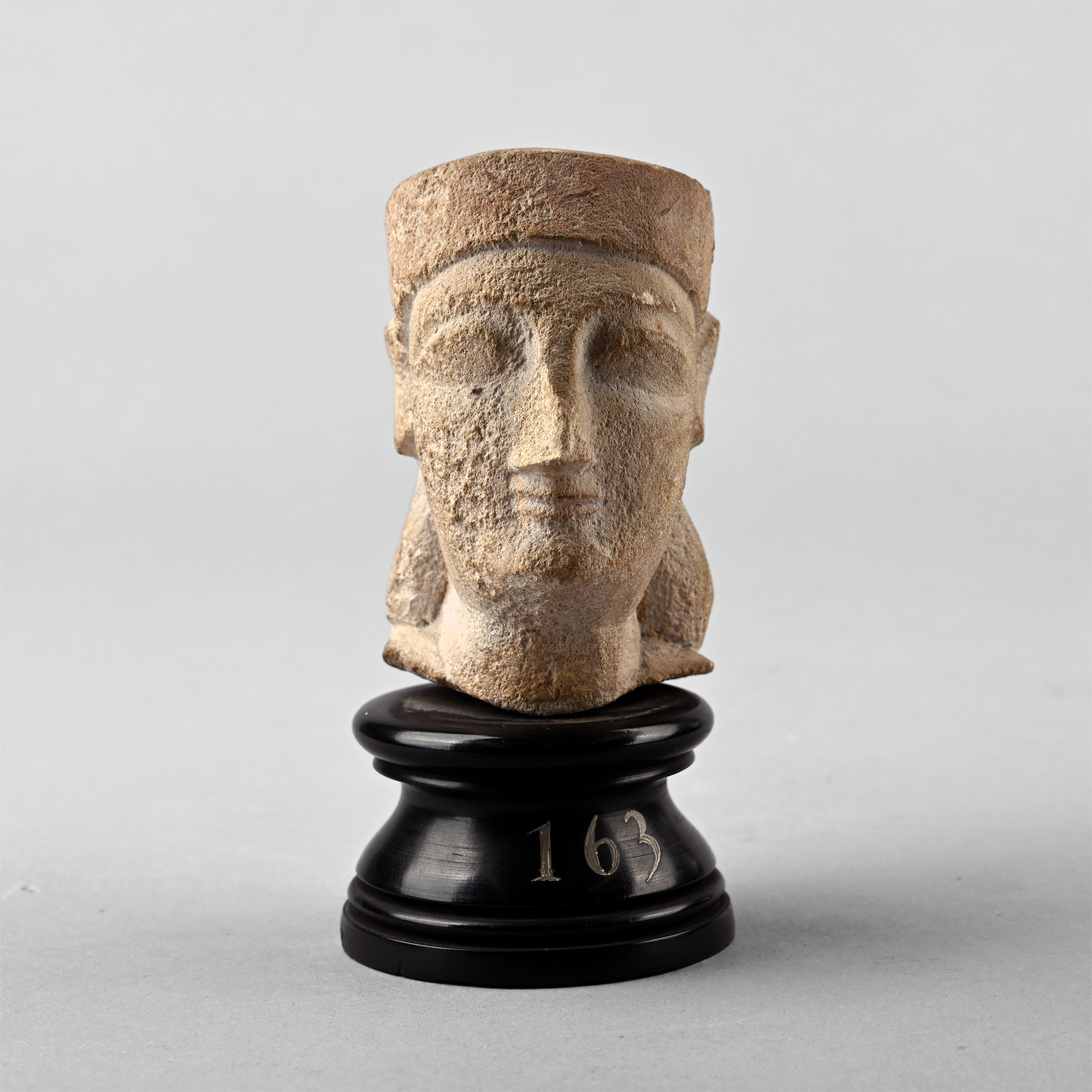
The head stands thirteen centimetres on its base and weighs a little over a third of a kilogram, small enough to cup in one hand. A young man in soft creamy limestone, weathered and pitted: almond eyes under arched brows, a strong nose, a faint closed-mouth smile of the kind Greek sculptors gave their standing youths and then gave up around 480 BC. On his head sits a tall conical cap with a raised band across the brow, the ears left clear. He has been smiling like this for roughly 2,500 years.
Turn him around and the portrait ends. The back of the head is not carved at all: a rough, nearly flat plane where the stone broke. This was never a head. It is the top of a small standing figure, snapped at the neck, the weakest point, when the whole statuette came apart. The base it now stands on is a second piece of evidence, later by two millennia: a turned wooden socle, blackened in the nineteenth-century manner, with the number 163 inlaid in pale metal across the front. The smile and the number are the two ends of the story.
Lot 43 in our sale of 8 September carries an estimate of £700 to £900 and one of the longest paper trails an antiquity of this price will ever have. Its provenance names, in order, Luigi Palma di Cesnola, the Metropolitan Museum of Art, a New York collector, Christie's, and a private family. A round trip from Cypriot soil to one of the world's great museums and back to a saleroom, with almost every leg on paper. That is uncommon, and the reason it is possible begins with the first name on the list, a man who reached Cyprus after a war with a consul's title and a plan.
A consul with a firman
Luigi Palma di Cesnola was born in 1832 near Turin, in Piedmont, into the minor nobility and the family trade of soldiering. He fought in the Crimean War, emigrated to New York in his twenties, ran a military academy there, and when the American Civil War came he raised and led cavalry for the Union, finishing it a brevet brigadier-general with a wound and a spell in a Confederate prison behind him. What he did not have, when the fighting stopped, was money. Like many a discharged officer he went looking for a government post abroad, and in 1865 he got one: United States consul on Cyprus, at Larnaca. He arrived on Christmas Day.
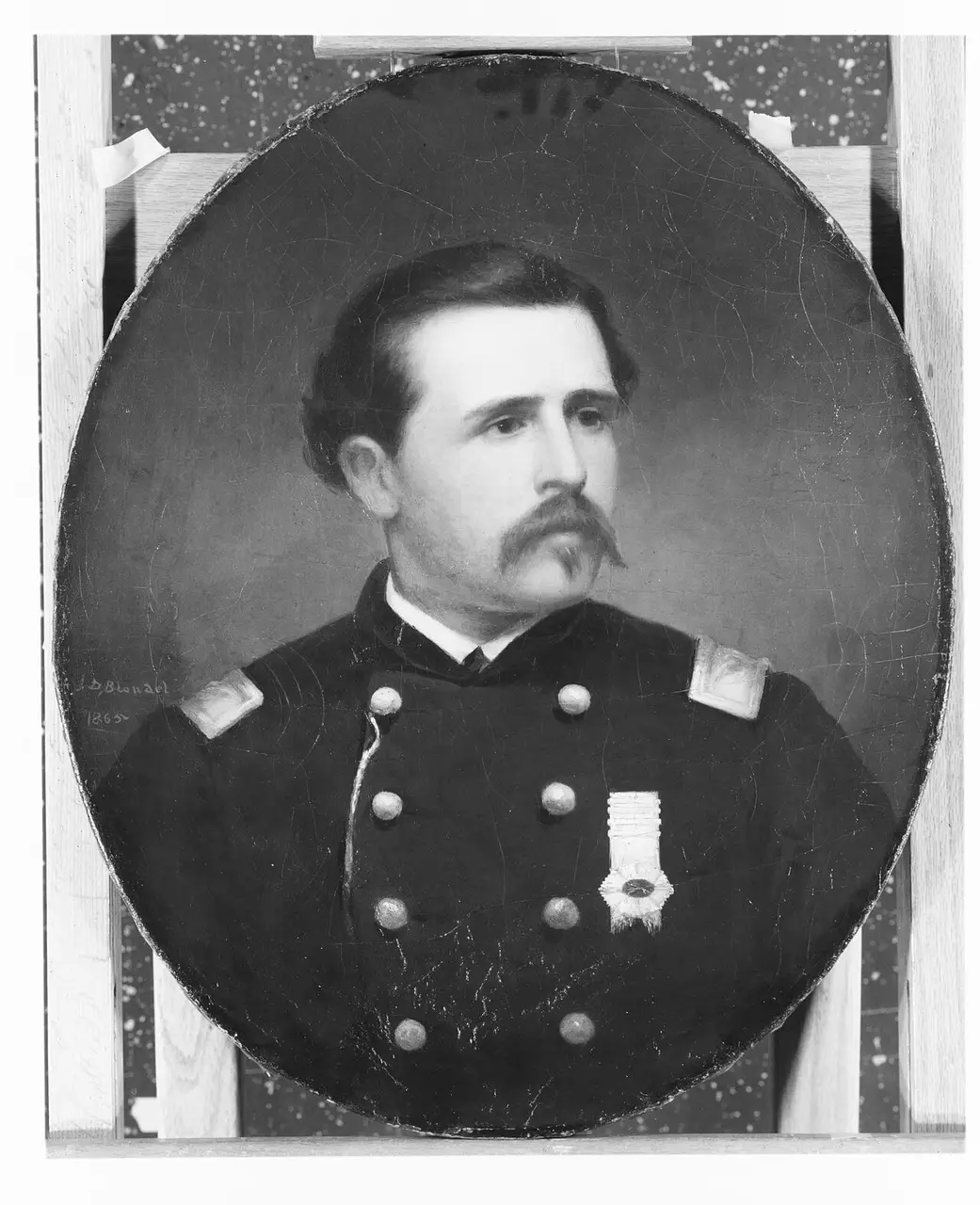 Cesnola painted by Jacob D. Blondel in 1865, around the time he reached Cyprus. The Metropolitan Museum of Art, CC0, via Wikimedia Commons.
Cyprus was then a quiet Ottoman province, and a consul's duties were light. Cesnola filled the time by digging. He was not the first to try it: the British and French consuls dug too, and the trade in classical antiquities out of the eastern Mediterranean was competitive and only lightly policed. What set Cesnola apart was the scale he brought to it, and the way he used his office. His consular standing let him secure a firman, an Ottoman permit, for excavation across the island, and when local officials or rival diggers got in his way he was quick to invoke, in his letters, "the honor of the American flag." The consulate was the engine of the whole enterprise. He put gangs of local workmen across site after site, and for the better part of a decade he had Cyprus more or less to himself.
Sixty thousand tombs
How much he dug is hard to state soberly, because Cesnola was not a sober witness to his own work. His 1877 book, Cyprus: Its Ancient Cities, Tombs, and Temples, claims that he opened 60,932 tombs. The number is self-reported and almost certainly inflated, the boast of a man who never undersold himself. He dug for objects, kept next to no record of where anything had lain in the ground, and moved on. In March 1870 his workmen struck what he took for a temple at Golgoi, in the centre of the island, and brought up close to a thousand pieces of limestone sculpture; the Met's modern catalogue of the collection, by Antoine Hermary and Joan Mertens, puts the real figure at a little under seven hundred, some 570 of them heads. Hermary calls it the most important group of limestone sculpture ever found on Cyprus, and it became the core of what Cesnola sold. The head on its little black stand belongs to exactly that class of object, and very likely came out of the ground in one of these campaigns.
The cost of the method was plain at the time. The French scholar Georges Perrot, writing in 1879, called Cesnola's digging "rude et destructrice," rough and destructive. In 1875 a young man named Sigismund, working on the excavations, fell to his death down one of Cesnola's shafts at Amathus. Later verdicts have been harder still. The historian George Hill wrote that Cesnola "did more harm to Cyprus archaeology by 'hogging' tombs and sites than anyone else on record," and the Cypriot archaeologist Vassos Karageorghis filed him among the "scholarly looters." The counter-case, put by Stanley Casson, is worth holding in view: whatever the methods, Cesnola "at least sedulously saved antiquities from destruction," and the collection he assembled "will always remain the principal basis of future study." Both things are true, and the head sits precisely on the seam between them.
A worshipper, not a god
The smiling young man in the conical cap is not a god. Cypriot sanctuaries were filled with statues like him, and they represent the people who dedicated them: sculpted stand-ins left in the temple to keep up a worshipper's presence and prayers after he had gone home. Casson called the plain votary "by far the largest class of all Cypriot statues," the ordinary dedication "of the man of moderate means and ambitions, often perhaps bought ready-made from a sculptor's stock." Actual images of gods are the rarest thing in this material. The head from the Met is a stock item, a worshipper rather than a deity, and a fairly modest worshipper at that.
It is only a head because of how these figures met their end, and how they were later collected. The statues were smashed in antiquity, toppled and broken across the sanctuary floors; Cesnola found them "all more or less mutilated," lying over a layer of ash he chose to blame on "Christian fanaticism." The neck is where a standing figure gives way. And once broken, the head was the part worth keeping, so museum holdings of this material run top-heavy with them: of 140 Cesnola sculptures sent to Liverpool, 119 were heads and nothing else. Ours came from a small statuette, perhaps half a metre to two-thirds of a metre tall when whole, a complete little worshipper in a long robe of which only the face now survives.
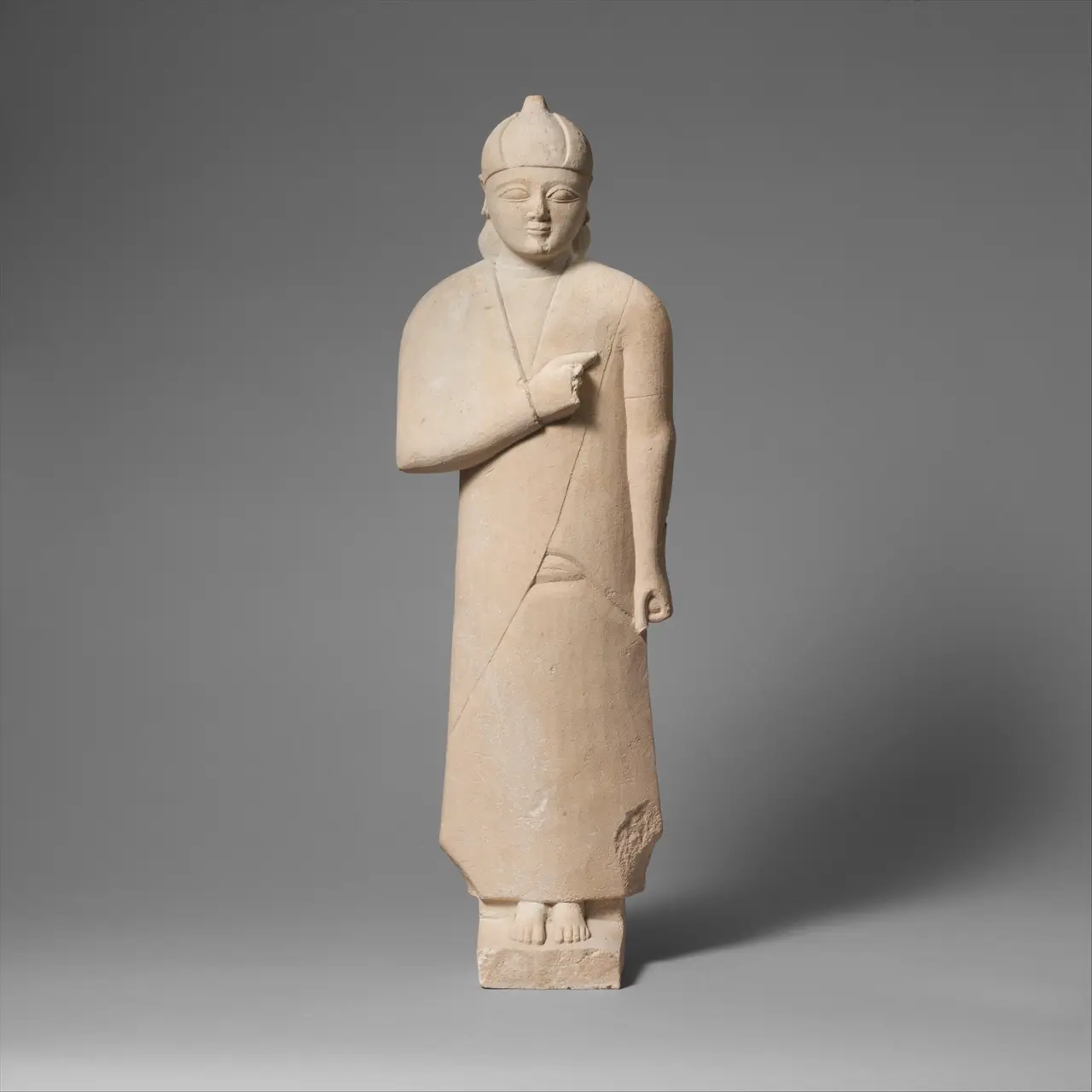 A complete beardless votary in a conical cap and long robe, mid-sixth century BC, in the Cesnola Collection. Our head began as the top of a small figure like this. The Metropolitan Museum of Art.
The catalogue compares the face to "the Greek kouroi," the nude standing youths of archaic Greece, and for the face alone the comparison holds: the almond eyes, the frontal stare and the smile all reached Cyprus from the Greek and East Greek world in the later sixth century BC. The cap is another matter. Real kouroi are naked and bare-headed; the tall conical cap is the native Cypriot element, a sign of a votary's rank or role and not of any divinity, and it is the feature the Met uses to open its whole sequence of male worshippers, the earliest and most archaic type. Karageorghis put the caution bluntly: "Cypriot sculpture cannot, and should not, be compared with Greek sculpture. Cesnola was wrong when he attempted to do so." The Cypriot workshops borrowed the Greek face and kept their own head.
The smile also helps date the piece, and the catalogue's "circa 5th century B.C." is looser than it looks. In Greece the archaic smile disappears around 480 BC, dropped for the severe, unsmiling faces of the next generation. Cyprus, more conservative, went on smiling; the archaic smile, one survey notes, "in Cyprus is still a common feature" well after Greece had abandoned it. But every beardless, conical-capped head in the Met's own Cesnola catalogue is dated to the sixth century, and by the fifth the cap has usually given way to a leaf-wreath or diadem. A date in the later sixth or early fifth century BC fits the head better than a flat "fifth century."
None of which makes it valuable, and that is much of the point. The stone is a soft local limestone, friable and quick to carve, the creamy chalk of the Idalion and Golgoi district; Cesnola himself, defending his restorations, once called his statues "of a friable stone." It carved fast and broke easily, which is why the faces are so often worn and the necks so often snapped. Figures like this were mass-produced and cheap in their own day, and they survive in the tens of thousands: a single sanctuary could yield hundreds, and the Met kept more than 6,000 pieces of Cypriot sculpture even after selling off what it judged surplus. That ordinariness is exactly why a genuine ancient sculpture, dug up in the 1870s and pedigreed to the Metropolitan Museum, can be bought today for the price of a decent bicycle.
The collection that built the Met
When Cesnola started shipping his finds to New York, the Metropolitan Museum of Art was three years old and owned almost nothing. His collection changed that. The trustees approved the first purchase in December 1872: more than 30,000 items packed into 275 crates, for somewhere near $60,000. The crates reached New York in February 1873. A second group, the so-called Curium collection, followed in November 1876 for $45,640. Gaston Feuardent, the dealer who would later become Cesnola's chief accuser, put the whole of it at 35,573 objects for $121,866.95. At a stroke, it was the foundation of the Museum's holdings of ancient art.
Cesnola came with the collection. The Met made him its Secretary in 1877 and its first Director in 1879, and he ran the institution until he died in 1904. The founding collection and the founding director arrived in the same crates. To this day those objects carry accession numbers that open with "74.51" and the credit line "The Cesnola Collection, Purchased by subscription, 1874-76." That is worth a pause, because the head's own paperwork says it entered the Met in 1872. It did not. 1872 is the year the sculptures reached London and were inventoried; the Museum accepted and paid for the collection in 1874 and 1876. The head came in with that founding purchase, a year or two after the date on the catalogue line.
Tampering with antiquities
Not everything about the collection was as clean as its accession numbers. In 1880 Feuardent published an article under the title "Tampering with Antiquities," charging the Museum's director with "deceptive alterations and unintelligent restorations" of the Cypriot sculpture in his care. The examples were pointed. A statuette had been relabelled from Elpis, a personification of hope, to the far more saleable Aphrodite, on the strength of a carved mirror added to its hand; the critic Clarence Cook dismissed the Museum's "Aphrodite and Eros" as "a fraudulent patchwork of unrelated parts." Cesnola sued for libel. The trial ran nine and a half weeks across 1883 and 1884, and the jury found for him. The verdict has not aged well: modern reference works conclude that much of what Feuardent charged was correct, and as early as 1885 W. J. Stillman judged that the collection's value had been "seriously diminished" by concealed repairs and a "deplorable recklessness of attribution."
For a head like ours, the scandal lands gently. A plain broken votary is the last thing a restorer would trouble to fake or reassemble; there are no spare parts to marry, no goddess to manufacture. Cesnola's methods never threatened this object's authenticity. What they destroyed was its context: the ash layer, the sanctuary, the crowd of near-identical worshippers it once stood among, all of it dug away and unrecorded. Which sanctuary it came from, Golgoi or Idalion or Athienou or another, cannot now be recovered, because whoever lifted it out of the ground, Cesnola or one of his gangs, kept no note of the spot.
How a museum comes to sell what it owns
The head did not stay in New York. Of the roughly 35,000 objects Cesnola took out of Cyprus, only about 6,000 are still at the Met; the rest were let go over the following decades. There was nothing underhand in this. Museums have always sold what they judge surplus, and in the nineteenth century they said so plainly: the Met sold 5,000 terracotta "duplicates" to Leland Stanford in 1896. The notion that selling from a collection is a scandal requiring a special word, "deaccessioning," and a rule that the proceeds may only buy more art, is a later development. The term entered common use only in 1972, and American museum directors first issued formal guidance on it in 1987. When the Met shed its Cesnola duplicates it broke no rule that then existed. It was housekeeping.
The housekeeping was done quietly and by the piece. Between 1916 and 1926 the Museum disposed of Cypriot duplicates in over-the-counter sales to private individuals, keeping dated records as it went; the two well-known Anderson Galleries auctions of 1928, catalogued as Duplicates of the Cesnola & Other Collections, were the finale, not the whole event. The head left in that earlier, quieter phase. Its provenance records it as acquired from the Museum on 12 March 1926 by a New York buyer named Ira Martin. The name most likely belongs to Ira W. Martin, first staff photographer of the Frick Art Reference Library, an art-world figure in the right city at the right time; nothing records him collecting antiquities, though, so the identification is a reasonable guess and no more. From there the trail runs to a Christie's antiquities sale in New York on 5 June 1998, lot 133, and then into the private collection from which it now comes to us.
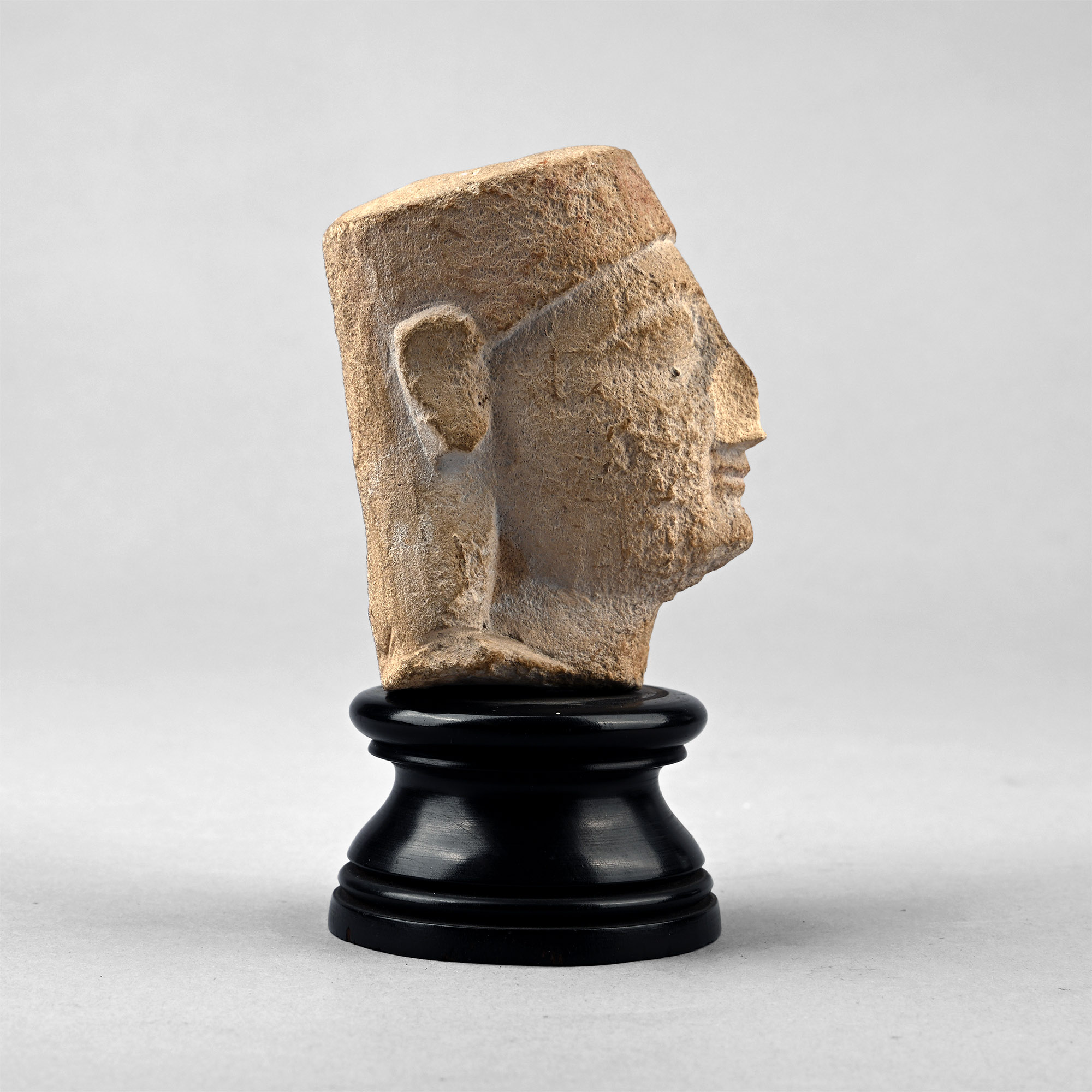 The nineteenth-century socle, with an old inventory number, 163, inlaid in metal: the visible trace of the museum years
So the round trip closes. A sanctuary somewhere in central Cyprus; a Cesnola shaft in the 1860s or 70s; 275 crates across the Atlantic; the founding gallery of the Metropolitan Museum; a sale across a desk in 1926; a New York collector; a saleroom in 1998; a private family; and now a modest estimate in a September auction. Almost every leg documented, which is what makes the head both easy to own and easy to trust. An antiquity that was sitting inside the Metropolitan Museum long before 1970, the date the market treats as its line between clean and questionable, carries a paper trail most antiquities cannot.
And the same paper trail is a record of what was lost. The process that makes the head simple to own, dug up fast, boxed, catalogued, sold on as surplus, is the very process that cut it loose from the ground it came from. The black socle and its old number tell you the young man in the cap belonged, for half a century, to the Metropolitan Museum of Art. They cannot tell you that he once stood in a temple among a hundred like him, because that fact went into a shaft in the 1870s and never came back up. The smile is 2,500 years old and perfectly clear. The address is gone.
TimeLine Auctions, 5th August 2026