Home > Stories by TimeLine Auctions
Stories by TimeLine Auctions
The Gods of the Ancient Near East: Religion from the Neolithic to the Classical Period
In a case in Oxford's Ashmolean Museum sits a human skull packed with plaster, its eye-sockets set with shell, the brow and cheeks modelled back into a face. It came out of the ground at Jericho, and it is roughly nine thousand years old. Kathleen Kenyon, who found a group of them in the early 1950s, called them the earliest portraits. Whoever made this one had buried a relative beneath the floor of the house, waited for the flesh to go, lifted the skull back out, and given it a second face. There is no god anywhere near it.
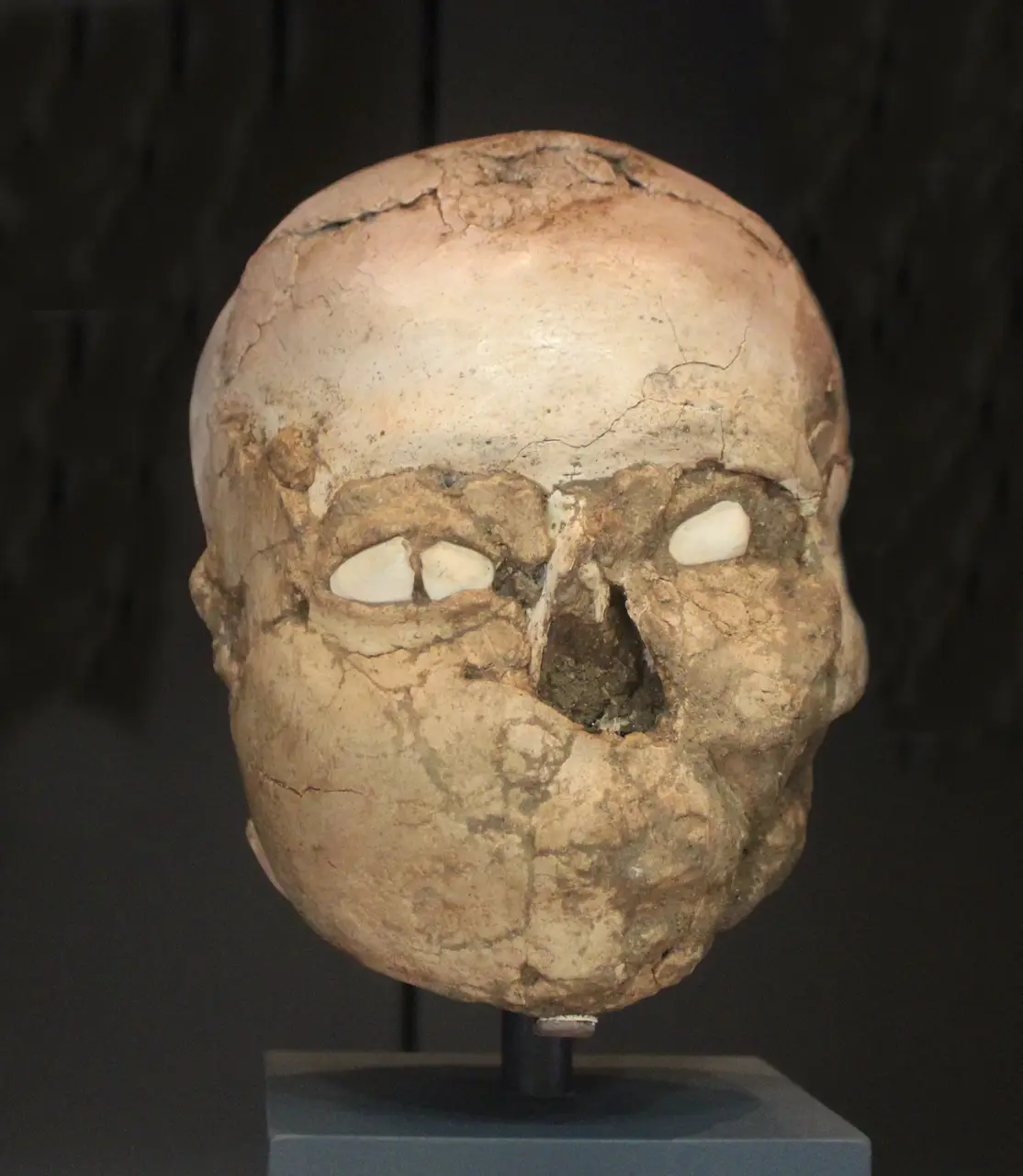 A plastered human skull from Neolithic Jericho (Tell es-Sultan), the face modelled in lime plaster over the bone with shell set into the eye-sockets, Pre-Pottery Neolithic B, around 7000 BC. British Museum, London. Photo: Zunkir, CC BY-SA 4.0, via Wikimedia Commons.
Four thousand years later, and far to the east, someone carved a tall alabaster vase with a procession: naked men carrying baskets of fruit and grain up toward a figure who waits at the top, two looped bundles of reed standing behind her like gateposts. The figure is the goddess Inanna, or her priestess; the looped reeds are her sign, the mark that means "Inanna" in the first writing anyone ever did. Here is a god with a name, a house, and a city, receiving her dinner. Between the Jericho skull and the Warka Vase lie four of the most consequential millennia in the history of religion, and most of what anyone means by "the gods" was assembled inside them.
This is the story of how that assembly happened, from the first ritual monuments around 9600 BC to the slow extinction of the old cults under Christian Rome. It runs from southeastern Anatolia down through Mesopotamia, Syria and the Levant to Cyprus, and it has a plot. Religion here did not begin with gods. The gods, when they arrived, acquired names, then households, then politics, and they rose and fell with the fortunes of the people who needed them. The tidy pantheons in our handbooks are partly the ancient bookkeeping that produced them and partly a tidying-up we have done ourselves. A good deal of what "everyone knows" about this world, the universal Mother Goddess, sacred prostitution, the god who dies and rises, was made not in antiquity but in the nineteenth and twentieth centuries. Sorting the made gods from the made-up ones is half the interest.
A word about the evidence, because the gaps shape the story as much as the finds. Mesopotamia left hundreds of thousands of clay tablets; the Phoenicians left no sacred book at all, so their religion is pieced together from inscriptions, archaeology, hostile neighbours and late Greek writers. What we call "Canaanite religion" leans almost entirely on one north-Syrian city, Ugarit, and on the polemics of its enemies in the Hebrew Bible. For the prehistoric stretch there are no texts whatever, only objects whose meaning we infer and argue about. Every confident sentence below should be weighed against the kind of source that produced it.
Before the Gods
The oldest monumental religion in the world has no nameable gods in it. At Göbekli Tepe, on a waterless hilltop in southeastern Turkey, Pre-Pottery Neolithic builders raised rings of T-shaped limestone pillars, some 5.5 metres tall and weighing up to ten tonnes, carved in relief with foxes, snakes, boars, vultures and aurochs. They did this in the tenth millennium BC, before pottery, before farming. The excavator Klaus Schmidt read the site as a regional sanctuary built and visited by hunter-gatherers who did not live there, and went further: the labour of building and feeding such gatherings, he argued, helped push people toward domesticating the wild grasses growing nearby. Colin Renfrew called it the world's first temple.
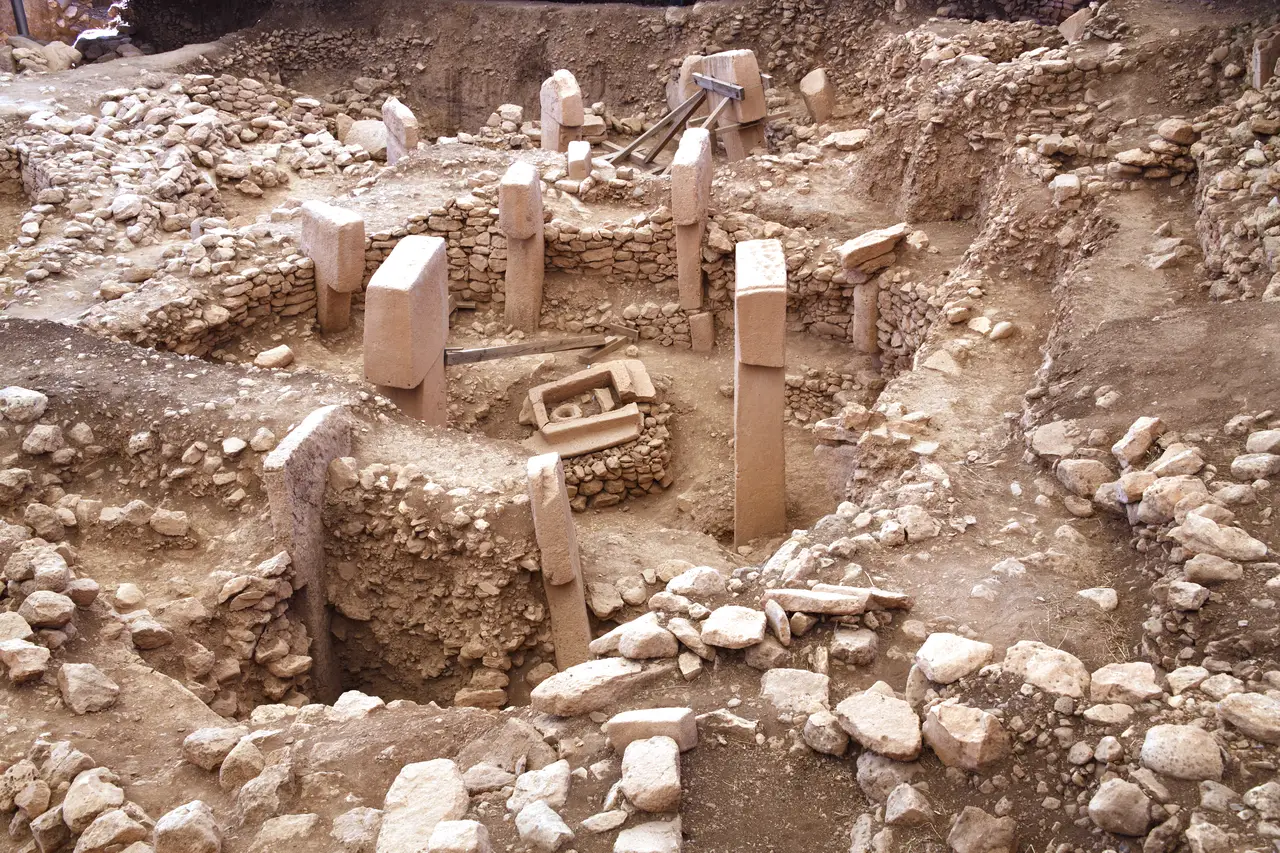 T-shaped limestone pillars in one of the circular enclosures at Göbekli Tepe, near Şanlıurfa in southeastern Turkey, Pre-Pottery Neolithic, 10th millennium BC. Photo: Dosseman, CC BY-SA 4.0, via Wikimedia Commons.
The claim has not gone unchallenged, and the challenge matters. E. B. Banning has argued that the split between "sacred" and "profane" space is a modern habit we are projecting backward, that nothing proves these were temples rather than unusually elaborate houses, and that the sheer quantity of debris and food-processing tools points to people living on the spot. Schmidt himself later allowed for some occupation. What survives the argument is genuinely odd: a hilltop with no water, no ordinary houses, no hearths, no clay figurines, a carving-list dominated by carrion birds, manipulated human bone, and an imagery almost entirely male. Whatever Göbekli Tepe was, the one thing it was not is a shrine to a mother goddess. Nor was it alone; at nearby Karahan Tepe excavators have counted 266 pillars still standing in place, part of a whole cluster of such sites.
The dead, by contrast, are everywhere in the early Neolithic, and they were handled with sustained attention. The most coherent ritual of the period is mortuary. Across the Levant between about 8500 and 6500 BC the dead were buried flexed beneath the floors of houses; later the grave was reopened and the skull taken out, sometimes its face built back up in plaster with shells for eyes, then kept, displayed, and finally reburied. Plastered skulls have come from Jericho, 'Ain Ghazal, Tell Aswad, Çatalhöyük, Çayönü's so-called Skull Building, and a dozen sites besides. At Kfar HaHoresh in the Galilee, a place with no ordinary houses that looks like a regional cult and burial centre, one human skull was laid out paired with the headless skeleton of a gazelle. It is tempting to call all this ancestor worship, and many do, but the skulls include men, women and children with no clear bias, and there are far too few of them for the populations involved, which has made others doubt that a tidy ancestor cult is the right description.
At 'Ain Ghazal in Jordan, two pits held some thirty large figures of lime plaster modelled over bundles of reed, up to a metre tall, their eyes rimmed with bitumen, a few of them unsettlingly two-headed. Denise Schmandt-Besserat, who studied them, weighs three possibilities, ancestors, ghosts, or gods, and settles on none. They are best described as evidence of organised public ritual whose objects we cannot name.
And then there are the figurines, the small modelled human bodies, very often female, that turn up in their thousands across the Neolithic Near East and have carried more interpretive weight than any other class of object. For most of the twentieth century they were read as images of a single Mother Goddess, a fertility deity whose worship supposedly ran unbroken from the Stone Age down to Cybele, Artemis and Aphrodite. James Mellaart found her at Çatalhöyük in central Anatolia, in a seated figure flanked by two leopards, and identified some forty rooms there as shrines. Marija Gimbutas built the same goddess into a whole lost matriarchy of Old Europe.
Almost none of this has survived re-examination. Ian Hodder's long re-excavation of Çatalhöyük found no clean line between shrine and house: the buildings are all houses, some more thickly decorated with bull horns and plaster reliefs than others. The seated "goddess" came out of a grain bin and is heavily restored. When Lynn Meskell and Carolyn Nakamura catalogued nearly a thousand figurine fragments from the site, only about three per cent were clearly female; most were animals or could not be sexed at all, and they came overwhelmingly from rubbish middens. The recurring emphasis on breasts, bellies and buttocks, they suggested, reads better as age and accumulated maturity than as fertility. Hodder concluded that if Çatalhöyük's imagery leans in any direction, it leans toward maleness, authority and power. The universal Mother Goddess, and the peaceful matriarchy attached to her, is now treated by most specialists as a construction of modern scholarship rather than a fact of prehistory. The figurines are real and interesting; the goddess who was supposed to unify them is, so far, a guess that did not hold.
This is the pattern of the whole prehistoric stretch: rich, deliberate ritual, and objects we cannot reliably attach to named beings. Naming required something the Neolithic did not have.
How the Gods Got Their Names
That something was writing, and it appeared in southern Mesopotamia around 3300 BC. With it, the gods become countable, nameable, and biographied for the first time. Each Sumerian city now had a divine owner who literally lived in it: Enki in the marsh-city of Eridu, Enlil at Nippur, Inanna at Uruk, the moon-god Nanna at Ur, the sun-god Utu at Sippar. The relationship was concrete and proprietary. Nippur, Enlil's city, seems never to have held any military power, yet it stayed the holy city of Sumer that every would-be king had to court, because Enlil was the god who handed out kingship.
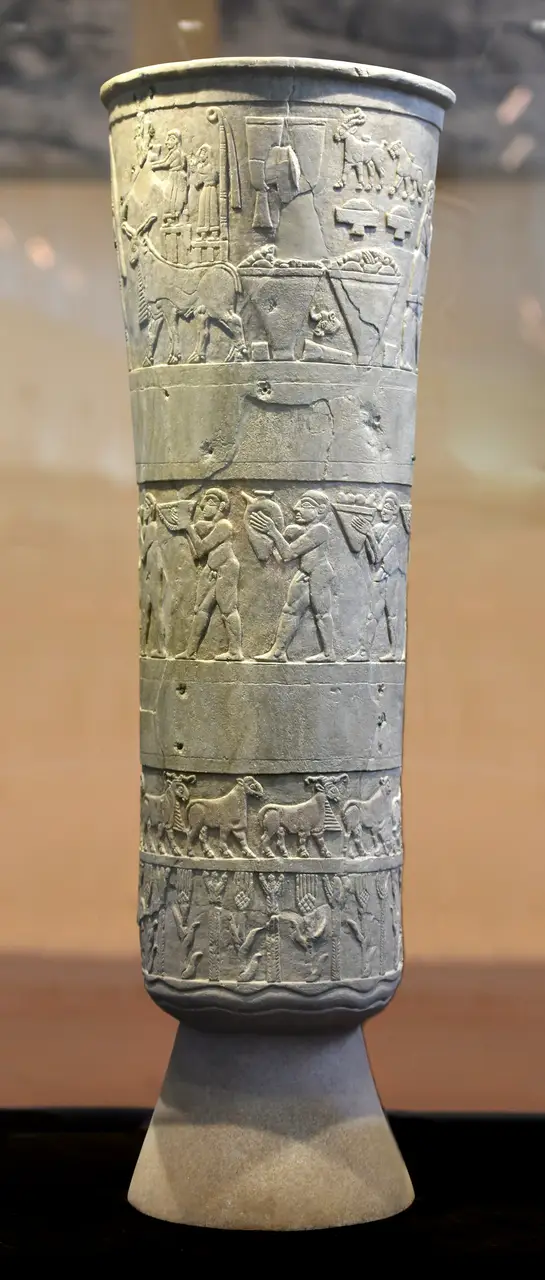 The Warka (Uruk) Vase, a carved alabaster vessel showing a procession of offering-bearers, from Uruk in southern Iraq, around 3200 to 3000 BC. Iraq Museum, Baghdad. Photo: Osama Shukir Muhammed Amin FRCP(Glasg), CC BY-SA 4.0, via Wikimedia Commons.
The temple was not a meeting-hall for worshippers. It was the god's house, the Sumerian é, run like the household of a great lord, with kitchens, bedchambers, storerooms and stables. At its centre stood the cult statue, made of precious wood overlaid with gold, in which the god was understood to be genuinely present without being trapped. The point of the cult was to keep this divine householder fed, washed, clothed and content, because humanity had been created, the myths said, precisely to do the gods' labour for them. The statue was bathed and dressed and given two meals a day; one text reckons a single divine dinner at forty sheep, eight lambs and seventy ducks. Neglect was dangerous. Without the service of its people, the same tradition held, the cosmos itself would stop working.
Two popular images need correcting. The ziggurat, the stepped tower we picture as the great temple, was not where worship happened; it was a raised platform, a monumental plinth, and the cult went on in house-like rooms below and beside it. And the statue was not, to the people who served it, a symbol or a stand-in. A specific ritual saw to that: the mīs pî, the "washing of the mouth," and pīt pî, the "opening of the mouth," a two-day rite carried out at the riverbank and in an orchard that purified the new image of every trace of human manufacture and turned it into a living god. At its climax the craftsmen who had carved the thing swore, with their hands symbolically cut free by a wooden sword, that they had not made it, so that the god could be said to have come into being on its own. This is the sharpest statement of divine presence in an object that the Near East produced, and it is the thing against which a much later Israelite horror of images would define itself.
The gods sorted themselves into a structure the scribes were happy to tabulate. At the top sat a triad of the cosmos: An, the sky, who drifted over time into a remote and largely idle figure; Enlil, the air and the storms and the real executive power, king of the gods; and Enki, god of the fresh underground waters, of wisdom and of clever solutions. Across this lay a second triad drawn from the sky itself: the moon-god Sîn, the sun-god Shamash who was also the god of justice, and Ishtar, who was the planet Venus and a great deal else. When Akkadian-speakers took over the Sumerian gods they matched them name for name: Inanna became Ishtar, Utu became Shamash, the storm-god Ishkur became Adad. The gods were translatable from the start.
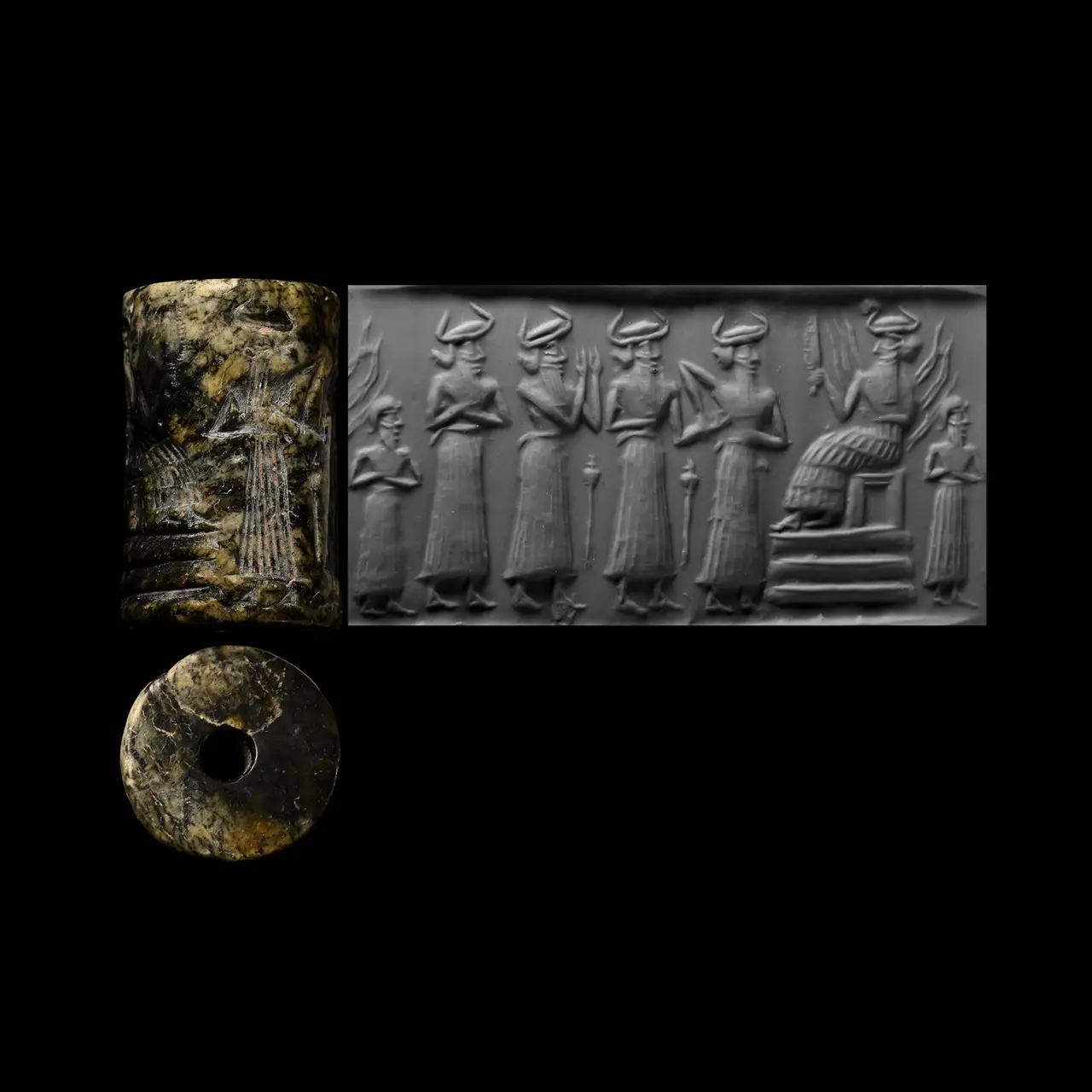
These were objects, not abstractions, and they were made in enormous numbers. The carved cylinder seals that Mesopotamians rolled across wet clay to sign their documents show the gods enthroned and receiving their worshippers, and such seals still reach the saleroom regularly, among the most ordinary ancient things a collector can hold.
When a City Rose, Its God Rose With It
The gods' fortunes tracked their cities' with almost embarrassing fidelity. For most of the third millennium the head of the active pantheon was Enlil of Nippur. Then Babylon rose, and Babylon's own city-god, Marduk, a relative nobody, rose with it, taking over Enlil's titles, functions and rank as king of the gods; the turning point came under Nebuchadnezzar I in the twelfth century BC. The same thing happened again to the north. Ashur began, as far as anyone can tell, as nothing more than the local god of the city that shares his name. As Assyria became the terror of the Near East, Ashur swelled into a national god who absorbed Enlil's identity and then, after Sennacherib sacked Babylon in 689 BC, helped himself to Marduk's deeds and Marduk's New Year ritual as well. He ended, in the Encyclopaedia Britannica's phrase, seeming "to lack all real distinctiveness," a "mere personification of the interests of Assyria as a political entity." The god was the state with a face on.
The clearest case of theology following power is the Enuma Elish, the Babylonian poem usually called the Epic of Creation. It tells how the young storm-god Marduk killed Tiamat, the monstrous salt sea, split her body to make the sky and the earth, fashioned the first humans from the blood of a slaughtered god, and was rewarded by the assembled gods with fifty names and permanent kingship. It is, more honestly, a hymn justifying Marduk's promotion, written to match Babylon's. When Assyria wanted the same story it swapped Ashur into the hero's place; an older version may once have starred Enlil. The poem was recited every year on the fourth day of the Akitu, the New Year festival, and the festival was where the whole arrangement between gods, king and city was renewed.
The Akitu had a startling moment in it. The rite ran for days, with purification, the recital of the Enuma Elish, and the gods brought together in Marduk's temple Esagil. At its centre the reigning king was led into the god's presence, stripped of his regalia, struck across the face by the high priest, and made to kneel and swear that he had not sinned against the city, before his crown was returned and he "took the hand of Bel," the god, to lead him in procession and so fix the destinies of the coming year. A king who would not or could not perform it was no true king. The last time anyone is recorded performing the rite at Babylon, the hand that took Bel's belonged to Cambyses, the son of Cyrus the Persian, in 538 BC. Kings could even cross the line themselves: Naram-Sin of Akkad was the first Mesopotamian ruler to write his own name with the small sign that marked a god.
The same anxiety to read divine intentions ran through daily life as constant divination, above all extispicy, the inspection of the liver of a sacrificed sheep by a trained diviner, the bārû, alongside an ever more elaborate astrology that watched the planet-gods for warnings. And the dead, like the gods, had to be fed. The Mesopotamian underworld was a grim place, "the house from which none who enter return," a dusty dark ruled by the queen Ereshkigal where king and pauper shared one fate; there was, flatly, no hope of immortality, which sets the whole region apart from Egypt and its elaborate bid for an afterlife. The living owed their dead the kispum, regular offerings of food and water and the speaking-aloud of their names, and a neglected ghost was thought to turn hungry and dangerous. The plastered skulls of Jericho had no gods around them; this world had a crowded pantheon. But the impulse, to keep the dead present at the table, to feed them and name them, runs unbroken between the two.
Below the great gods moved a population of demons and protective spirits, and this is the level of religion most people actually lived at. Mothers guarded their infants against Lamashtu, the child-snatching she-demon, with amulets of an even nastier demon, Pazuzu, "king of the evil wind-demons," set to frighten her off, and a sufferer who felt abandoned by his personal god had a poem to recognise himself in, Ludlul bēl nēmeqi, the so-called Babylonian Job. This cult outlasted the empires that grew up around it. Babylon's great temple still functioned in the first century AD, its astronomers keeping cuneiform alive much as Latin survived in medieval monasteries, long after the political world that built it had gone.
The Storm God and the Dragon
One figure keeps walking into this story from different directions and in different languages: a young male god of storm and rain who becomes king of the gods by killing a monster of chaos, usually the sea or a great serpent, and whose animal is the bull. In Sumer he was Ishkur; in Akkadian Adad; in the West Semitic world Hadad, better known by his title Baal, "the Lord"; among the Hurrians Teshub; among the Hittites and Luwians Tarhunna or Tarhunza. The Greeks would meet him again as Zeus and the Romans as Jupiter, and under Rome the cults of Zeus and Jupiter in the Syrian cities largely carried on the old worship of Baal-Hadad. He is the nearest thing the Near East has to a single recurring character.
His best portrait comes from Ugarit, the Syrian port whose archives, found in 1929, gave us almost everything we securely know about Bronze Age Canaanite religion. Ugarit is worth pausing on, because it is the one place where this religion speaks for itself rather than through its enemies. At the head of its pantheon sat El, old, wise and merciful, "the Bull," father of the gods and "father of years," a king whose authority was settled and static. His consort was Athirat, the Hebrew Bible's Asherah, "Lady Athirat of the Sea," mother of the gods, whose children were reckoned at seventy. The energy in this family came from the younger generation, above all from Baal, the storm-god, "rider of the clouds," whose holy mountain was Zaphon, the peak now called Jebel al-Aqra, north of the city. Baal's kingship, unlike El's, had to be won and defended.
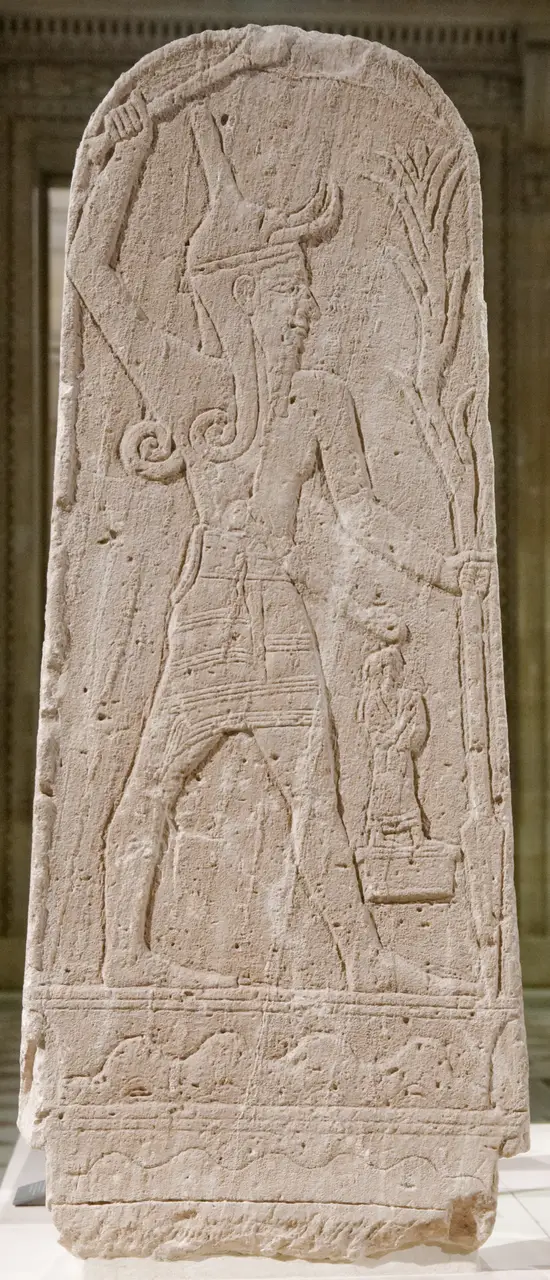 The "Baal au foudre" stele from Ugarit (Ras Shamra), showing the storm-god striding with a raised club and a spear shaped like lightning, around the 15th to 13th century BC. Louvre, Paris (AO 15775). Photo: Jastrow, Public domain, via Wikimedia Commons.
The Baal Cycle, the major surviving poem of the second-millennium Levant, is the story of that winning. Baal fights and defeats Yam, the Sea, "Judge River," with two magical weapons made for him by the craftsman-god Kothar; he gets his palace, the proof of a king; and then he is challenged by Mot, Death itself, who swallows him, so that Baal goes down into the underworld and the world withers, until his sister, the warrior-goddess Anat, who waded knee-deep in the blood of her enemies, hunts Mot down, and the sun-goddess Shapshu helps bring Baal back. Whether this makes Baal a true "dying and rising god" is one of the field's long quarrels, and we will return to it; for now, notice the shape of the plot, the storm-king who must beat the chaos-water to take his throne.
That plot was everywhere. Move north into Anatolia and the storm-god heads a state religion of bewildering size. The Hittites called their gods "the Thousand Gods of Hatti," a hoard assembled from Hattian, Hurrian, Luwian and Mesopotamian sources, and they made a point of not merging them: where a newer empire might have rolled a dozen local storm-gods into one, the Hittites preferred to honour each separately, absorbing conquered gods rather than dissolving them. The figure was rhetoric; only a little over six hundred are actually named, many of them only on paper. Their supreme deity was, in the older Hattian layer, not the storm-god at all but his consort, the Sun Goddess of Arinna, to whom one text insists even the Weather-god of Heaven is subordinate. The king was her chief priest, and letting the great seasonal festivals lapse was thought to bring plague: the Plague Prayers of Mursili II, among the most personal religious texts to survive from the age, trace a devastating epidemic to offerings neglected at a river and to a treaty oath his father had broken.
The storm-god's signature fight runs all through Anatolian myth. In the Hittite Illuyanka tale he battles a giant serpent; in a Hurrian story he fights the Sea; and the Hurrian succession-myth called the Kumarbi cycle tells how heaven changed hands by violence down the generations, Alalu giving way to the sky-god Anu, Anu to Kumarbi (who bites off Anu's genitals and is made pregnant with the storm-god Teshub by the act), and Kumarbi at last to Teshub himself. Anyone who knows Hesiod will feel the ground shift, because this is essentially the plot of the Greek Theogony, Ouranos and Kronos and Zeus, the castration, the swallowed stone, several centuries before Hesiod wrote it down. That the Greeks took the story from the East is now widely accepted; by what road, whether through Hesiod directly or, as Carolina López-Ruiz argues, through channels closer to the Orphic poems, is still argued. The parallel is real; the route is open.
The combats line up too neatly for coincidence: Marduk against Tiamat in Babylon, Baal against Yam at Ugarit, the Hittite storm-god against the serpent and the Sea. Daniel Schwemer has argued that the core story, storm-god versus the Sea, did not begin in Mesopotamia at all but circulated across the second-millennium Near East from Egypt in the south to Hatti in the north, and was only later grafted onto Marduk when Babylon wrote its national epic. The chaos-water the god defeats is one of the genuinely shared possessions of the whole region.
When the Hittite empire collapsed around 1200 BC the storm-god did not. He carried on for centuries in the small Luwian-speaking states of southern Anatolia and north Syria, where a king named Warpalawas had himself carved on the cliff at İvriz, standing in prayer before a colossal Tarhunza who holds out bunches of grapes and ears of grain, god of the weather become god of the harvest. From one of these cities, Karkemish, came a goddess called Kubaba who would travel west to become the Phrygian mountain-mother Matar and, in time, the Cybele the Romans worshipped as the Great Mother, though the line from one to the next is more tangled than that quick summary allows.
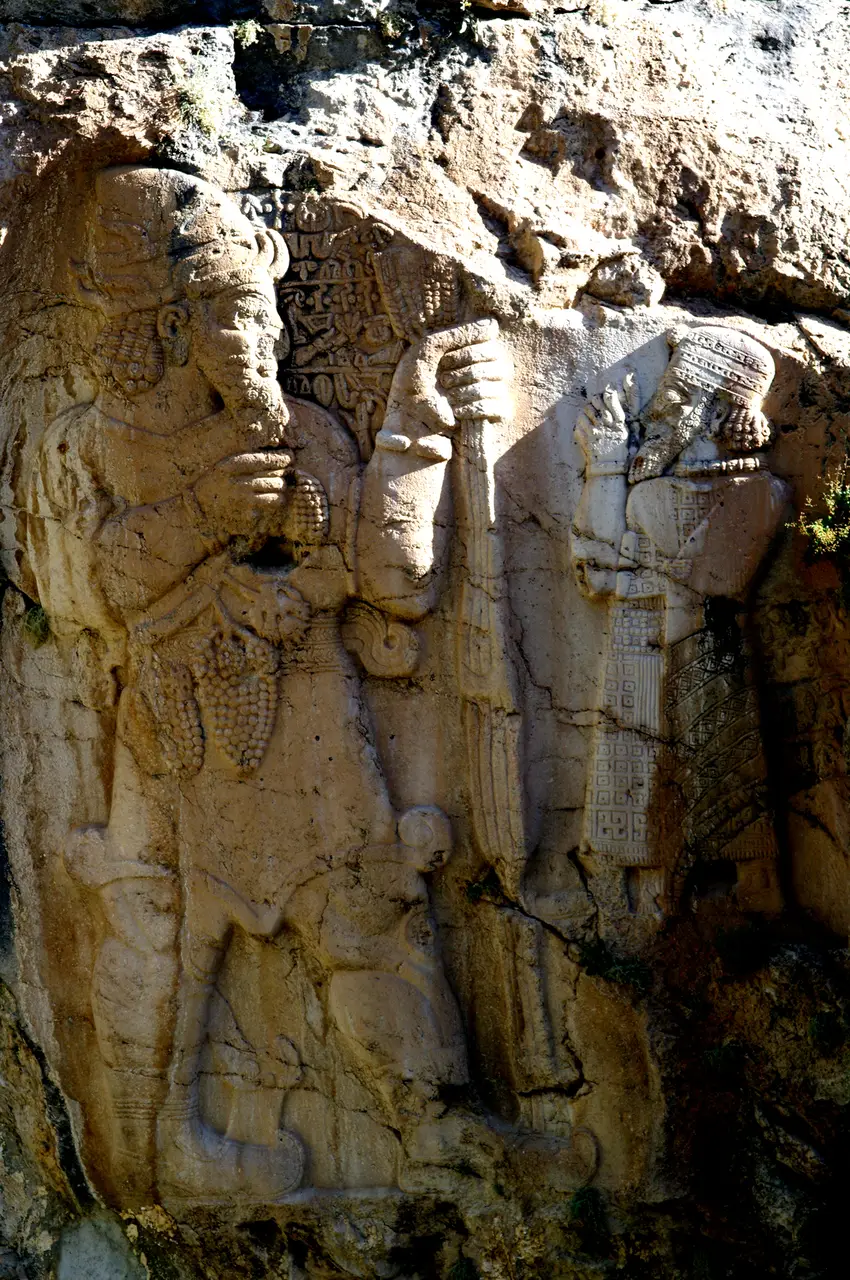 The İvriz rock relief near Konya in southern Turkey, where the storm-god Tarhunza, holding grain and grapes, faces the Neo-Hittite king Warpalawas of Tuwana in an attitude of prayer, 8th century BC. Photo: Zeynel Cebeci, CC BY-SA 3.0, via Wikimedia Commons.
The Goddess of Love and War
The other figure who recurs across the whole region is harder to pin down, which is part of her character: a great goddess of sex and violence together, desire and slaughter in one person. In Mesopotamia she is Inanna, then Ishtar, the planet Venus, morning and evening star, patron of the bedroom and the battlefield. The most powerful Mesopotamian myth about her is her Descent. Inanna goes down into the underworld of her sister Ereshkigal, is stripped of her powers at seven gates, is killed and hung on a hook, and is revived only on the condition that she send someone down to take her place. The substitute she chooses is her own husband, the shepherd-god Dumuzi, the Tammuz of the Bible. His is a divided death: he and his sister Geshtinanna split the sentence between them, each spending half the year below and half above. That alternation matters, because Dumuzi is the ancestor of a whole line of gods who go down and come back, and the line has been badly misread.
The goddess herself travelled and changed names without quite losing her shape. In the West Semitic world she splits and multiplies: Astarte, a goddess of royalty, war and the sea; Anat, the unmarried warrior of Ugarit; and behind them the older Asherah, El's consort. The Phoenicians made a local Astarte the "Lady" of almost every city they founded, and where the Phoenicians went, so did she, until on Cyprus she met and merged with another goddess and helped to produce Aphrodite. It is tempting to draw one continuous line, Inanna to Ishtar to Astarte to Aphrodite, a single goddess wearing different names down the millennia. The links are real in places, and Herodotus already equated the eastern goddess with an "Aphrodite Urania," but the strong version of the thesis is now treated with suspicion; some scholars think the three may have to be understood as largely separate figures who were assimilated late, not divided early.
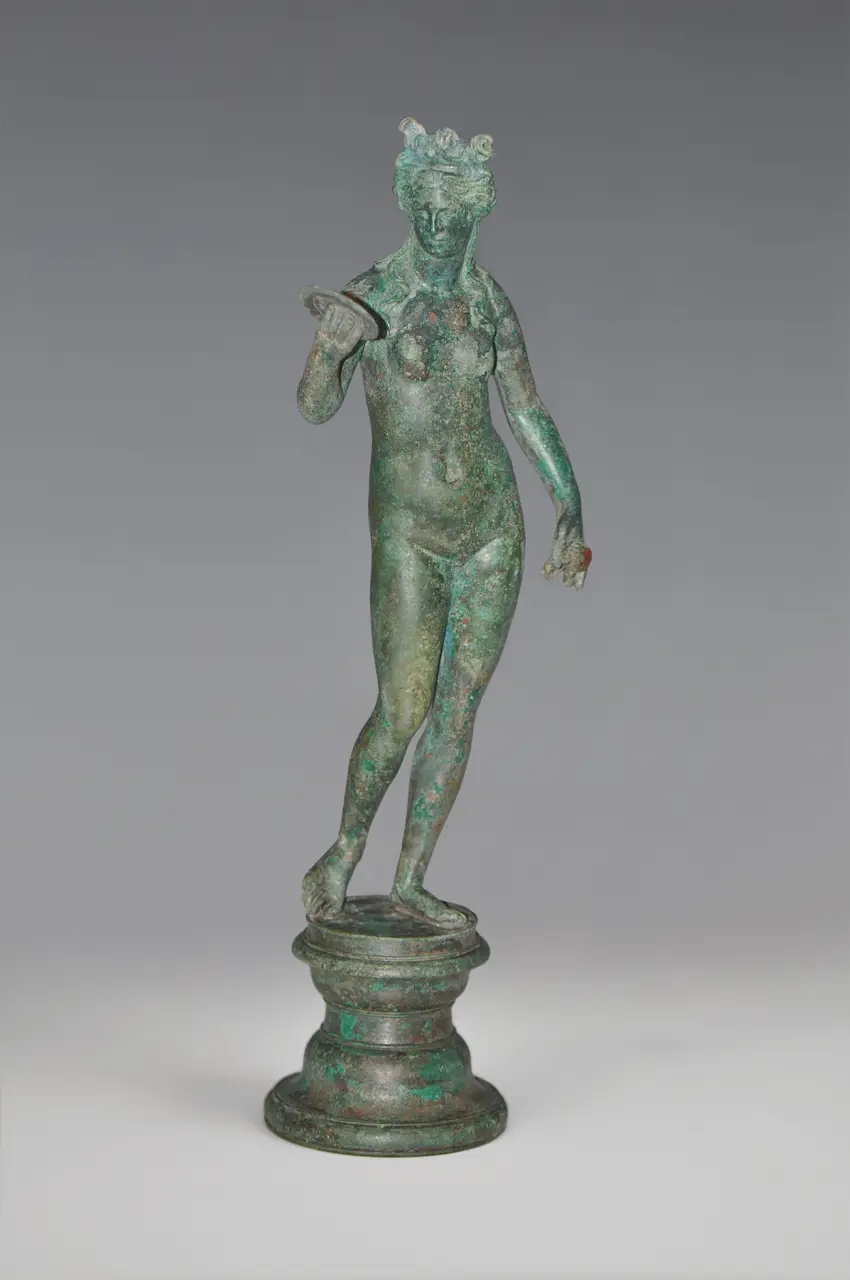
One thing this goddess is now agreed not to have had is sacred prostitution. The image of temple women selling themselves to strangers in the service of Ishtar or Astarte or Aphrodite, most famously at Babylon and at Paphos, is one of the most durable things "everyone knows" about ancient religion, and Stephanie Budin has shown, at length, that it did not exist. It was built up out of a single lurid passage in Herodotus, a line or two in Strabo, and a string of nineteenth-century mistranslations of cult-titles, and it has been repeated ever since. There were priestesses, and there were prostitutes; there was no holy brothel.
Which brings us back to the gods who die. The line that starts with Dumuzi is the one modern readers know best, usually under the heading of the "dying and rising god." Baal is swallowed by Death and comes back; Dumuzi-Tammuz alternates with the seasons; at Byblos the Greeks found a beautiful youth called Adonis, from the Semitic adon, "lord," mourned by women each year as the local river ran red with the spring rains; at Tyre the god Melqart had an annual festival called the egersis, his "awakening." It looks like one grand pattern, and Sir James Frazer, a century ago, made it one: the god who dies with the failing year and rises with the returning crops, worshipped from Mesopotamia to the Mediterranean.
The pattern has largely come apart under scrutiny. Jonathan Z. Smith and Mark S. Smith pointed out that the cases do not actually match. Telipinu, the Hittite god usually filed under "dying and rising," does not die at all; he vanishes in a rage and has to be searched for and fetched home, and a dying-god story with no dying god in it is a contradiction. Dumuzi alternates rather than resurrects. Whether Baal "rises" in any real sense, or the text means something looser, is disputed; whether Melqart's "awakening" was a resurrection or the yearly reconsecration of his temple is disputed too. The category had also picked up a particular freight, attractive partly because it seemed to supply pagan precedents for the Christian resurrection, and that apologetic motive is worth knowing about. Tryggve Mettinger has since made a careful, limited case that Baal and Melqart, at least, do fit a dying-and-rising shape. The honest position is that there is a family of gods who disappear and return, by death or absence or sleep, and that Frazer's single template flattened the real differences between them.
One Nation, One God
When the Bronze Age empires fell around 1200 BC, the political map of the Levant broke into small kingdoms, and each did what Babylon and Assyria had done: it raised one god to stand for the nation. Moab had Chemosh, Ammon had Milcom, Edom had Qaus, Aram-Damascus had the storm-god Hadad, and a small hill-kingdom called Israel, with its southern neighbour Judah, had Yahweh. This is not yet monotheism. It is one nation, one chief god, who gives victory and can also turn his anger on his own people when they fail him.
We can watch the pattern from the outside, in the words of a neighbour. Around 840 BC the Moabite king Mesha set up a victory stele, now in the Louvre, to thank his god Chemosh for throwing off the rule of Israel. The god Mesha describes behaves exactly as the Hebrew Bible says Yahweh behaved: Chemosh had been angry with his own land and so let Israel oppress it, and then, his anger past, gave the word and delivered Moab. The same theology, a national god who punishes his people through their enemies, sits on both sides of the border. The stele also carries, on line 18, what most scholars read as the earliest mention of Yahweh anywhere outside the Bible, named as the god of the Israelite enemy whose cult-vessels Mesha drags off to Chemosh. A generation or so later an Aramean king set up a stele at Tel Dan crediting his storm-god Hadad with going before him into battle, in the same idiom; that inscription is famous for a second reason, a broken phrase most read as "the House of David," the earliest possible reference to David's dynasty.
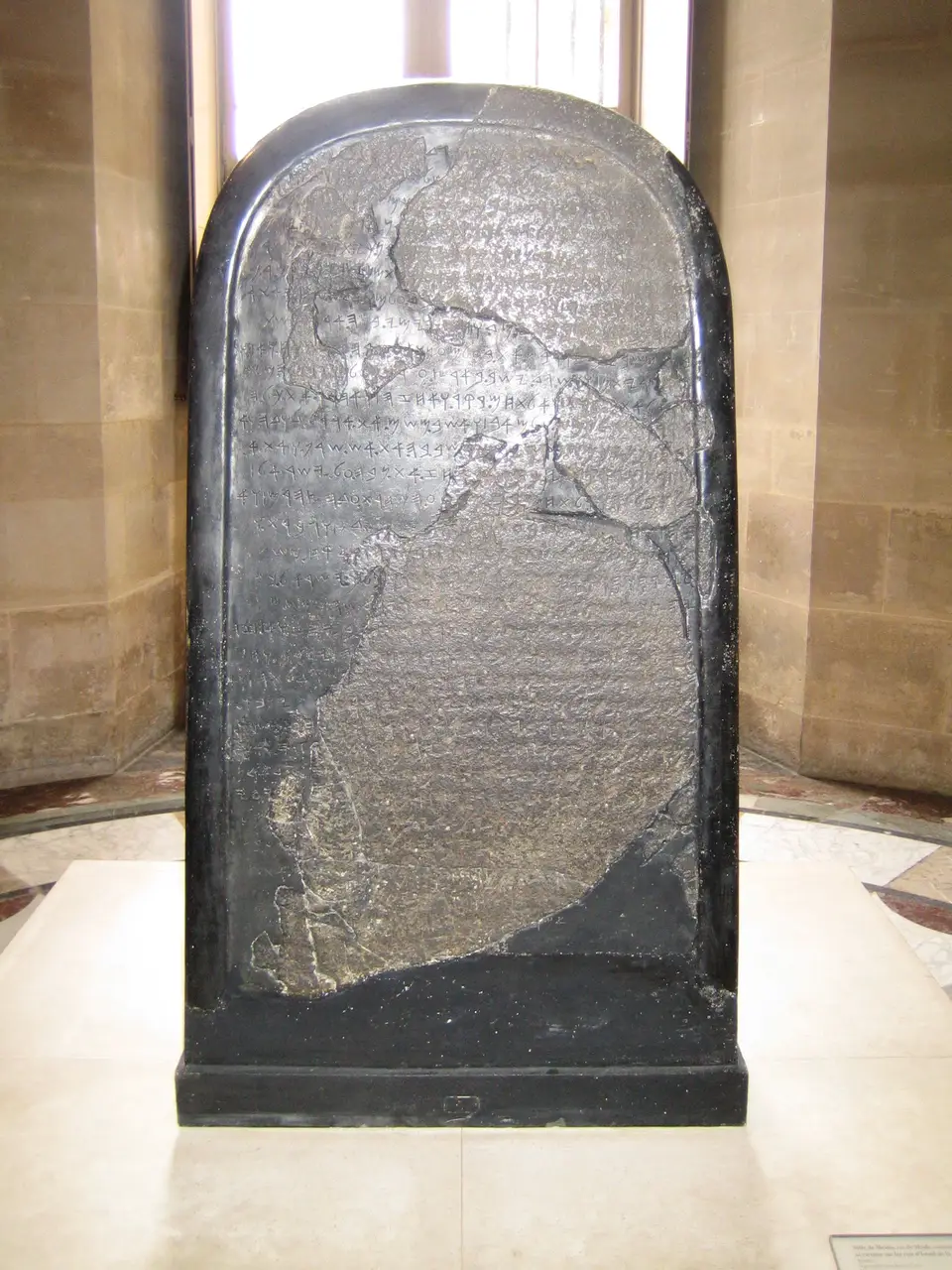 The Mesha Stele, or Moabite Stone, set up by King Mesha of Moab around 840 to 830 BC and inscribed in the Moabite alphabet, now in the Louvre (AO 5066). Photo: Henri Sivonen, CC BY 2.0, via Wikimedia Commons.
The origin of Yahweh is one of the live problems of the field, and the honest answer has two threads that do not fully meet. The oldest possible trace of the name is not a god but a place: Egyptian lists under Amenhotep III and Ramesses II mention "the land of the Shasu, Yhw," nomads in the region of Edom and Seir to the south, and several biblical poems independently remember Yahweh marching up from exactly there, from Seir, Teman, Sinai and Mount Paran. This is the Midianite-Kenite hypothesis, that Yahweh began as the god of southern desert tribes before he was ever Israel's. (Daniel Fleming warns that the field has too often read the Bible into the thin Egyptian evidence, and that the link is not as firm as textbooks make it.) What is reasonably clear is that the original high god of Israel was not Yahweh at all but El, the same aged father-god of the Ugaritic pantheon, whose name is the one built into the word Israel. Over time Yahweh and El converged into a single god. El's traits passed to Yahweh, his fatherly seniority, his bull imagery, his consort Asherah; and Yahweh also took over the storm-god Baal's weather imagery, riding the clouds in the Psalms, even as Baal himself came to be rejected as the great enemy. El was family, and was absorbed; Baal was a rival, and was cast out.
The evidence that Israelite religion was once not monotheist at all is now on the ground, literally. At a desert way-station called Kuntillet Ajrud, around 800 BC, travellers scratched blessings onto storage jars and plaster in the name of "Yahweh of Samaria and his asherah" and "Yahweh of Teman and his asherah," the local Yahwehs named exactly as one might name "Ishtar of Nineveh." At Khirbet el-Qom a tomb inscription blesses a man "to Yahweh and by his asherah." What "his asherah" means is the crux: the goddess Asherah herself, El's old consort now attached to Yahweh, or the wooden cult-pole that bore her name, or, very possibly, both at once, the object never quite separable from the goddess behind it. Across Judah, archaeologists have dug up more than a thousand small clay figurines of women cupping their breasts, mass-produced in ordinary houses right up to the Babylonian destruction of Jerusalem in 586 BC; whether these are Asherah or simply household charms for fertility and safe childbirth is unresolved, but they show that whatever the priests in Jerusalem wanted, ordinary Judahite homes kept a goddess on the shelf.
Even the Hebrew Bible keeps the fossils of the older arrangement, lightly painted over. In the oldest readable version of one passage in Deuteronomy, the Most High divides up the nations of the world "according to the number of the sons of God," giving each people to a different divine son, and Yahweh receives Israel as his allotted share, one god among the family, not yet its head. A psalm shows God rising in the assembly of "the gods" to sentence them to die "like men." Mark S. Smith has described the long road from this to monotheism as two movements: first convergence, El and Yahweh merging and Baal's powers drawn in, then differentiation, the deliberate casting-out of everything now branded foreign, Baal, the asherah, the worship of sun and stars, the cult of the dead. The decisive push came with catastrophe. When Babylon destroyed Jerusalem and carried its elite into exile, the prophet we call Deutero-Isaiah did something new. Prophets had urged Israel to worship Yahweh alone for a century; Deutero-Isaiah went further, and declared that the other gods simply did not exist, that there was no god but Yahweh and never had been. That is the first unambiguous monotheism in the record, and it was forged in defeat.
It came with a prohibition that turns the Mesopotamian cult statue on its head. Where the mīs pî ritual had laboured to make an image genuinely become its god, Israel arrived, by stages, at a god who could not be imaged at all. The roots were old and shared: standing stones with no figure carved on them, the empty space above the cherubim in the temple where the god sat invisibly enthroned. Tryggve Mettinger calls these "material" and "empty-space" aniconism, the wider West Semitic background out of which Israel's outright ban on images slowly grew, though even this is argued over, with Herbert Niehr maintaining that there was a statue of Yahweh in the Jerusalem temple after all. The image-ban became, in time, the single most distinctive thing about the religion, and the thing its daughter faiths carried furthest.
A Cone of Stone
Out in the sea between all these worlds lay Cyprus, close enough to the Levant to share its gods and far enough to keep its own accent. The island's religion has a distinct character from the start, bound up first with its dead and then with the thing that made it rich: copper.
In the Chalcolithic, Cypriots carved small cruciform figures from picrolite, a blue-green stone local to the island, and wore them as pendants. One type shows a figure that itself wears a smaller cruciform pendant, and the deposit it came from, at Kissonerga-Mosphilia, included a model building, a model birthing-stool and a figure apparently giving birth, which ties the whole class to childbirth rather than to any cosmic goddess. The one limestone figure sometimes promoted to "deity," the half-metre Lemba Lady, is so sexually ambiguous, a female body under a head one archaeologist calls "roughly phallic," that the identification is, in the excavators' own word, highly speculative. The "Great Goddess of Cyprus," like her cousins elsewhere, has had to be talked down. What was distinctly Cypriot was the marriage of cult and copper. In the Late Bronze Age the island's gods stand, literally, on metal: the bronze "Ingot God" from Enkomi is a horned warrior, armed, planted on a base cast in the shape of an oxhide ingot, the standard export-shape of Cypriot copper, and a smaller female figure, the "Ingot Goddess" now in the Ashmolean, stands on another. The reading is that these are divine protectors of the trade that made the island matter, though careful sceptics point out that their divinity is inferred entirely from a horned helmet and a martial pose. The link was physical, built into the architecture: at Kition the sanctuary stood next door to a copper-smelting workshop, the smell of the furnaces in the worshippers' nostrils. At the open-air shrine of Ayia Irini, archaeologists found more than two thousand terracotta figures still standing where they had been left, ranks of male worshippers and bull-masked priests and model chariots, crowded around an altar topped by a single smooth oval stone. The coastal cities to the east, the Phoenician ports of Tyre, Sidon, Byblos and the rest, are the hardest of all these religions to see clearly, because the Phoenicians wrote their sacred texts on perishable papyrus and none survives; we reconstruct their gods from inscriptions, from their enemies in the Bible, and from late and unreliable Greek summaries. Each city had a divine couple that mirrored its royal one, a male Baal or Adon, "Lord," and a female Baalat, "Lady," and the Lady was almost everywhere a form of Astarte. At Tyre the city-god was Melqart, whose name means "king of the city," a god grown out of the line of dead and deified kings; the Greeks took one look and called him Herakles. Herodotus visited his temple at Tyre and reported two great pillars, one of gold and one of emerald. At Sidon the healing-god Eshmun, whom the Greeks made Asklepios, had a sanctuary built around a pool; the Sidonian kings Tabnit and Eshmunazar lie in Egyptian-style stone sarcophagi carrying some of the longest Phoenician inscriptions we have. At Byblos the Lady of the city kept company with the young god the Greeks called Adonis, mourned each spring at the source of the river that bears his name, where iron in the water still turns the spring flood red.
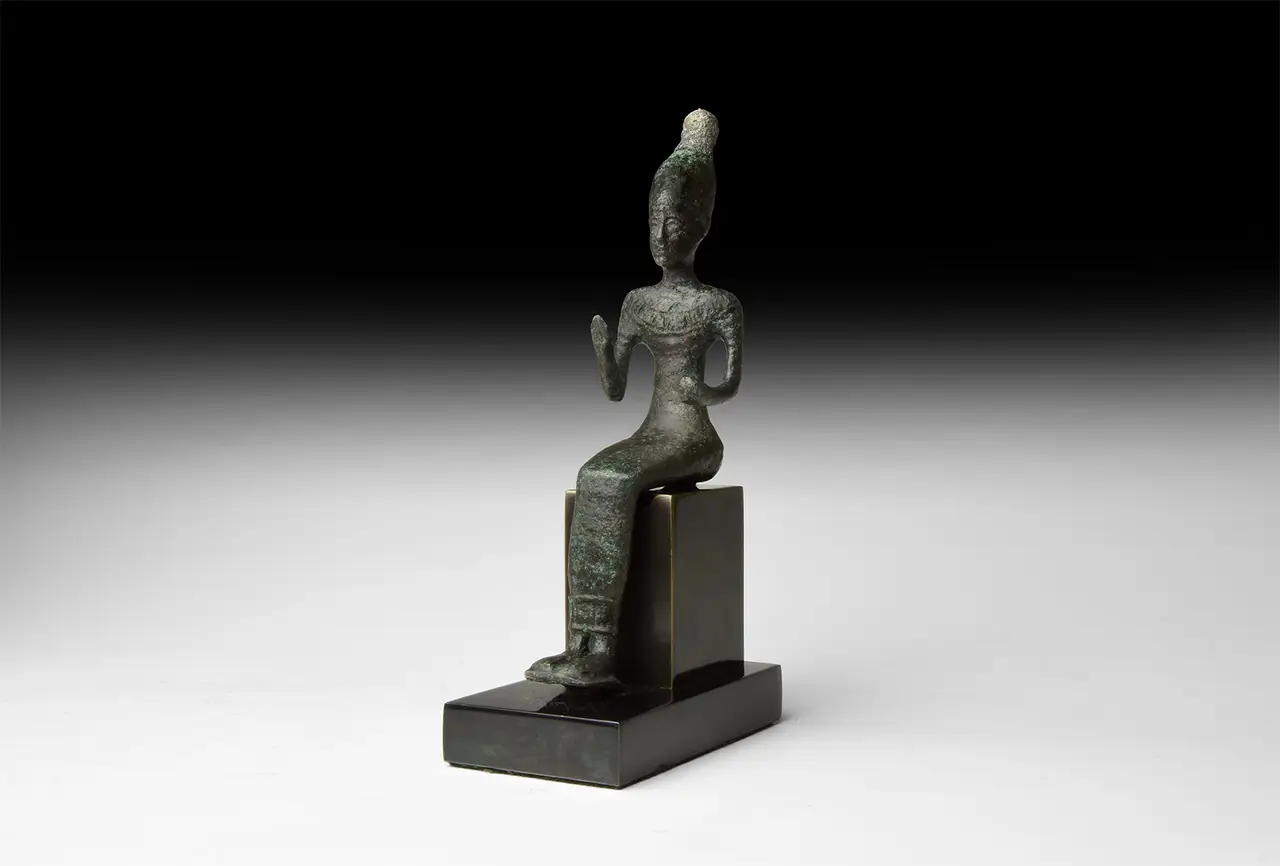
Phoenician ships carried these gods the length of the Mediterranean, to Cyprus, Sardinia, Sicily, Malta, North Africa and Spain. When they settled Kition on Cyprus around 800 BC they rebuilt an old Bronze Age sanctuary as a temple of Astarte that ran for some five hundred years, described by its excavators as the largest Phoenician shrine yet found, and, in the island's old habit, they kept a copper workshop beside it. At their greatest western colony, Carthage, the chief pair became Baal Hammon, whom the Romans later renamed Saturn, and the goddess Tanit, the "face of Baal," whose stylised emblem, a triangle topped by a disc and a bar, covers thousands of memorial stones.
Those Carthaginian stones stood over a deposit that scholars are still fighting about. In open-air precincts called tophets, at Carthage and on Sicily and Sardinia, the Carthaginians buried urns, some three thousand at Carthage alone, holding the cremated bones of very young infants, sometimes with young animals, beneath stelae dedicated to Baal Hammon and Tanit. Greek and Roman writers, and the Hebrew Bible, accused the Phoenicians and Carthaginians of burning their children alive to their gods, and whether this is true is genuinely open. One camp, reading the burnt bone and teeth, finds the ages clustering tightly around one to two months in a way they call unequivocal evidence of selective sacrifice; another reads much of the same material as prenatal and newborn, exactly what ordinary infant mortality would leave, and concludes the tophet was a cemetery for those who died too young to be buried elsewhere. The argument turns on the fine question of how bone and forming teeth shrink in a cremation fire, and it has not been settled. One thing can be cleared away: the "Moloch" to whom the Bible says children were given is most likely not a god at all but the name of a type of offering, mlk, later misread as a divine name and turned, by Flaubert and others, into a brazen idol with a furnace in its belly.
Through all of this the Phoenician gods were reluctant to be portrayed. They were marked instead by betyls, standing stones whose name means "house of god," and by empty thrones flanked by sphinxes on which an invisible deity was understood to sit. The same instinct shaped the most famous cult on Cyprus. At Palaepaphos, old Paphos, the goddess whom the Greek world would eventually call Aphrodite was worshipped for centuries not as a beautiful woman but as a cone of dark stone. It still exists, in the museum at Kouklia: a little over a metre of greenish-black gabbro, its surface worn smooth by generations of worshippers rubbing it with olive oil, and the Romans found it strange enough, and important enough, to stamp on their coins, the conical stone under its canopy, struck at Paphos from Augustus down to the Severans. In the local script she was not "Aphrodite" until the Hellenistic period but the Wanassa, "the Queen," a purely Cypriot title that matches the Phoenician Baalat next door at Kition. Her first priest, the myth said, was a king called Kinyras, ancestor of a line of Cypriot priest-kings. Hesiod, far away in Greece, told how Aphrodite was born from the sea-foam off Cyprus and came ashore there, which is why the Greeks called her the Cyprian.
The Gods in Greek Dress
Babylon fell to Cyrus the Persian in 539 BC, and Cyrus advertised himself, on the clay cylinder now in the British Museum, as the man who restored Marduk's neglected cult and sent the exiled gods of conquered cities home to their temples; the Bible remembered him as the foreign king who let the Judaeans go back and rebuild. The cylinder is sometimes called the first charter of human rights. It is better read as good propaganda: Cyrus was a conqueror like any other, presenting himself as the rescuer of Babylon's gods from a king his subjects had come to dislike. Persian rule did bring a new religion into the region, the Iranian worship of Ahura Mazda and the cosmic war between him and the evil spirit Angra Mainyu, along with Mithra and the goddess Anahita; how far this dualism shaped Jewish ideas of angels, the devil, the last judgment and resurrection is endlessly debated and probably undecidable, since the Zoroastrian scriptures were written down so late that even the direction of borrowing is unclear.
Then came Alexander, and after him centuries of Greek and Roman rule, and the old gods learned to wear Greek and Roman dress. The Greeks had a habit of looking at a foreign god and deciding which of their own he "really" was, and the Near Eastern gods were translated wholesale: Melqart was Herakles, Eshmun was Asklepios, the Cypriot Queen and Phoenician Astarte were Aphrodite, Baal-Hadad and Baal Shamem were Zeus and Jupiter, Tammuz was Adonis. The translations were never quite fixed, and the local cult underneath usually went on much as before; one historian has described the shared Greco-Roman religious world as a common grammar laid over the distinct local names, the grammar universal, the names the local speech. Some of these hybrids became great international cults. The Syrian goddess Atargatis, the "Dea Syria" whose strange cult Lucian described, sat enthroned among lions beside her consort Hadad on his bulls, served by priests who castrated themselves in her honour, her temple ponds full of sacred fish no one was allowed to eat. The storm-god of the Syrian town Doliche became Jupiter Dolichenus, who stood on a bull with a thunderbolt and a double axe and was carried to the frontiers of the empire by Roman soldiers. The god of Emesa was a conical black stone, a betyl like the one at Paphos, and when a teenage hereditary priest of that god became Roman emperor he brought the stone to Rome and tried, briefly and disastrously, to make it the chief god of the empire; we know him by the god's name, Elagabalus. At Dura-Europos on the Euphrates, a single garrison town has yielded the temples of half a dozen of these gods side by side, Syrian, Palmyrene, Mesopotamian and Greek, with a synagogue and a Mithraeum among them, the whole jostling religious world of the Roman East in one ruined block.
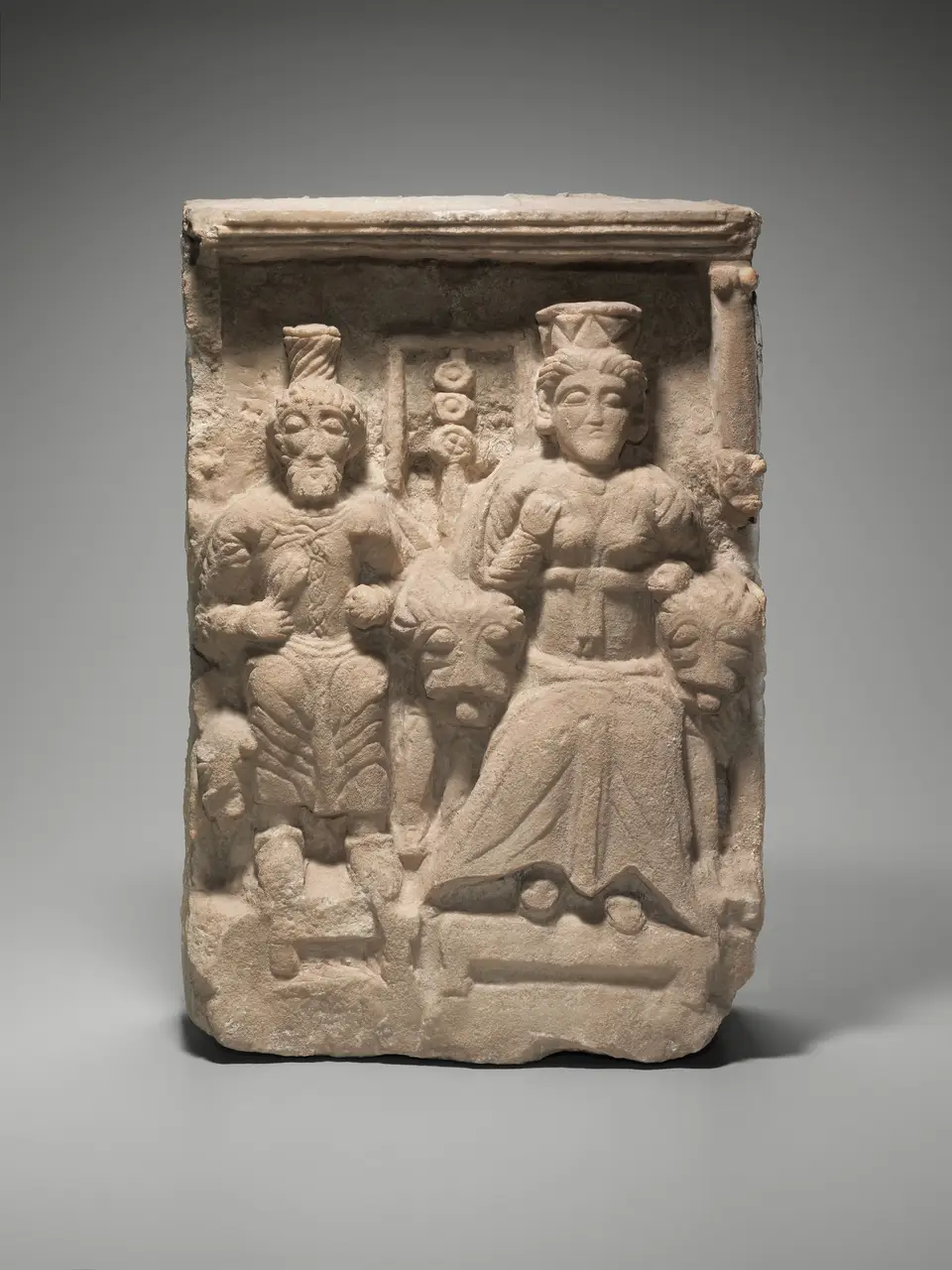 Limestone relief of the enthroned Syrian goddess Atargatis, at right, beside the god Hadad, with their flanking animals and the cult standard between them, from the Temple of Atargatis at Dura-Europos, about AD 100 to 256. Yale University Art Gallery.
And then, slowly, they ended. Christianity did not sweep the old gods away in a generation; the process ran for centuries, from the first tentative restrictions under Constantine, through the ban on sacrifice and the closing of temples in the mid-fourth century, to the destruction of the great Serapeum at Alexandria in 391 or 392. But cult is stubborn. Pagan rites were still being performed at Edessa late in the sixth century. On the island of Philae in the Nile the old Egyptian gods kept their cult until Justinian's officials closed the temple of Isis around AD 535 to 537. And at Harran in northern Mesopotamia, the city of the moon-god Sîn, the people were still openly worshipping the planets and the stars, in a cult with roots in the oldest layer of this whole story, when the armies of Islam reached them in the seventh century, and in quieter forms for generations after. The moon-god of Ur outlasted the temples of Babylon by a thousand years.
The story ends, in time, at Harran. It does not quite end in argument. The cone of dark stone from Paphos still stands in its case at Kouklia, worn glossy by the oil of worshippers who are themselves nine hundred years gone, and the scholars who study it cannot agree whether the goddess it stood for, Wanassa, Astarte, Aphrodite, was carried in across the sea from Ascalon by Phoenicians, as Herodotus thought, or grew up, as Stephanie Budin argues, on the island that gave her one of her names.
TimeLine Auctions, 11th July 2026