Home > Stories by TimeLine Auctions
Stories by TimeLine Auctions
The Handbag That Wasn't: The Truth About the 'Handbags of the Gods'
The internet is convinced that the gods carried handbags. The evidence is a collage you have probably scrolled past: a carved pillar from Göbekli Tepe in Turkey, a winged spirit from an Assyrian palace wall, an Olmec relief from Mexico, and in each frame, gripped by some imposing figure, a flat-bottomed object with a rounded handle. Civilisations that never met, apparently holding the same accessory. The caption varies, but the implication is fixed: someone visited all of these people, and never put the bag down.
None of the three objects is a bag, and their real identities have nothing to do with one another. The ancient world, meanwhile, did produce an object that genuinely earns the comparison, a class of carved stone "bags" that archaeologists have argued over for half a century, and the collage never includes it. One is in our September sale.
A bucket, three boxes and a pouch
The Assyrian exhibit comes with its own paperwork. The winged spirits carved on the palace walls of Ashurnasirpal II at Nimrud (883 to 859 BC) hold the "bag" in one hand and something like a pine cone in the other, and Assyrian ritual texts name both objects: the banduddû, a bucket, and the mullilu, a purifier. F. A. M. Wiggermann matched the words to the pictures in 1992. The bucket seems to have held water, the cone to have sprinkled it, and the beings that carry them, the apkallu or sages, stand at doorways because texts prescribe such figures to "block the entry of the enemy in someone's house". The god's handbag, in Assyria, is a bucket of holy water drawn side-on.
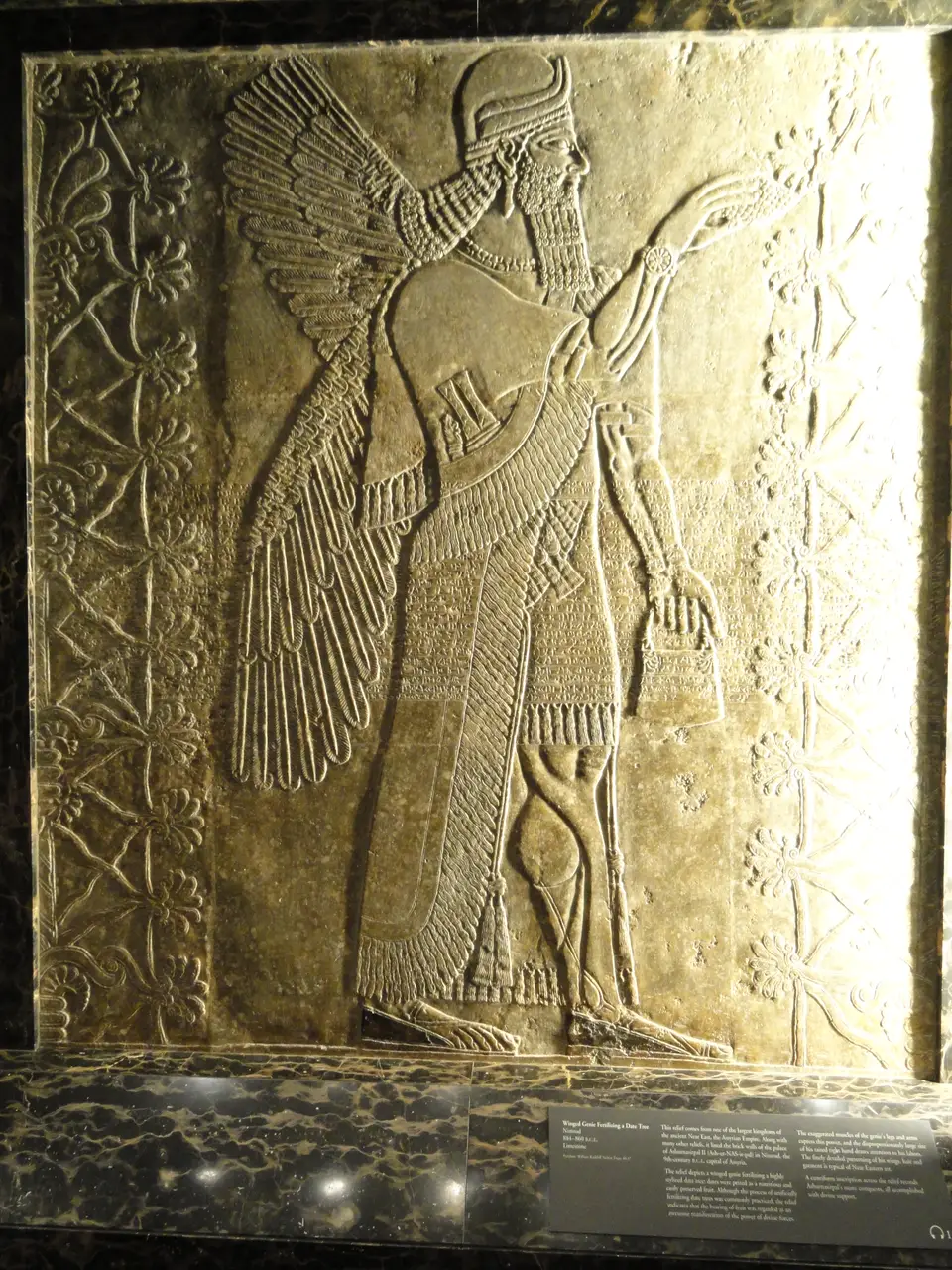 A winged apkallu with bucket and cone on a relief from Ashurnasirpal II's palace at Nimrud, ninth century BC, now in the Nelson-Atkins Museum of Art, Kansas City. Public domain, via Wikimedia Commons.
Pillar 43 at Göbekli Tepe, the so-called Vulture Stone, was carved around 9500 BC by hunter-gatherers who had not yet invented pottery. It shows a vulture with spread wings, a scorpion, snakes and a headless man, and along its top edge a row of three box-like shapes with looped tops, a small creature perched beside each. Klaus Schmidt, who excavated the site from 1995 until his death in 2014, left them unidentified, and his team's publications still do. Guesses in print run from baskets to buildings to small boats; none has stuck. The meme prefers the mystery, but "nobody knows" is an honest answer, and it is a different answer from "a handbag".
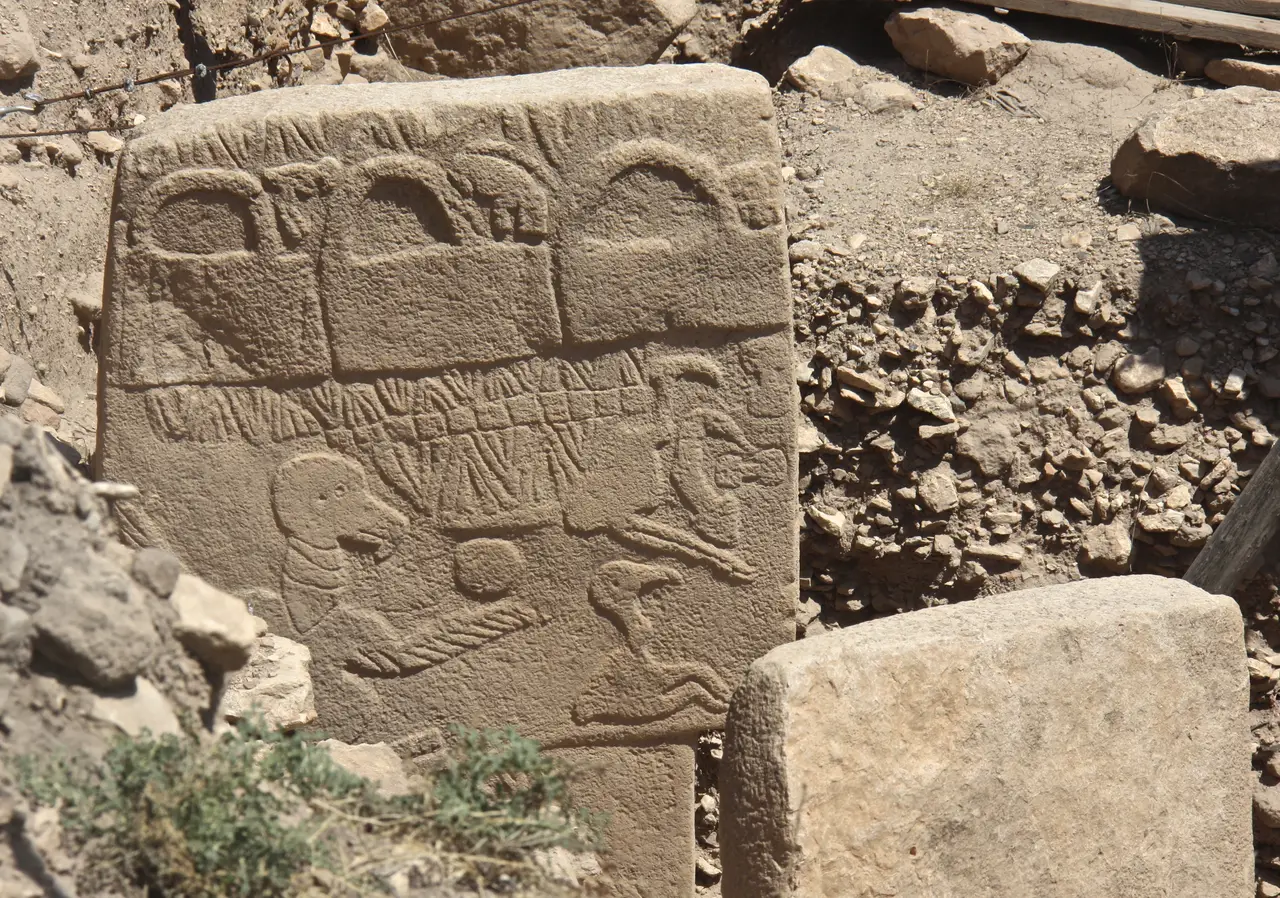 Pillar 43 in Enclosure D at Göbekli Tepe, the row of looped shapes running along its top edge. Photo: Sue Fleckney, CC BY-SA 2.0, via Wikimedia Commons.
The Olmec exhibit is the only one holding something honestly baggish. Monument 19 from La Venta, near Mexico's Gulf coast, carved somewhere between 900 and 400 BC, shows a man seated inside the coil of a rattlesnake; the archaeologists Philip Drucker, Robert Heizer and Robert Squier published the stone in 1959. In the man's hand swings a small pouch. Mesoamerican ritual ran on copal, a tree resin burned as incense, and the sixteenth-century friar Diego de Landa recorded that Maya travellers carried incense and a little dish to burn it in.
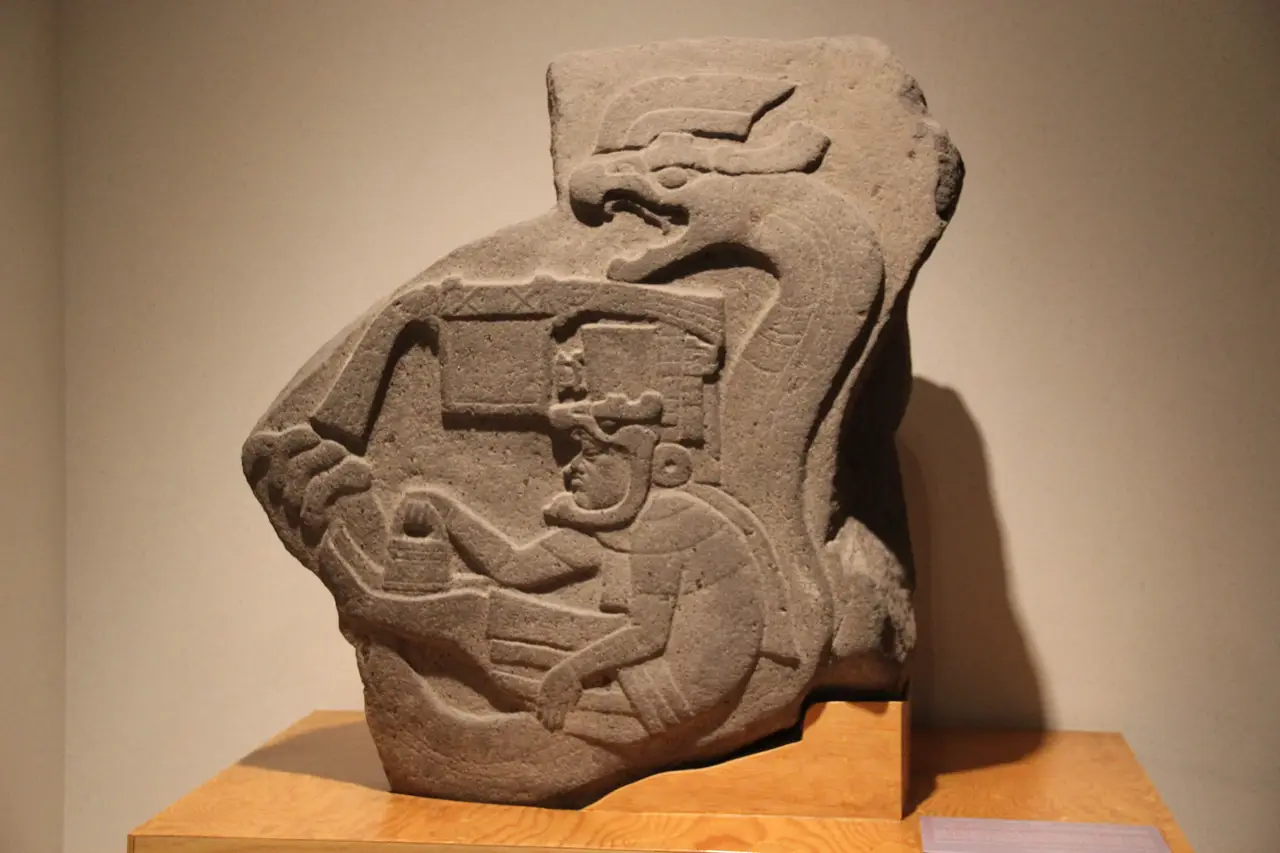 Monument 19 from La Venta, now in the National Museum of Anthropology in Mexico City. Photo: Gary Todd, CC0, via Wikimedia Commons.
So the full case reads: a bucket in Assyria, three unknowns in Anatolia, a resin pouch on the Gulf of Mexico, spread over nine thousand years and two hemispheres. The theory of the shared divine handbag rests on the observation that a handle looks like a handle.
The one ancient object that actually looks like a handbag
Lot 225 in our sale of 8 September is a block of black chlorite, a soft stone that takes fine carving, cut in the silhouette of a handbag: D-shaped in profile, with a round-sectioned loop for a handle. On one face two lions advance on a small animal, their coats picked out in fine hatching. On the other an eagle spreads its wings between two rearing serpents, a scorpion tucked in beside them. On its mount it stands 28 centimetres tall and weighs over six kilos, and its paper trail runs back to a Tel Aviv gallery invoice dated November 1969. You could never put anything in it. The stone is solid; if this is a bag, it is a picture of one.
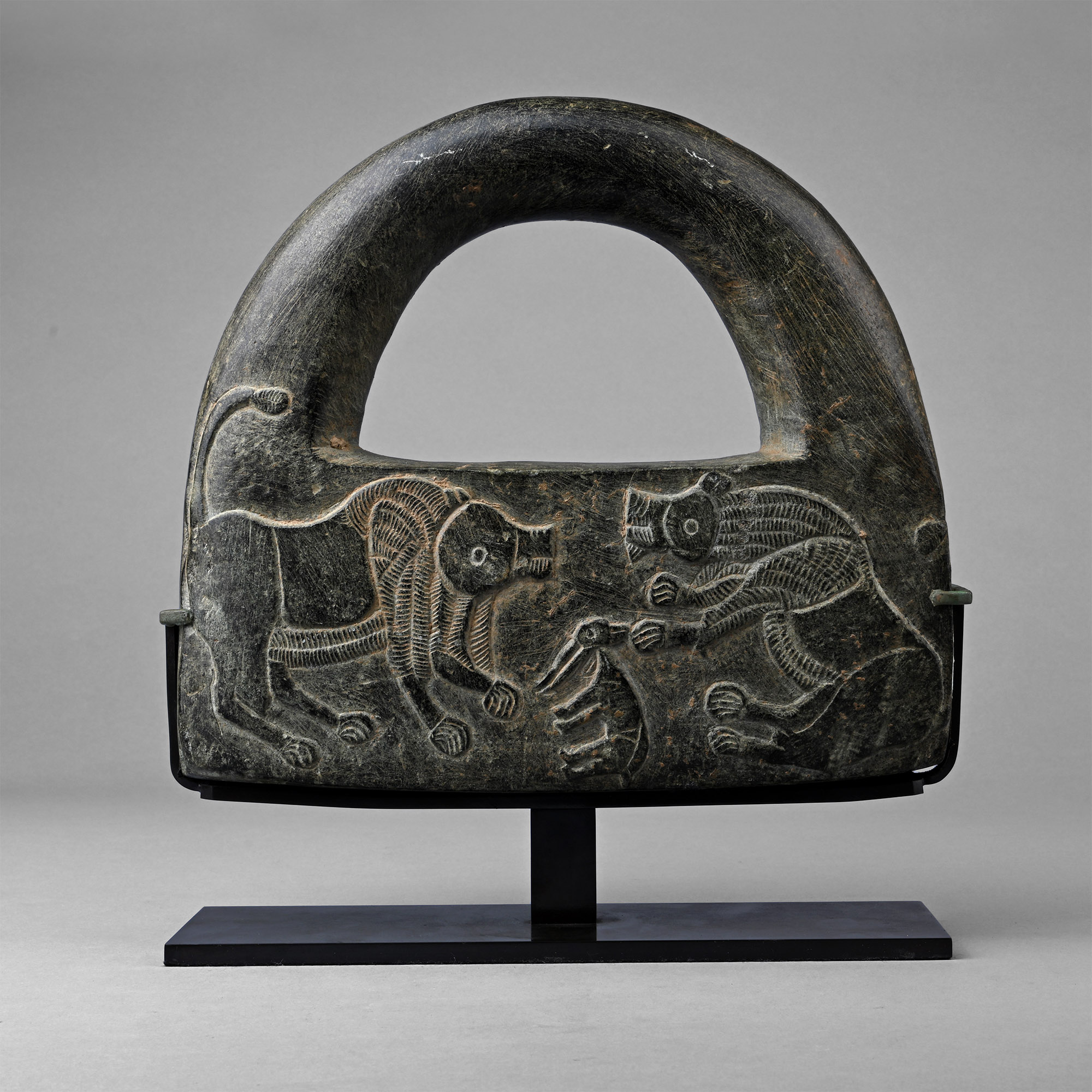
It was carved in the third millennium BC in Bactria, the country along the Oxus river in what is now northern Afghanistan and its neighbours, whose Bronze Age cities archaeologists group as the Oxus civilisation. The animals on its faces are the local theology. On Oxus seals and amulets the eagle and the snake are the two principal creatures and the standing adversaries, a contest Henri-Paul Francfort has traced across the civilisation's imagery, with lions and scorpions in supporting roles.
Weights, badges and a saint's tomb
Nor is it a one-off. These carvings belong to what the Metropolitan Museum's Art of the First Cities catalogue calls the "Intercultural Style", soft-stone wares that circulated between the Euphrates and the Indus in the mid-to-late third millennium BC. Handled examples turn up from Nippur in Mesopotamia to Tepe Yahya in southeastern Iran to Soch in the Ferghana valley, in chlorite, breccia, onyx and fossiliferous limestone; unfinished pieces have been excavated at both Nippur and Yahya, the Yahya piece found near a scatter of chlorite-working debris. The Metropolitan owns one carved with date palms. The usual name for the class is "weights", and the quotation marks are load-bearing: the Met's entry for its own example settles for "assumed to have been weights". Our catalogue takes the other view, that they began as badges of high office, carried to signal authority rather than to measure anything.
The Tepe Yahya expedition recorded two of these objects still at large in the Kerman hills: one was brought in to the dig house at Baghin by a villager, and another, undecorated, lay at the tomb of a local saint near Ashin, in the Soghun valley, where the team photographed it in 1970. Daniel Potts printed the pictures in the excavation's 2001 report. Four thousand years after the carvers died, nobody at Ashin knew what the stone bag had been, and nobody needed a collage to feel what it was: a thing with authority, owed a place on a shrine. They proposed no visitors from anywhere. They gave the handbag to the saint.
TimeLine Auctions, 3rd August 2026