Home > Stories by TimeLine Auctions
Stories by TimeLine Auctions
The Helmet in the River: A Greek Warrior's Bronze in Southern Spain
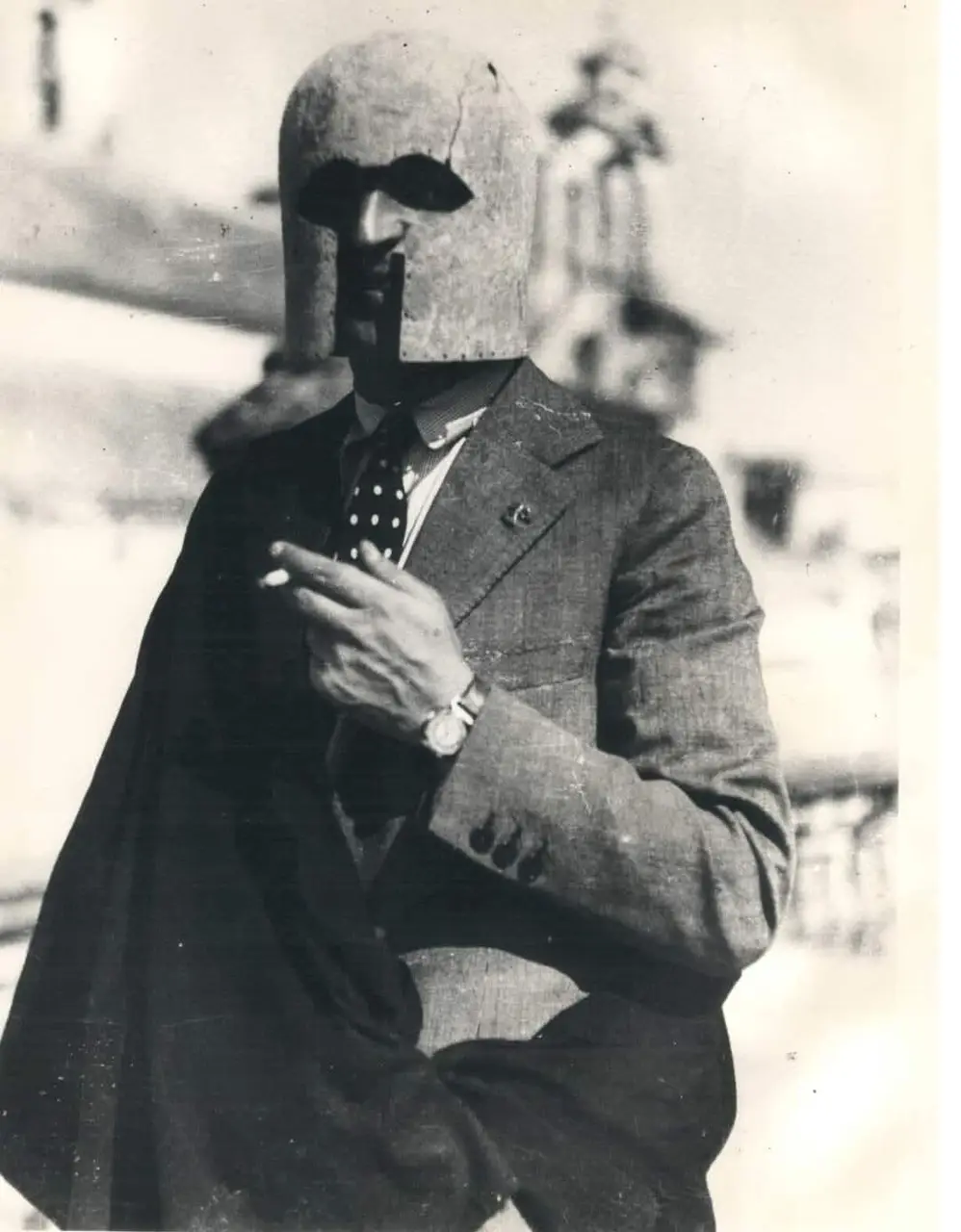
In 1938, tangled in the undergrowth on the left bank of the Guadalete River near Jerez de la Frontera, a bronze Corinthian helmet turned up. Manuel Esteve, then director of the Museo Arqueológico Municipal de Jerez, recognised it immediately for what it was: a piece of Greek military equipment, hammered from a single sheet of bronze, that had no obvious business being in southern Spain. He acquired it for the municipal collection, where it remains today, one of only three Corinthian helmets ever recovered from the Iberian Peninsula.
Esteve initially dated the helmet to the sixth century BC, but subsequent analysis by scholars including Anthony Snodgrass of Cambridge, Brian Shefton, and Hermann Pflug pushed the date considerably earlier, to the first quarter of the seventh century BC. That makes it one of the oldest Greek objects found in the far west of the Mediterranean, and places it within a period when the relationship between Greek, Phoenician, and local Tartessian cultures was still being negotiated through trade, rivalry, and ritual.
Anatomy of a Helmet
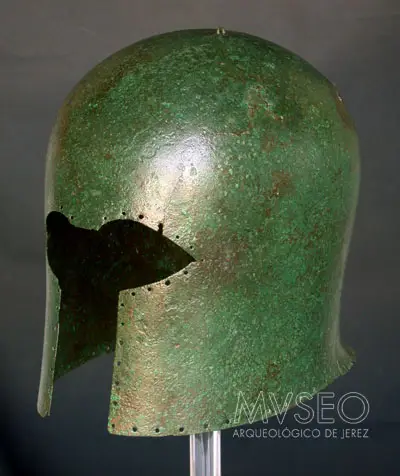
The helmet stands 22.5 cm tall and 16.5 cm wide, with a maximum diameter of 22 cm. According to Paloma Cabrera Bonet of the Museo Arqueológico Nacional, who published a detailed study of the piece, it was forged from a single core of bronze beaten with a hammer to a remarkably uniform wall thickness. The dome is rounded, the walls nearly vertical, and the eye openings are wide and symmetrical, with straight upper and lower rims. A row of small perforations runs along the entire lower edge, where a leather liner would once have been stitched to cushion the wearer's head against the blows of battle.
Three bronze staples survive: one at the back along the centreline and two at the top, which scholars interpret as attachment points for a horsehair crest. The nasal spike, which would have projected down between the eyes, is missing. More telling still, a puncture hole sits on the left side of the forehead, with a crack running from it to the left eye opening. These are likely signs of deliberate damage, what archaeologists call "ritual killing," the intentional destruction of an object before it was offered to the gods.
Where It Fits in the Corinthian Lineage
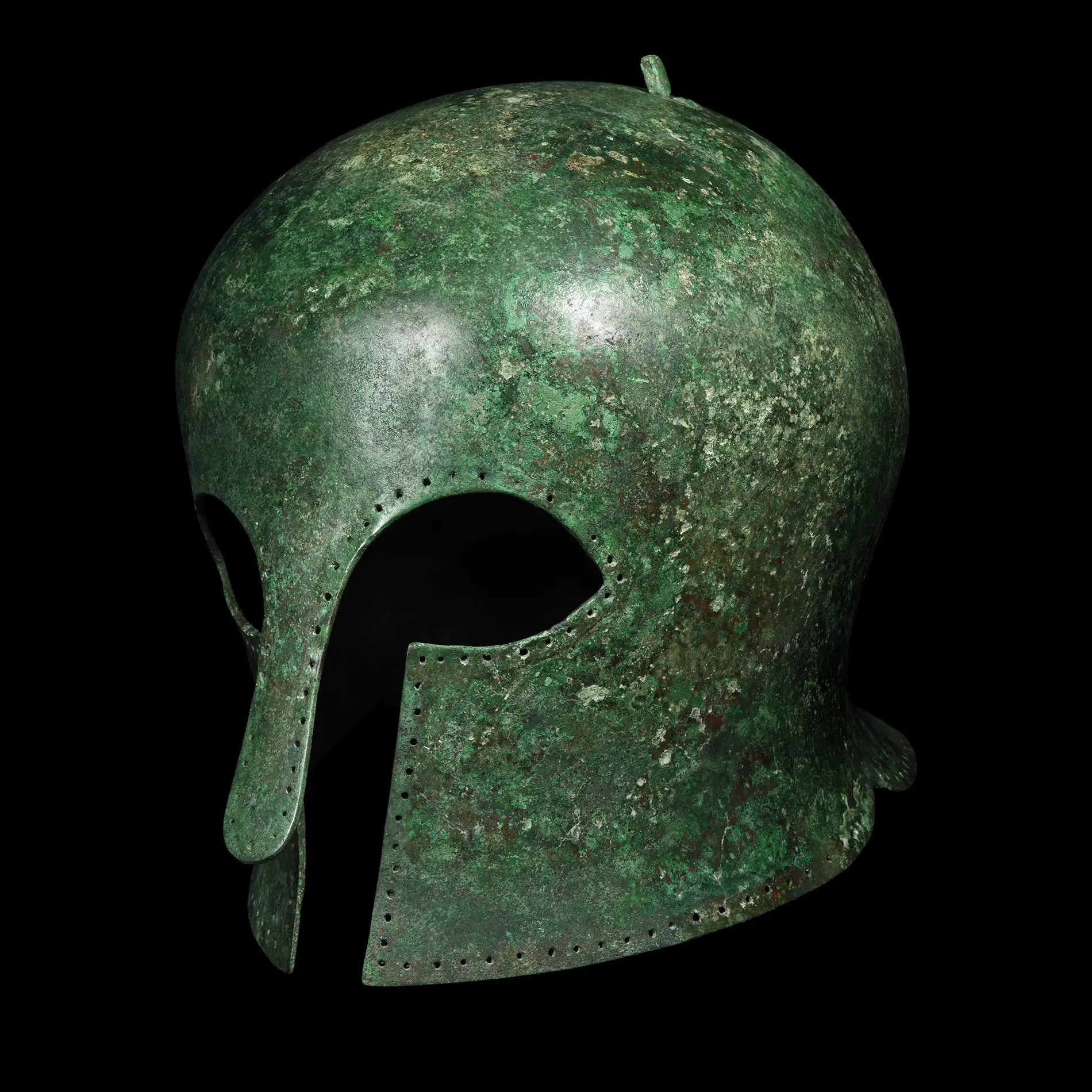
The Corinthian helmet, originating in the Peloponnese, was the signature headgear of the Greek hoplite and one of the most enduring designs in ancient armour, used regularly from the late eighth century BC through the early fifth century BC. Researchers such as Ernst Kukahn, Snodgrass, and Pflug have classified its development into three broad phases. Early examples (Period I, late eighth to mid-seventh century BC) are rigid, tall, and boxy, with minimal curvature and no decoration. The Guadalete helmet belongs to this earliest group: the neck guard drops almost vertically, the cheekpieces are straight and do not project forward, and the lower rim sits flat on any surface, all hallmarks of the type's stiff, archaic profile.
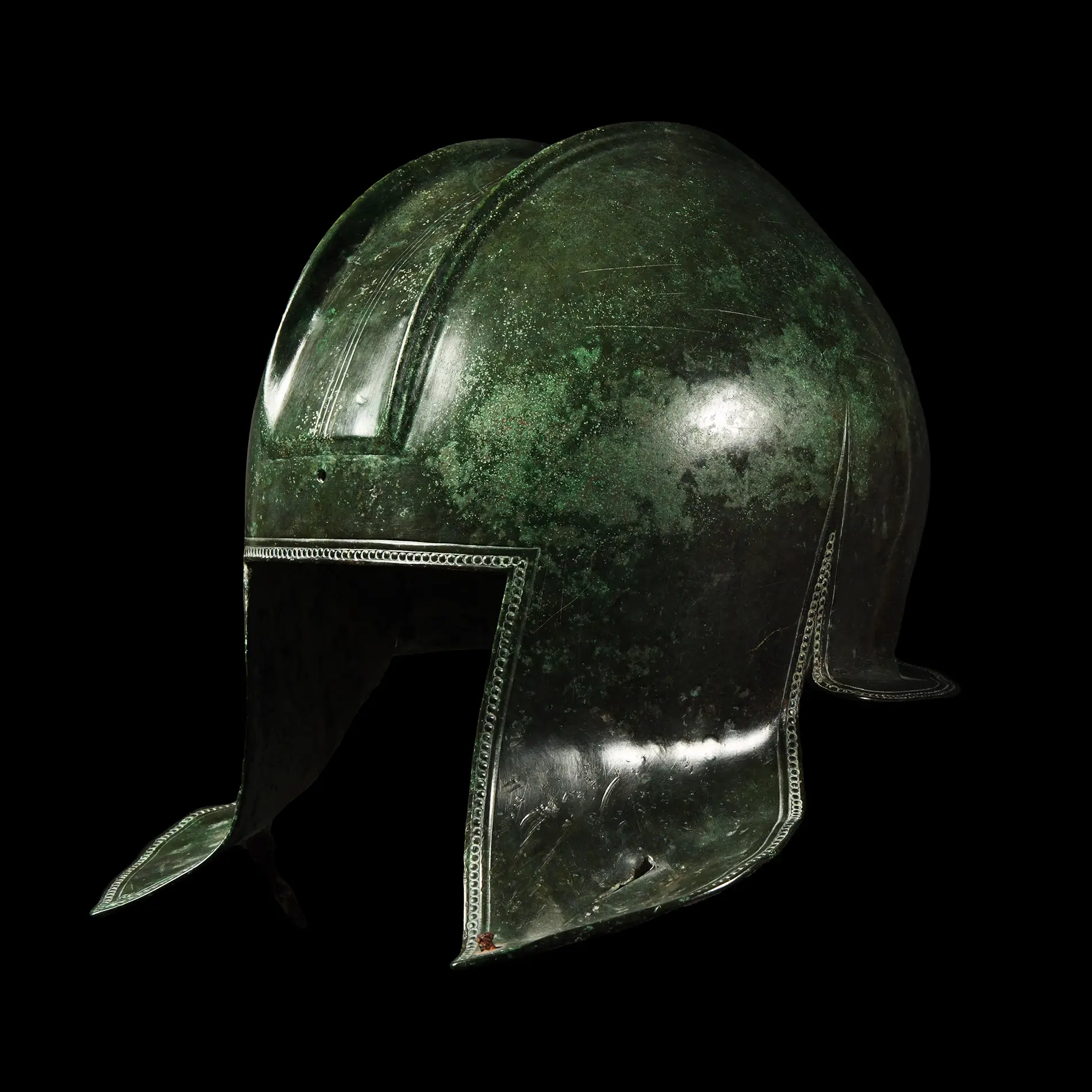
By the middle phases (Period II, roughly 650–530 BC), the design became more organic, with curved profiles, bulging cranial vaults, and incised decoration around the eyes and mouth. The latest versions (Period III, 530–480 BC) featured a pronounced keel, deep cutouts, and elongated cheekpieces, the form familiar from the frieze of the Siphnian Treasury at Delphi.
Who Left It in the Water?
The real mystery is how a Greek helmet from around 675 BC wound up in a river in Phoenician-controlled territory near Cádiz. It is not alone in this. Two other Corinthian helmets have been recovered from waterways in the same region: one from the Ría de Huelva and another from Sanlúcar de Barrameda.
Earlier scholars, including César Pemán and Antonio García y Bellido, tried to link the helmets to Kolaios of Samos, the Greek navigator who, according to Herodotus, opened up the riches of Tartessos to Greek commerce. But as Cabrera Bonet notes, that voyage is now dated to around 630 BC, well after the helmet was made and probably after it was deposited.
More recent work by Marisa Ruiz-Gálvez and by Raimon Graells and Alberto Lorrio places these finds within a long-established tradition of depositing weapons in rivers as sacred offerings, a practice well documented across Atlantic and Central Europe during the Late Bronze Age. The famous arms hoard from the Ría de Huelva fits the same pattern. The objects were deliberately rendered unusable (hence the punctured skull and broken nasal) and then consigned to the water, where they could never be retrieved. The act was the point.
Whether the person who made the offering was a Greek sailor giving thanks for safe passage, a Phoenician trader who had acquired the helmet through the busy exchange networks linking Pithecusae (near Naples), Carthage, and the western colonies, or even a local Tartessian chief integrating a foreign prestige object into native ritual practice remains, as Cabrera Bonet concludes, an open question. All three possibilities find support in the archaeological record.
Greek Goods in Tartessian Lands
The helmet does not exist in isolation. Excavations across southern Spain, particularly at Huelva, have produced Euboean drinking cups, Corinthian amphorae, and Attic SOS amphorae dating from the mid-eighth to early seventh century BC, evidence that Greek manufactured goods were reaching the Atlantic coast of Iberia far earlier than once assumed. Whether they arrived via Phoenician middlemen operating out of Sulcis and Carthage, or through direct Greek voyages from the Euboean colony at Pithecusae, is still debated.
What is clear is that the western Mediterranean in the early seventh century BC was a far more connected, cosmopolitan place than older models of neat Phoenician and Greek "spheres of influence" allowed. A Greek helmet in a Spanish river, ritually destroyed and offered to forces we can only guess at, is a vivid reminder of just how far objects, and the ideas attached to them, could travel.
Ancient Greek bronzes, including helmets, armour fittings, and vessels, appear periodically in specialist sales. Browse our upcoming and past catalogues for Greek and Mediterranean antiquities.
TimeLine Auctions, 18th May 2026