Home > Stories by TimeLine Auctions
Stories by TimeLine Auctions
The Lotus: One Name, Several Plants, Two Symbolic Traditions
When chemists ran petals of the Egyptian blue lotus through a mass spectrometer, hunting the narcotic that newspapers had promised, they came up with kaempferol and quercetin: two ordinary flavonoids, the kind of compound in an onion skin, and not a trace of the alkaloids that would make anyone feel anything at all. One of the samples was an ancient petal, lifted from a first-century AD flower garland at Hawara in the Fayum. The "Egyptian Viagra," the blue lotus as a recreational high, was a media gloss the researchers themselves disowned as oversensational.
The alkaloids in the popular story came from somewhere else entirely. A bloom had once been sent from the Cairo Botanical Gardens, labelled Nymphaea caerulea, the Egyptian blue water-lily. Analysed, it duly produced apomorphine derivatives, the exact compounds the legend wanted. The flower had been mislabelled. It was not the Egyptian water-lily at all. It was a Nelumbo, the Asian sacred lotus, a plant from a different family that happens to share the English name. Even in Cairo, even on a specimen label, the two get swapped under one word.
That confusion is not modern, and it goes deeper than a mislabelled flower. "Lotus" is a net thrown over plants from at least three botanical families, and almost every popular account of "the lotus" is built on the tangle. Pull the names apart, plant by plant, and a tidier and stranger story falls out of the knot. There is not one ancient lotus symbolism. There are two, built on two different plants, in two parts of the world whose native plant ranges never touched. They grew up independently, on separate myths, and they met late and only as decoration. The thing that travelled between them was the shape of the flower. The meaning mostly stayed at home.
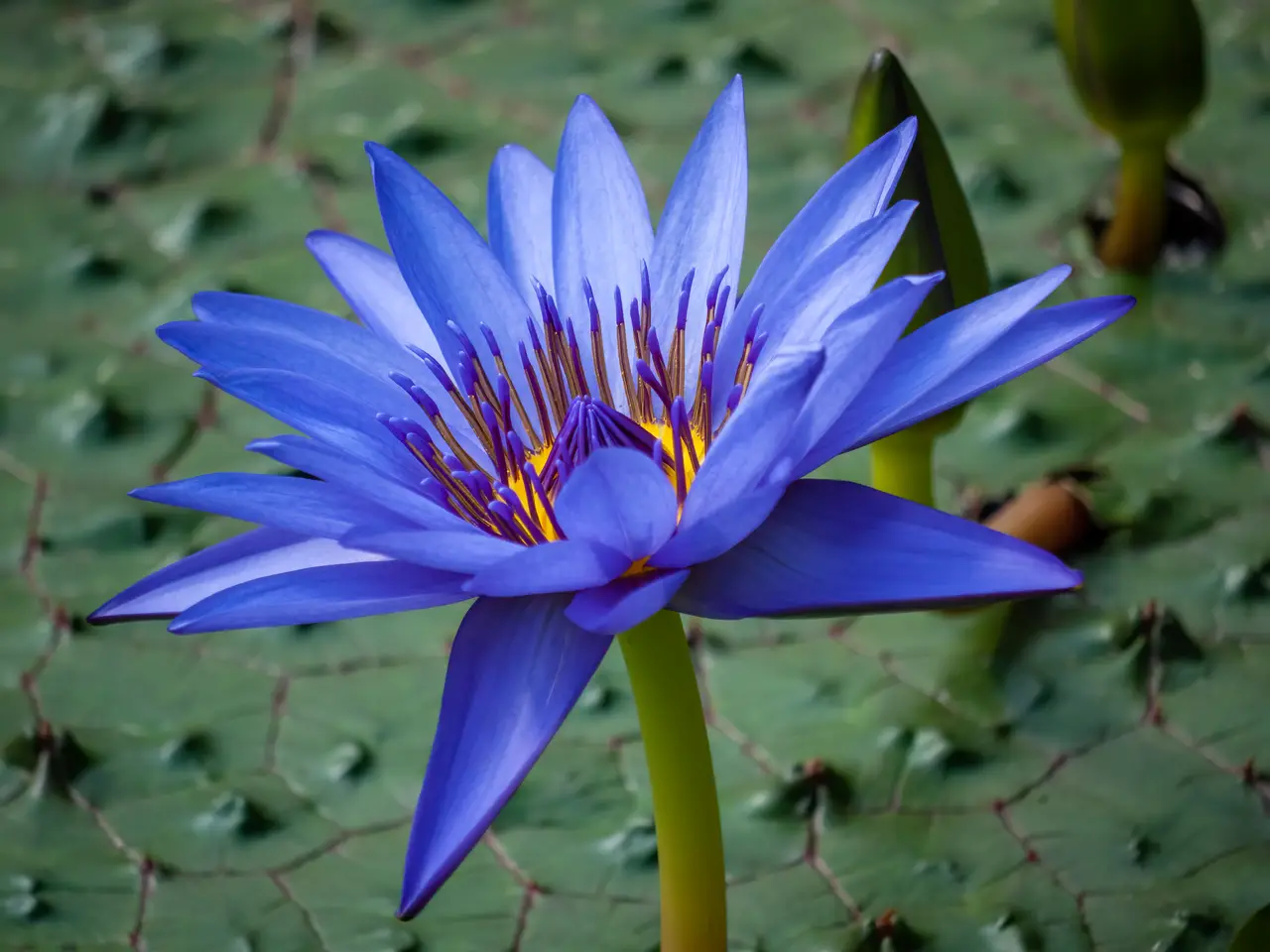 The Egyptian blue water-lily, Nymphaea caerulea: violet-blue, with sharply pointed petals, open by day on the surface of the water. This is the flower Egyptologists conventionally call the lotus. Photo: Reinhold Möller, CC BY-SA 4.0, via Wikimedia Commons.
The word that holds too many plants
The damage starts with Greek. The word λωτός, as one commentary on Homer puts it, "is a name applied indifferently to a number of quite different families of plants." Herodotus, describing the Nile marshes, calls the Egyptian flowers "lilies which the Egyptians call lotus," which is closer to right, since the Egyptian plant is a water-lily. The Egyptians did not call it λωτός; their own word was seshen. Egyptologists, by an old and universal convention, still write "lotus" for the Egyptian water-lily, and specialists now flag the problem in print, deliberately writing "water-lily" instead "to avoid confusion with the Indian lotus Nelumbo nucifera."
Four plants wear the name. Three matter for symbolism; the fourth is a trap.
- The Egyptian blue water-lily (Nymphaea caerulea) is native to the Nile. Its flower is violet-blue with sharply pointed, elongated petals, eight to sixteen centimetres across; it sits on or just above the water, opens by day, and its floating leaf has an entire, untoothed edge.
- The Egyptian white water-lily (Nymphaea lotus) is also native, larger, white, with bluntly pointed petals; it blooms at night, and its floating leaf has a sharply toothed margin. That toothed leaf is the surest way to tell it from the blue.
- The Asian sacred lotus (Nelumbo nucifera) belongs to a separate family. It is pink, and instead of floating it holds its leaves and flowers high above the water on long stalks. Its seed-pod is the giveaway: a swollen, flat-topped, spongy receptacle like a shower-head, studded with twenty or thirty seeds. Its native range runs from South and Southeast Asia to northeast Australia, with one American cousin. It is naturally absent from Africa.
- The lotus-tree (Ziziphus lotus) is none of these. It is a Mediterranean shrub of the buckthorn family, the food of Homer's lotus-eaters. Theophrastus describes this lotos as a tree "as tall as a pear-tree," its bean-sized fruit pressed into a wine that soured within days. It has nothing to do with any flower.
The practical test, for anyone looking at an ancient image and wanting to know which plant is in front of them, comes down to a few features. Flowers and leaves resting on or just above the water surface mean a Nymphaea, an Egyptian water-lily. Flowers and leaves held high on stalks, and above all that distinctive seed-pod, mean a Nelumbo, the Asian lotus; this is the single most decisive marker, and it is exactly why the great Nile Mosaic at Palestrina, with its seedheads "which rise above the water on long stalks," shows Nelumbo and not the Egyptian flower. Between the two Egyptian species, the leaf decides: an untoothed margin is the blue, a toothed one the white. On the temple of Ramesses II at Abydos, the water-lily was identified as the blue species precisely because each flower-cluster's leaf had an entire, untoothed edge.
Two facts follow from the native ranges, and they govern everything after. The Egyptian water-lilies are African and Nilotic. The sacred lotus is Asian. The plant most people picture when they hear "lotus," the pink one with the seed-pod, was not present in pharaonic Egypt at all. It arrived as a botanical import, most likely under Persian rule, around 525 BC. For the whole of the period when Egypt was building the first great lotus symbolism, the Asian sacred lotus was not there to see.
Egypt and the flower at the nose of Re
The earliest developed lotus symbolism is Egyptian, and it is built on watching the blue water-lily behave. The flower opens by day and closes again, it rises from the water, and Egyptian priests read those plain facts as a model of the sun and of rebirth. As one summary of the evidence puts it, the Egyptians "observed that their native blue water lily raised its flowers above the water and faced the sun at dawn," and tied that to the daily re-birth of the sun. (The tidier modern version, in which a single bloom sinks every night and is resurrected every dawn, is partly romance: new buds replace old ones, and the literature on bloom-timing is inconsistent.)
The flower is in the record from the beginning. It appears on Naqada II painted pottery, around 3650 to 3300 BC, before the First Dynasty. The closest study of the early material argues that its symbolic use takes root in the Early Dynastic period, and the physical traces support an early ritual life: faience model lotus buds and flowers from the early shrine at Elephantine, from the Main Deposit at Hierakonpolis, and from Abydos; pottery rattles shaped as blue water-lily buds, deposited in shrines at Tell el-Farkha and Hierakonpolis, the bud rising from an incised double line that reads as the surface of the water. The water-lily enters hieroglyphic writing at the start of the First Dynasty, a variant of the lotus sign, Gardiner's M9, appearing already under Iri-Hor. A small column of eight water-lily flowers bound together, in bone or ivory from Helwan, is the earliest known piece of floral architecture anywhere.
The myths grew on the plant. In the Hermopolitan account of creation, a Great Lotus rose from Nun, the primeval water, and opened to reveal the infant sun-god, who then "separated night from day." The flower was personified as Nefertem, "lord of perfumes," bound from early on to the solar cult at Heliopolis. The Pyramid Texts already have the dead king rise "like Nefertem, the lotus at the nostrils of Re." That solar reading is sharpest from the New Kingdom onward; for the Old Kingdom, scholars such as Morenz and Schubert read the lotus more cautiously, as an offering marker or a female attribute before it was fully a cult symbol. The chronology of the tomb reliefs supports the caution: the lotus is at first held by women, like Nofret at Meidum, and men begin holding it to the nose only in the late Sixth Dynasty.
Where the symbolism becomes unmistakable is in the funerary texts, and in one object above all. Spell 81 of the Book of the Dead is titled "for being transformed into a lotus," and in it the deceased declares, "I am this pure lotus which went forth from the sunshine, which is at the nose of Re." The three-dimensional statement of that idea is the painted wooden head of Tutankhamun emerging from a blue lotus (Egyptian Museum, Cairo, JE 60723), the child-king modelled as the newborn sun rising on the flower from a base of Nile water. It is one of the most reproduced images of the boy-king and one of the least documented: Howard Carter never properly catalogued it, and its findspot and authenticity have been argued over since the 1920s.
The same flower carried a quieter political meaning. The lotus was the heraldic plant of Upper Egypt, paired with the papyrus of Lower Egypt; the two were knotted around the sema sign, often by the twin Nile-gods, to express the sema-tawy, the union of the Two Lands. And it pervaded the New Kingdom banquet, where guests are shown holding lotus blossoms to their noses among garlands and friezes. Those scenes are routinely read as veiled drug-taking, which brings us back to the mass spectrometer. The chemistry gives no support to intoxication. The likelier point is the fragrance itself, and behind the fragrance an old religious idea, the acquiring of the scent of the gods in order to join them: "Your scent is as their scent," as the Pyramid Texts have it.
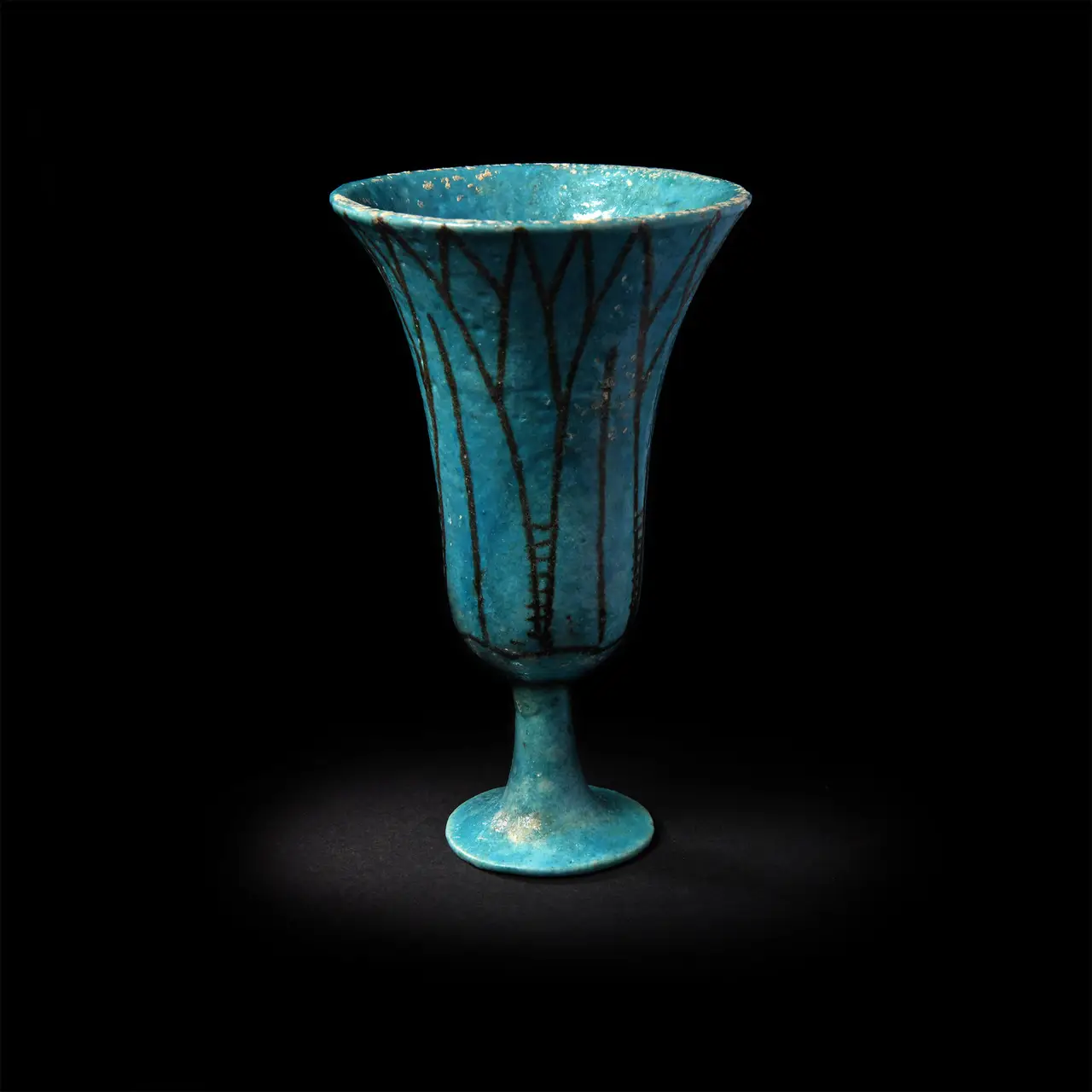
The flower climbed the architecture too. Plant columns appear early, and lotus capitals are dated to the Fifth Dynasty. Closed lotus-bud capitals, bundled flowers tied at the neck, recur from the Old Kingdom to the Late Period; open-lotus capitals are shown in relief from the Old Kingdom on, though the earliest that physically survive are Ptolemaic, at Philae and Hibis. Lotus and papyrus columns stand famously together at Karnak and Luxor. In the smaller arts the motif is everywhere: faience lotus chalices, the seshen goblets, appear at the start of the Eighteenth Dynasty and run for centuries, mostly in the blue-lotus form for ritual use, and Tutankhamun's alabaster "wishing-cup" is a white-lotus bloom with lotus-and-bud handles. Faience of this kind, much of it exported in antiquity, still reaches the market today.
The flower that became a pattern
The Egyptian lotus did not stay in Egypt. Over roughly fifteen centuries it travelled west and north, and as it travelled something happened to it: the meaning thinned out, and the shape hardened into a decorative band that would outlast every cult that gave it sense. The route is well documented. The flower enters Canaan in the second millennium BC, on Tell el-Yahudiyeh juglets and at Byblos, and runs as a lotus-chain along the tenth-century sarcophagus of Ahiram. From there it passes into the Phoenician and North Syrian workshops, onto their ivories and metal bowls, and out across the Mediterranean.
Cyprus and the Levant
Cyprus shows the pattern in miniature. The lotus appears on a single Cypriot jug around 1600 BC, then disappears for centuries, and only "flowered on the island's vessels," in Desmond Morris's phrase, in the Cypro-Archaic period, roughly 750 to 480 BC. On Bichrome ware it runs in shoulder friezes of flowers alternating with buds, and in the so-called free-field style a stylised bird stands beside a stemmed lotus. The richest examples are the Cypro-Phoenician metal bowls found at Idalion, Salamis and Kourion: a central rosette ringed by a register of lotus and bud and an outer frieze of figures. The silver-gilt Amathus bowl, now in the British Museum, carries in its middle band a child-god seated on a lotus between winged goddesses, a thoroughly mixed object, Egyptian and Greek and arguably Assyrian at once, and only "allegedly discovered in Amathus" at that.
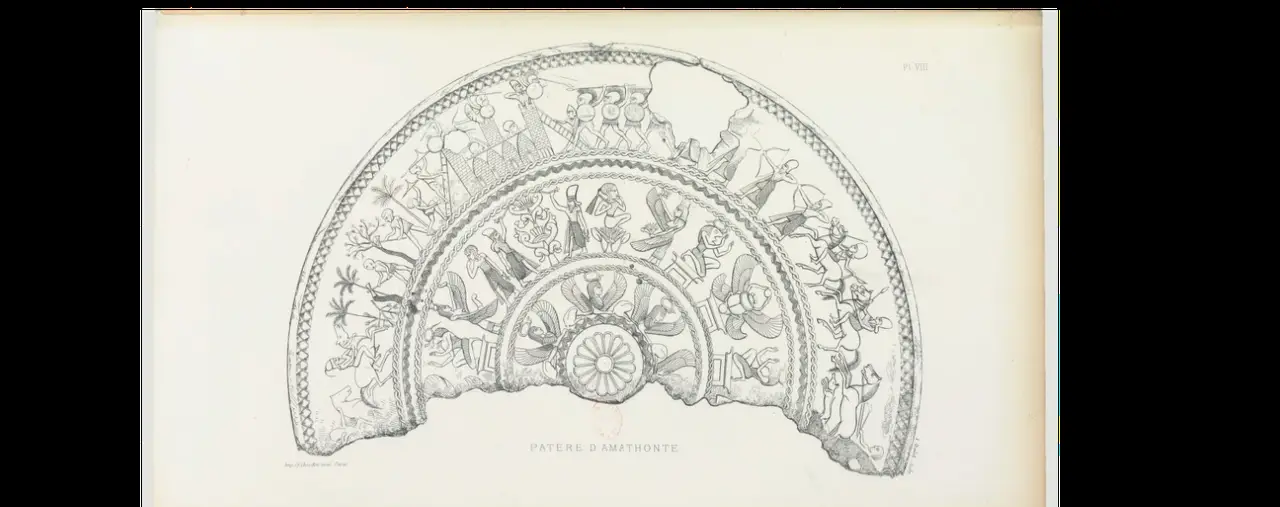 The silver-gilt Amathus bowl in a 19th-century engraving, its concentric registers of figures and plants set around a central rosette. British Museum. Public domain, via Wikimedia Commons.
The Levantine ivories from Nimrud, Phoenician and North Syrian work carried off as Assyrian booty, are saturated with Egyptian forms: lotus-and-bud chains as borders, Hathor-headed columns, a lioness mauling a man against a field of lotuses, the old pharaonic triumph scene transplanted whole. The transplanting is the point. On one ivory a goddess grasps a long-stemmed lotus and wears Hathor's horns and disc, and the natural reading is "Hathor." R. D. Barnett showed it is not: the form is Hathoric, but the figure is Ashtart of Tyre and Sidon, "a translation of Hathor into the artistic idiom" of the Phoenician cities. The flower kept its shape and changed its god. On Cyprus, in the same way, the lotus is tied to the sacred tree and to the island's own goddess, and a lotus-chain runs between the volutes of an early capital from the Aphrodite sanctuary at Idalion.
Whether the lotus carried its Egyptian meaning along with its form, or merely its form, is a genuine and unresolved argument, and Cyprus is where it is sharpest. On one side, the flower on Cyprus turns up overwhelmingly in funerary and royal settings, on tombs and sarcophagi like the Amathus royal sarcophagus in New York, which suggests it kept its charge of rebirth and kingship. On the other, the British Museum's own handbook, following Veronica Tatton-Brown, treats it like the rosette beside it as "a favourite plant motif" with "no reason to believe it had any deep significance," best read as pure decoration, a verdict that goes back to W. H. Goodyear's view of the lotus as a "stock motive." The honest synthesis is that both are true in sequence: in its Egypto-Levantine funerary use the flower held its meaning, and as it passed into Cypriot vase-painting and onward to Greece it was reworked, step by step, into a self-referential decorative system.
Assyria and Persia
In Mesopotamia the lotus is a guest, not a native. The deep local floral emblem is the rosette, the eight-petalled sign of Ishtar, attested from the Bronze Age. The lotus arrives only in the eighth century BC, an Egyptian import reaching Assyria by way of the Levant; one study traces the Assyrian lotus-and-bud garlands to "a common inspirational source in the Levant, which had acquired the motif from Egypt already in the second millennium." The king holds a lotus as a piece of royal equipment, first under Tiglath-pileser III, most lavishly under Sargon II at Khorsabad, then again under Ashurbanipal. One correction matters here, because the images are so often misdescribed: the famous winged genii of Ashurnasirpal's palace do not hold lotuses. They carry a bucket and a cone, a purification kit, and the sprig some of them hold is usually read as pomegranate. The apotropaic power belongs to the genii, not to the flower.
The set piece is Ashurbanipal's "Garden Party" relief from the North Palace at Nineveh, around 645 BC (British Museum, 124920). The king reclines on a couch with a lotus blossom and a bowl, his queen seated opposite, herself holding a lotus, under a trellised grapevine. In a nearby tree, easy to miss, hangs the severed head of Teumman, the defeated king of Elam. What the lotus means in that garden is contested in three directions: Pauline Albenda reads the scene as an image of peace and trophy-display, Paul Collins and Mehmet-Ali Ataç as vegetal fertility and regeneration, and an older line following Geo Widengren as a "plant of life," the bloom Assyrian texts speak of being held to the nostrils of the king's subjects. These are interpretive frameworks, not settled fact, and the relief is strong enough to carry all three at once.
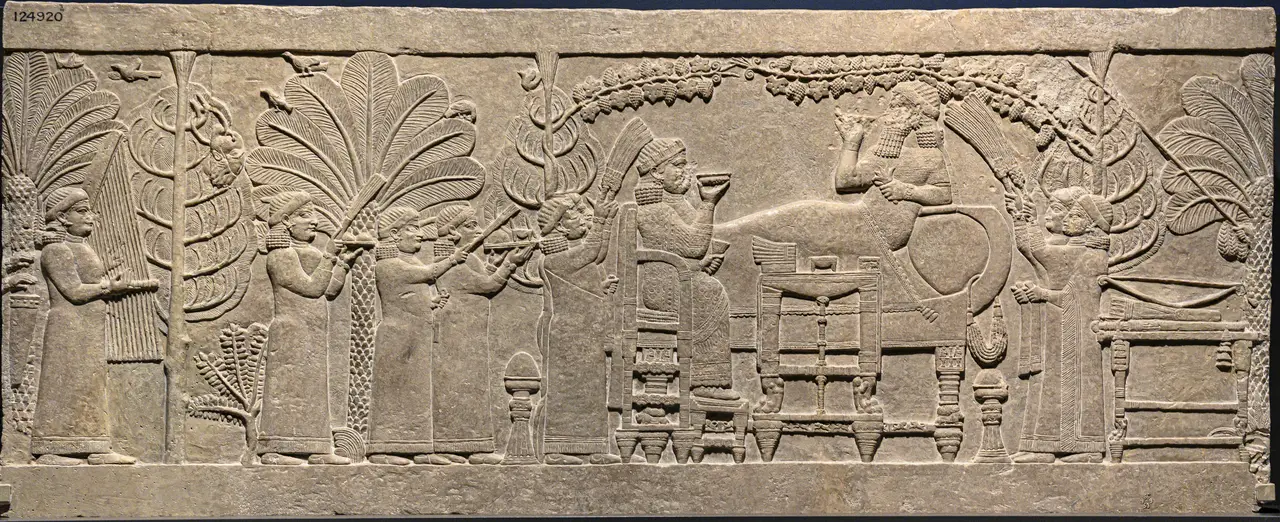 The "Garden Party" relief from the North Palace at Nineveh, about 645 BC. The severed head of the defeated Elamite king Teumman hangs in a tree to the left. British Museum. Photo: Allan Gluck, CC BY 4.0, via Wikimedia Commons.
Persia took the image from Assyria. On the great Apadana audience reliefs at Persepolis the enthroned Great King holds a sceptre and a flower, under a canopy with Ahuramazda above, a composition of openly Assyrian descent. A matching figure, "the Lady and the Lotus," a woman in Persian dress holding the flower, recurs across the empire on seals, on the Oxus treasure, and as far as the Pazyryk felt hanging in the Altai. Even here, in the very period when the Asian Nelumbo was reaching Egypt, the Persepolis flower is the old Egyptian-derived bell-flower, not the sacred lotus; and even its identity is argued, with some specialists calling it a pomegranate or a lily rather than a lotus at all.
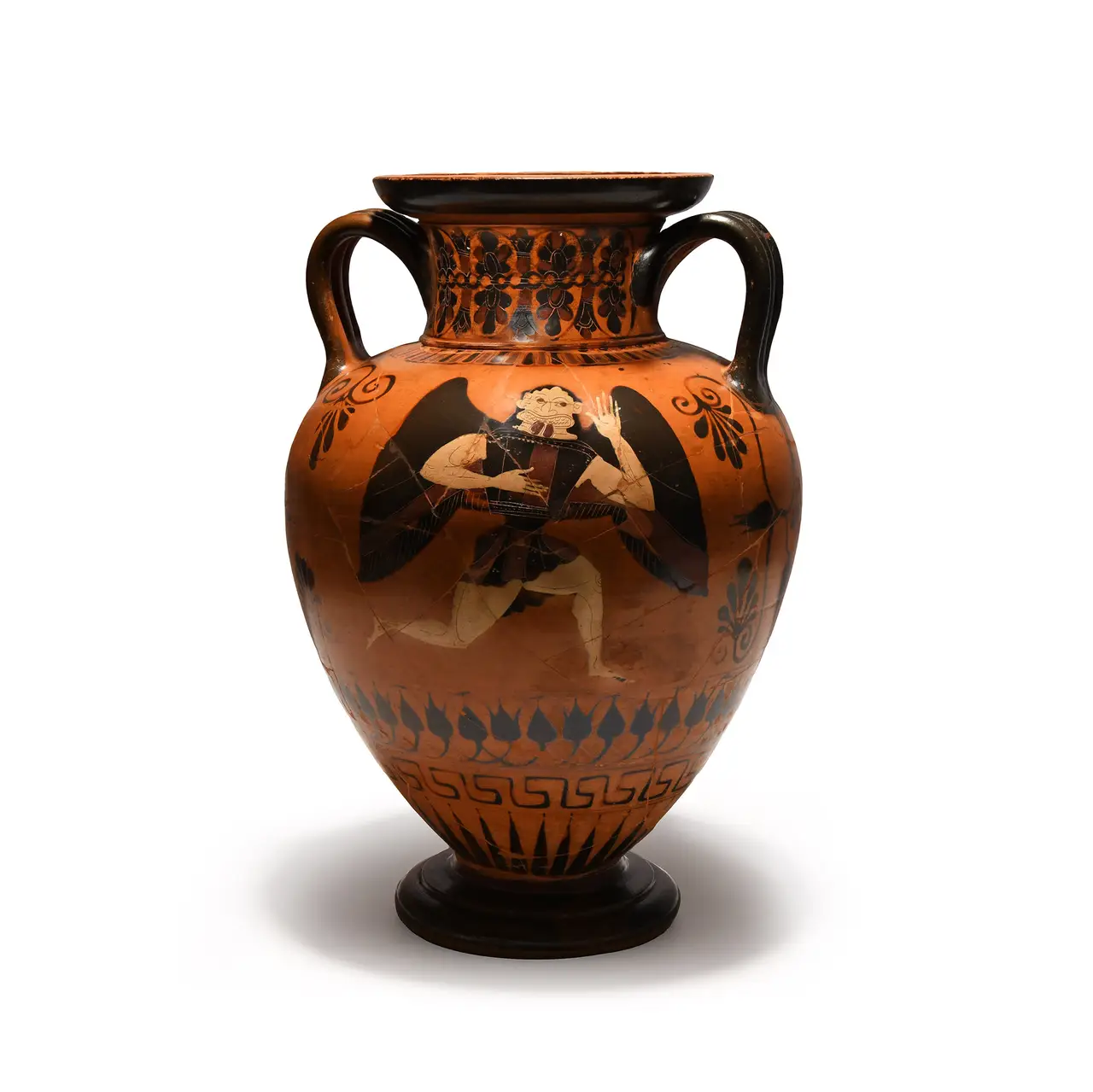
Greece: the pattern that forgot itself
In Greek hands the lotus completed its change from flower to filler, and in doing so found its largest afterlife. The Greek emblematic flowers had been the native lily, crocus and iris of Minoan Crete, not the lotus; what Greece took from the East was the lotus-and-palmette frieze, the anthemion, the running band of alternating flowers and fans that anyone who has looked at a Greek vase or temple has seen a thousand times without naming. W. H. Goodyear, in 1887 and then in his 1891 book The Grammar of the Lotus, argued that this band and far more besides descended from the Egyptian flower: the anthemion and the palmette, the Ionic capital "derived from a conventional form of lotus," egg-and-dart moulding from an Egyptian lotus border, and, at the far reach of his thesis, even geometric triangles and the spirals of Mycenae. It was a vast claim, and a generation later it was reined in by Alois Riegl, whose Stilfragen of 1893 traced the palmette as one continuous ornamental line from Egypt through Mesopotamia, Phoenicia, Persia, Greece and Rome and into Byzantine and Islamic art, but accepted only the lotus-to-palmette-to-acanthus sequence and rejected Goodyear's wilder identifications. Even the diffusionists policed one another.
The transmission can be watched at a single place. At the Greek trading post of Naukratis in the Egyptian Delta, and at the fort of Tell Defenneh, the archaic temple of Apollo preserved "an anthemion, some bits of the so-called Oriental palmette, and a few scraps of lotus pattern," after which the motif, in the words of the excavators, "speedily became the common property of both architects and vase-painters in all the schools of Hellas." The decorative band that later draughtsmen called "honeysuckle" is no such thing; it is, as one of those excavators flatly noted, "neither more nor less than a Greek variation upon the old familiar lotus and scroll."
By the time it was ubiquitous, almost nobody knew what it had been. The lotus-palmette decorates Greek temples, vases and grave markers, in one scholar's phrase, "usque ad nauseam, right down into Neoclassical architecture, to the point where nobody bothers to ask about their origin and significance." Whether even a residue of meaning survived is, again, a real argument: Karl Schefold read the Greek floral band as "the image of self-renewing life," while Danner "denies any solar or apotropaic significance" to it whatever. The fairest formulation is that the motif became overwhelmingly ornamental, while keeping a faint funerary resonance where it mattered most, on the carved palmette of a Greek grave stele.
India's other lotus
The second tradition begins on the other plant, in the other half of the world, and owes the first nothing. Its flower is the Asian sacred lotus, Nelumbo nucifera, the Sanskrit padma, pundarika, kamala, and its roots are Indian and Vedic. The whole logic of it can be heard in one line from the Śatapatha Brāhmaṇa: "the lotus means the waters." Where the Egyptian flower modelled the sun, the Indian one modelled the cosmos rising from the cosmic ocean, and purity rising from the mud.
What the Indian lotus is not matters too, because the assumptions run deep. There is no securely attested lotus cult in the Indus Valley civilisation; its dominant sacred plant is the pipal, the Ficus religiosa, and readings of Harappan terracotta women as a "proto-Lakshmi" are guesswork. The earliest firm literary anchor is the late-Vedic Śrī Sūkta, a hymn that drenches the goddess Śrī, or Lakshmi, in lotus epithets: lotus-coloured, lotus-eyed, lotus-seated, and surrounds her with elephants.
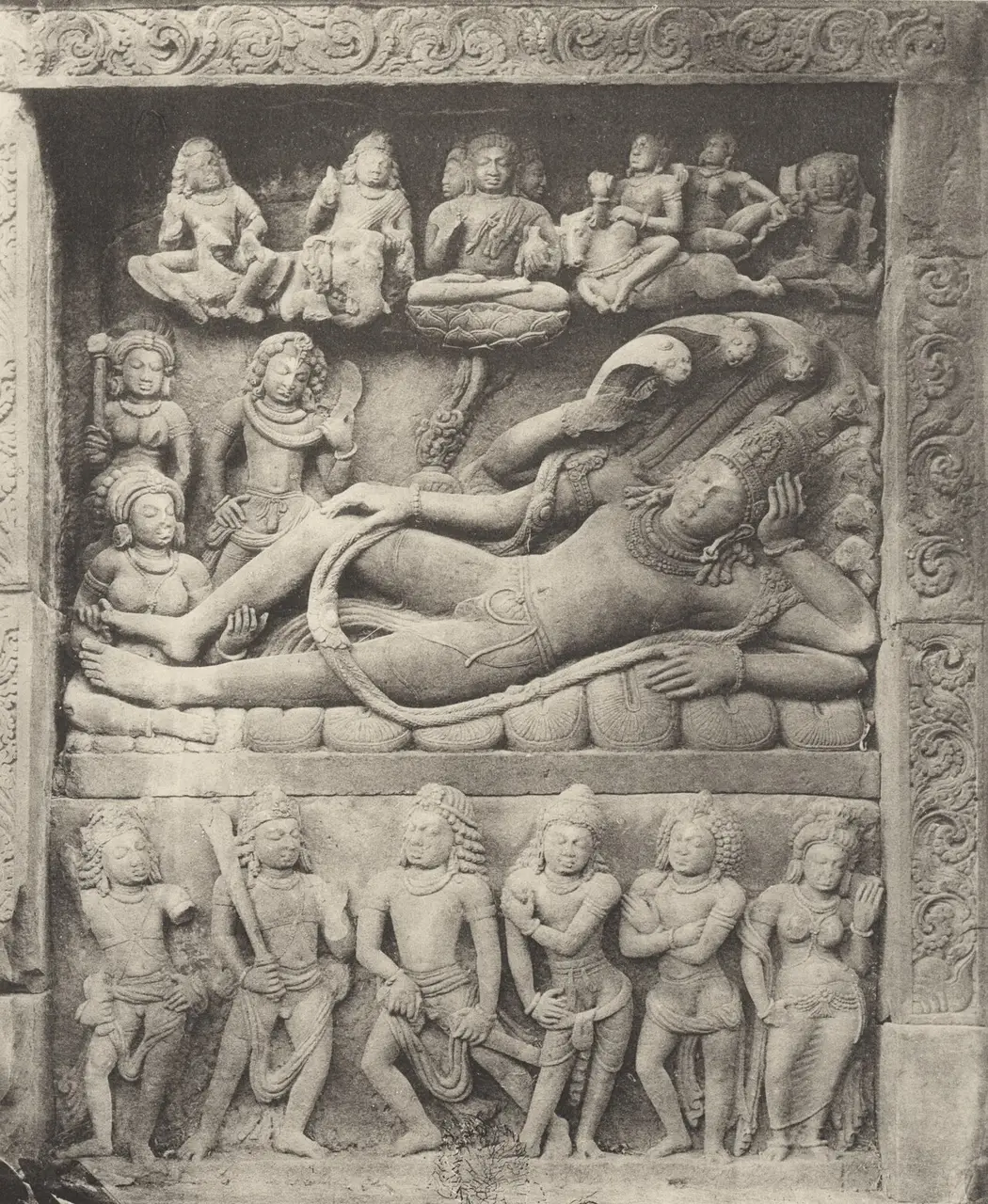 Vishnu asleep on the coils of the serpent Ananta, Brahma enthroned on the lotus above and attendant figures below: the Anantashayana panel at the Gupta-period Dashavatara temple, Deogarh, sixth century AD. Public domain, via Wikimedia Commons.
In the Hindu material the flower carries the act of creation itself. Vishnu reclines in cosmic sleep on the serpent Ananta upon the primeval ocean; a lotus grows from his navel; and seated within that lotus, Brahma begins to make the world. This is, in one historian's words, "the most ancient of Indian creation myths," and it is carved in the great Anantashayana relief at the sixth-century Gupta temple at Deogarh. The goddess of fortune is herself the lotus: Lakshmi stands or sits on the flower and holds it, and in her signature form, Gaja-Lakshmi, two elephants lustrate her from raised pots, an image Ananda Coomaraswamy read as the life-giving waters. The first-century Śrī Lakshmi from Mathura is shown, in the catalogue phrase, "thought of as emerging from" the plant. The same flower gives the seat of every later deity, the padma-pitha or lotus-pedestal, and the multi-petalled lotuses of the tantric chakras, and "lotus eyes" as the standing mark of divine beauty.
Buddhism gave the flower its most quoted meaning, the one most people now attach to the word. The lotus rises clean out of foul water, and the early verse makes it a figure of the awakened mind: "like a lotus risen up out of the water," says a poem of the Therigatha, and the saying runs that as the lotus born in the muddy swamp rises above it undefiled, so does the Perfected One stand undefiled by the world. From there the flower becomes the seat: Buddhas and bodhisattvas sit or stand on the lotus pedestal, the padmasana; Avalokiteshvara is Padmapani, "the lotus-bearer"; the mantra Om mani padme hum is glossed "the jewel in the lotus"; and the scripture that would matter most in East Asia, the Saddharma-pundarika or "White Lotus of the Good Law," the Lotus Sutra, was compiled around the first century BC or first century AD. The earliest Buddhist art is already full of it: lotus medallions and lotus-rhizome friezes cover the railings at Bharhut, in the mid-second century BC, and at Sanchi and Amaravati, and Gaja-Lakshmi herself sits on the gateways.
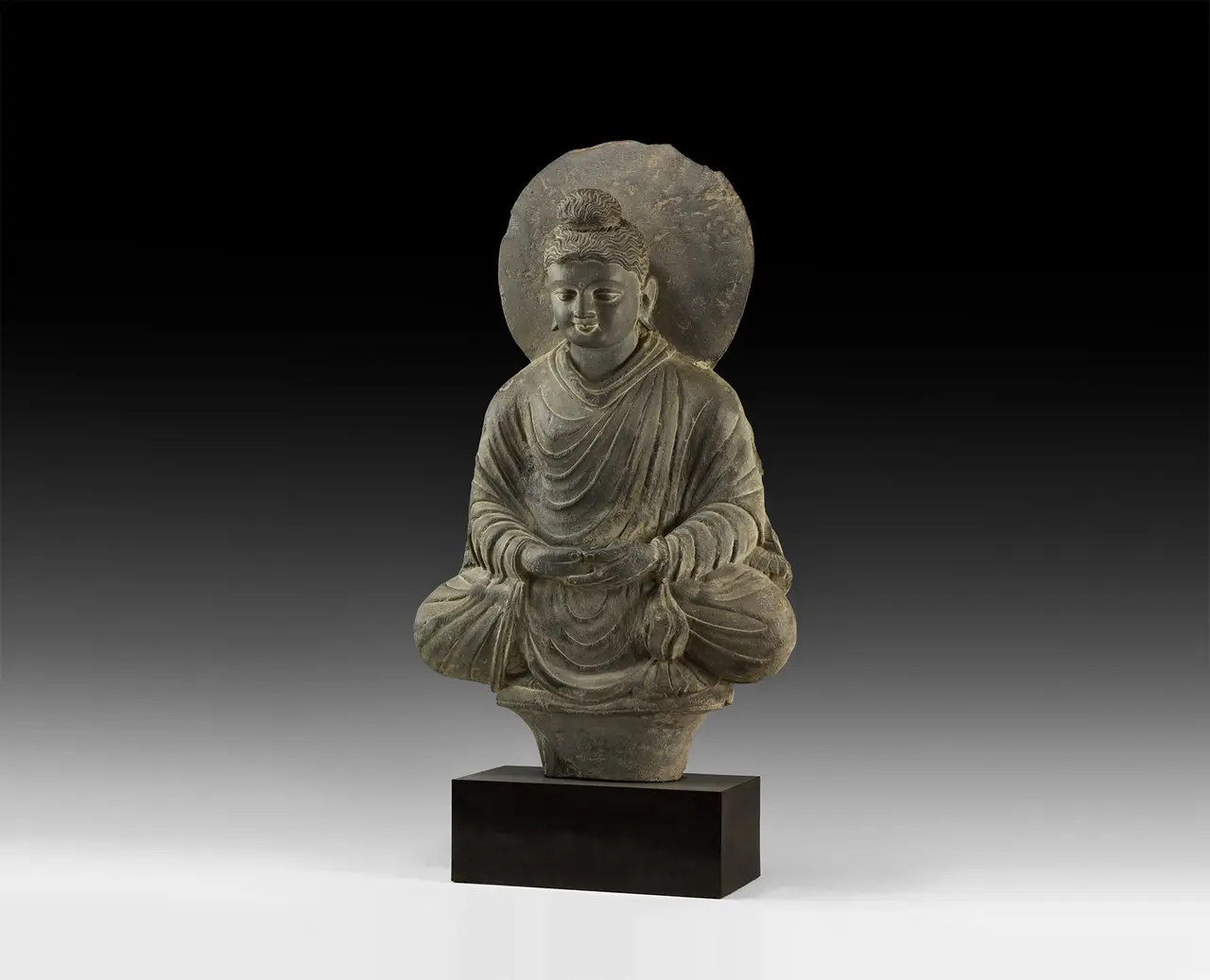
There is one place where the two streams may touch, and it has to be handled carefully, because the religious lotus and the decorative lotus behave differently. The bell-shaped capitals of the Mauryan and Ashokan pillars of the third century BC look Persian: the Sarnath capital, the Pataliputra capital "clearly Persepolitan in character," carry what many read as the influence of Achaemenid and Hellenistic court art. Coomaraswamy disagreed, holding the bell-capital "too much unlike the Persepolitan form to be a direct loan" and readily explained from Indian sources, the whole bell being a padma-pitha, the lotus that "means the waters"; he even floated the reverse, that some lotus ornament travelled from India toward Alexandria. The argument is unresolved. What is clear is the division it points to: the deep religious lotus of India, the cosmogony and the goddess and the purity simile, is an independent Indian growth, while the courtly ornament of the Mauryan capitals drew on the same Achaemenid and Greek decorative repertoire that the western stream had been passing along. The pattern may have reached India. The meaning was already there.
East with the Buddha
From India the lotus travelled east, and it travelled as religion. The lotus pedestal arrives in China beneath the earliest Chinese Buddhas of the third century AD, and is monumentalised in the cave temples of the fifth and sixth: Yungang, begun in 460, then Longmen, and the Mogao caves at Dunhuang, founded in 366, where the great Buddhas sit "on waisted lotus pedestals before enormous flaming mandorlas." With the image came the doctrine of lotus-birth. The Pure Land of Amitabha, the Western Paradise, is reached by being reborn on a lotus: the Visualization Sutra describes nine grades of rebirth, the moment of arrival being when the soul awakens atop a lotus as its petals open, and even sinners are granted rebirth "inside a lotus yet to bloom in the middle of its lake." That paradise was built in three dimensions in the Phoenix Hall of the Byodo-in at Uji, in 1053, conceived as a working imitation of the Pure Land and its lotus pond.
China already had lotuses of its own, and they merged with the import rather than yielding to it. A pre-Buddhist lotus motif decorated Han tomb ceilings, traced back to palace architecture, where its likely sense was as a lucky sign or a charm against fire, through the flower's link with water; it blended later with the Buddhist flower overhead. In folk usage the lotus became a pun: lian for the flower sounds like lian, "to join" or "continuous," and like words for abundance, so a lotus with a fish stood for "surplus year after year," and a lotus on a porcelain wedding gift meant "to unite." And for the educated, the lotus became the emblem of incorruptible character, fixed for good in Zhou Dunyi's eleventh-century essay "On the Love of the Lotus," which praised the flower that "rises from the mud unstained" as the bloom of the junzi, the gentleman who keeps his integrity in filthy company. The same image of purity-from-mud thus served two masters at once, read as enlightenment by the Buddhist and as moral cleanliness by the Confucian, the Buddhist reading attested earlier in China.
The flower fixed itself into the building materials of Korea and Japan. Korean roof-tiles carry lotus rosettes whose petals multiply with the centuries, four under early Koguryo, six then eight in Paekche, sixteen or thirty-two in Silla. And the Lotus Sutra, the scripture named for the flower, became the central text of Japanese Buddhism, the foundation of Saicho's Tendai school and the heart of Nichiren practice, where devotion centres on chanting the sutra's very title. None of this ended. Literati lotus painting runs unbroken into the twentieth century, to Wu Changshuo and Qi Baishi, and the Lotus Sutra remains the living scripture of millions.
Same symbol, no contact
Set the two traditions side by side and the coincidence is almost too neat. Egypt makes the lotus the sun, rebirth, creation from the primeval water, the seat of a god. India makes the lotus purity, fertility, creation from the cosmic ocean, the seat of a god. Both even tell a creation myth in which a deity emerges on a lotus out of the first waters. Faced with that, the natural conclusion is that one borrowed from the other, that a single great idea spread from one source across the ancient world. The natural conclusion is wrong, and the reason is the one we started with: the plants.
The Egyptian and Indian lotuses are different families, native to ranges that never met, and the Asian sacred lotus did not reach Egypt until around 525 BC, by which time Egyptian lotus theology was already two thousand years old. The very plant that carries the Indian symbolism arrives in Egypt only as a late import, long after the Egyptian flower had done its work on a separate species. Whatever the resemblance between the two traditions is, it cannot be one plant's symbolism handed from Egypt to India.
The resemblance has a simpler cause: the plant suggests the meanings to anyone who watches it, wherever it grows. A flower that opens with the sun proposes the sun and rebirth. A flower that rises clean out of mud proposes purity. A seed-pod packed with seeds, up to ten thousand by one count, proposes fertility and abundance. A flower that emerges from water proposes creation from water. Because each of these readings follows directly from something the plant does, two cultures can arrive at the same symbol without ever exchanging a word. The anti-borrowing instinct is an old one: surveying Egyptian columns in 1880, Waldo Pratt called their lotus form "a free and altogether creditable invention of early Egyptian fancy" rather than a borrowing from anywhere, and anthropology in time learned to distrust matching traits across continents. The cautionary tale is the hyperdiffusionism of Grafton Elliot Smith and W. J. Perry in the 1920s, the "Children of the Sun," who derived sun-worship and most of human civilisation from a single Egyptian source, and were dismantled by Roland Dixon, Glyn Daniel and V. Gordon Childe.
This gives a clean test, and the lotus passes it twice, in opposite directions. Shared meaning plus a shared specific form plus a route and a date equals real transmission. Shared meaning with independent forms equals convergence from the plant's own behaviour. The ornament passes the first test: you can trace the precise shape of the lotus-palmette from Egypt to Cyprus to Assyria to Greece, and you can date the plant itself moving to Egypt around 525 BC. The parallel theologies of purity and rebirth pass only the second: the meanings match, the plants and the forms do not, and there is no route. The two streams genuinely meet at exactly one point, when the Achaemenid and Hellenistic lotus-palmette was grafted onto the Mauryan court. They meet as decoration. The meanings never met at all.
When the lotus ended, and where it did not
Ask when lotus symbolism ended and the honest answer is that it depends entirely on which lotus you mean.
In the Mediterranean and the Near East the religious flower faded with the religion. As Christianity displaced the old cults between roughly the fourth and seventh centuries AD, the temple institutions and priestly workshops that carried the solar and funerary mythology were dismantled, and the pagan lotus lost its charge with them. The Egyptian solar flower goes quiet in the Coptic period as the temples close. What survived was the shape, drained of sense. The lotus-palmette had long since blended with the acanthus; now it carried on, secularised, into Byzantine and Coptic vine-scrolls, a "lotus border" still running along fifth- to seventh-century church and synagogue mosaics in Palestine, and on into the Islamic arabesque, whose plant ornament grew out of the same Coptic, Byzantine and Persian stock. The form had become so detached from its origin that it could be deliberately rediscovered: after Napoleon's expedition of 1798 and the publication of the Description de l'Égypte, Western designers consciously revived the Egyptian lotus capital, and the nineteenth-century Egyptian Revival put it back into circulation as a style.
In India and East Asia the lotus never ended, because the religions that carried it never ended. It is still the pedestal of the gods, the diagram of the chakras, the pond of the Pure Land, the white lotus of the sutra; it is the national flower of independent India. The contrast is exact. In the West the symbol died and the decoration lived on, meaning forgotten; in the East the symbol is still alive and still means what it meant.
Which leaves the Egyptian flower in a strange position at the end of its long western career. The lotus capitals on the great Mosque of Muhammad Ali above Cairo, raised in the 1830s, are lotus capitals; and they reached Egypt from Europe, as a fashion, with no surviving Egyptian memory of the flower behind them, more than two thousand years after Egyptian masons first cut the form and long after anyone setting one in place could have told you what the flower at the nose of Re had meant.
Objects carrying the lotus reach the market regularly: Egyptian faience, Greek black-figure, Gandharan schist. Our ancient art and antiquities sales are a good place to see the same motif moving between cultures in pieces you can hold.
TimeLine Auctions, 2nd July 2026