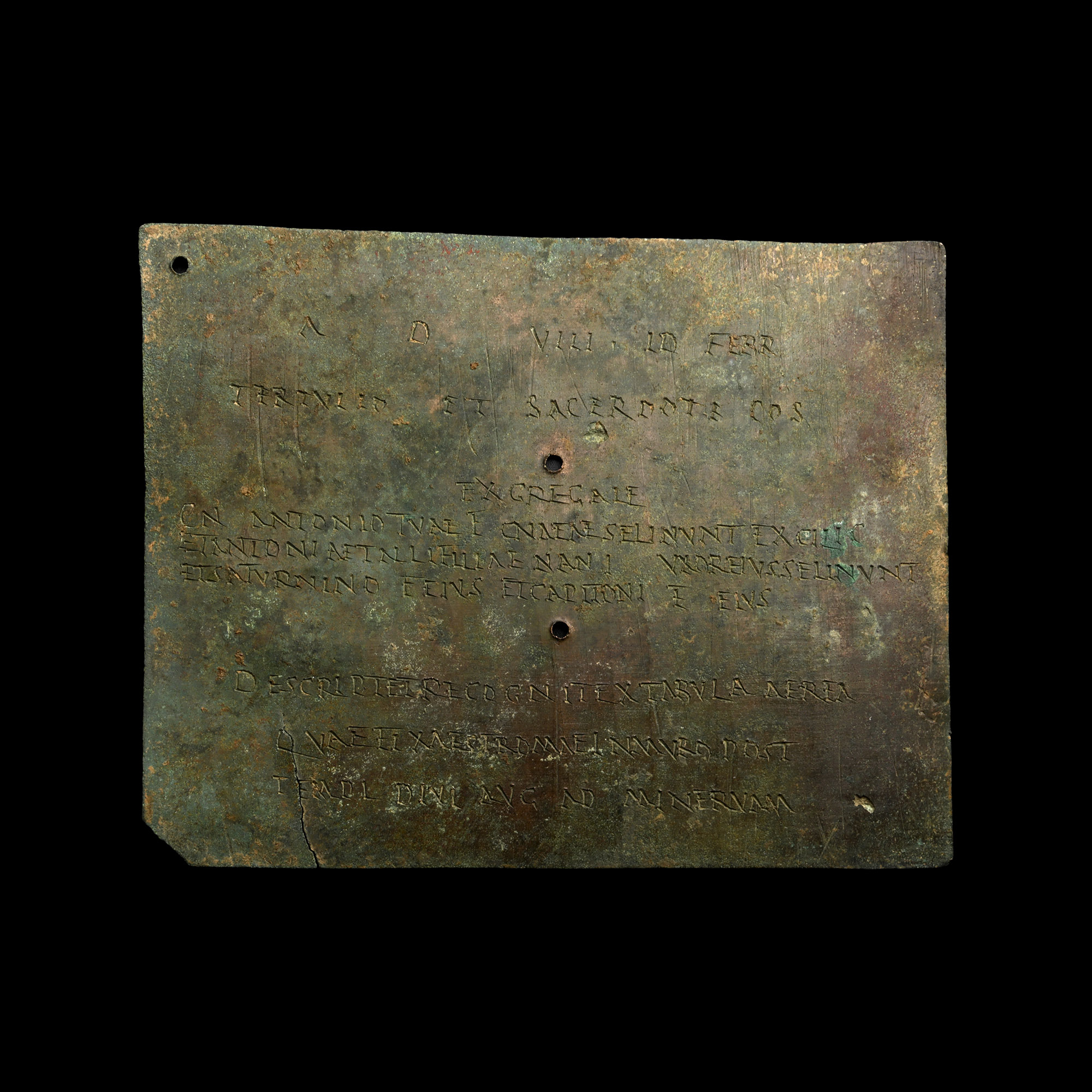
On 6 February AD 158 a sailor named Gnaeus Antonius Gnaea left the Roman fleet after twenty-six years, and the bronze tablet made for him that day is still clear enough to follow line by line. The date comes first, spaced wide across the top, with the names of the year's two consuls, Tertullus and Sacerdos. The engraver then had to fit a family into three crowded lines that run hard against the right-hand edge: Antonius himself, son of Tua, of Selinus in Cilicia; his wife Antonia Nanis, daughter of Tallus, also of Selinus; and their sons Saturninus and Capito. The last three lines are the clause that closes every Roman military diploma of the period: descriptum et recognitum ex tabula aerea quae fixa est Romae in muro post templum divi Augusti ad Minervam, "copied and checked from the bronze tablet that is fixed at Rome on the wall behind the temple of the deified Augustus, at the Minerva."
A diploma was a veteran's own copy of the emperor's grant of Roman citizenship, engraved on two bronze leaves that were wired and sealed together, and that closing clause is a street address for the original. The original was a bronze tablet on a wall at the edge of the Forum, listing every man the grant covered. That wall, and the Capitol before it, held more than five thousand such tablets over two centuries, and not one piece of them has ever been found in Rome. The copy made for Antonius survived, divided between two owners: the first of its two leaves is in the National Museum of Scotland in Edinburgh, and the second, seen here from the inside, is in the December sale.
A sailor from Selinus
Selinus, now Gazipaşa, is a small harbour on the rough western coast of Cilicia in southern Turkey. It entered the histories once, in 117, when Trajan, sailing home ill from his war in the East, put in there and died. The coast had once been notorious for piracy, and by Antonius's day its men went to sea for Rome in numbers: of the forty sailors from Asia Minor in the two Italian fleets whose home province is recorded, eighteen were Cilicians, nearly all of them from this western end of the province.
Antonius served in the senior of the two fleets, the praetorian fleet at Misenum on the Bay of Naples, for the full term of twenty-six years. Counting back from February 158, he enlisted around 131 or 132, under Hadrian, and he never rose from the ranks, since the tablet calls him ex gregale, a former ranker. Ships from Misenum did most of the navy's patrolling in the eastern Mediterranean, within easy reach of the Cilician shore, so a Cilician sailor could probably get home on leave in winter, when the sea was closed to shipping. Of the four Cilician sailors whose wives are recorded, three married women from home, and Antonia Nanis was from Selinus like her husband.
The two fathers on the tablet, Tua and Tallus, have the single names of men who were not Roman citizens, and Nanis is an old Anatolian name. Husband and wife both carry the Roman family name Antonius, which neither can have had from a father, and they gave their boys Latin names, Saturninus and Capito. The first leaf, in Edinburgh, names the fleet's commander that year, Tuticanius Capito. One of the boys shares his name, and the bronze cannot say whether that was a sailor's compliment to his admiral or the chance of a common Latin surname. A line from Lucan's list of the eastern peoples who fought for Pompey would have suited the father: "and the Cilician sails in a lawful ship, no longer a pirate."
What a Roman military diploma gave a sailor's family
Antonius left the fleet a Roman citizen, and the grant named his wife and both sons beside him, so the tablet records a Roman marriage as well as a discharge. By 158 the sons' place on it was something soldiers on land had lost. In 140 Antoninus Pius changed the terms for the auxiliaries, the provincial regiments recruited from non-citizens, so that the soldier still received citizenship and the children already born to him no longer did. The Metropolitan Museum in New York has a complete diploma of about 149, made out to Dasmenus son of Festus, an infantryman serving in Pannonia on the Danube, and it carries the new wording. The change never reached the fleets, whose diplomas went on naming sons into the third century, which is how two boys with Latin names come to be on Antonius's bronze as new Roman citizens.
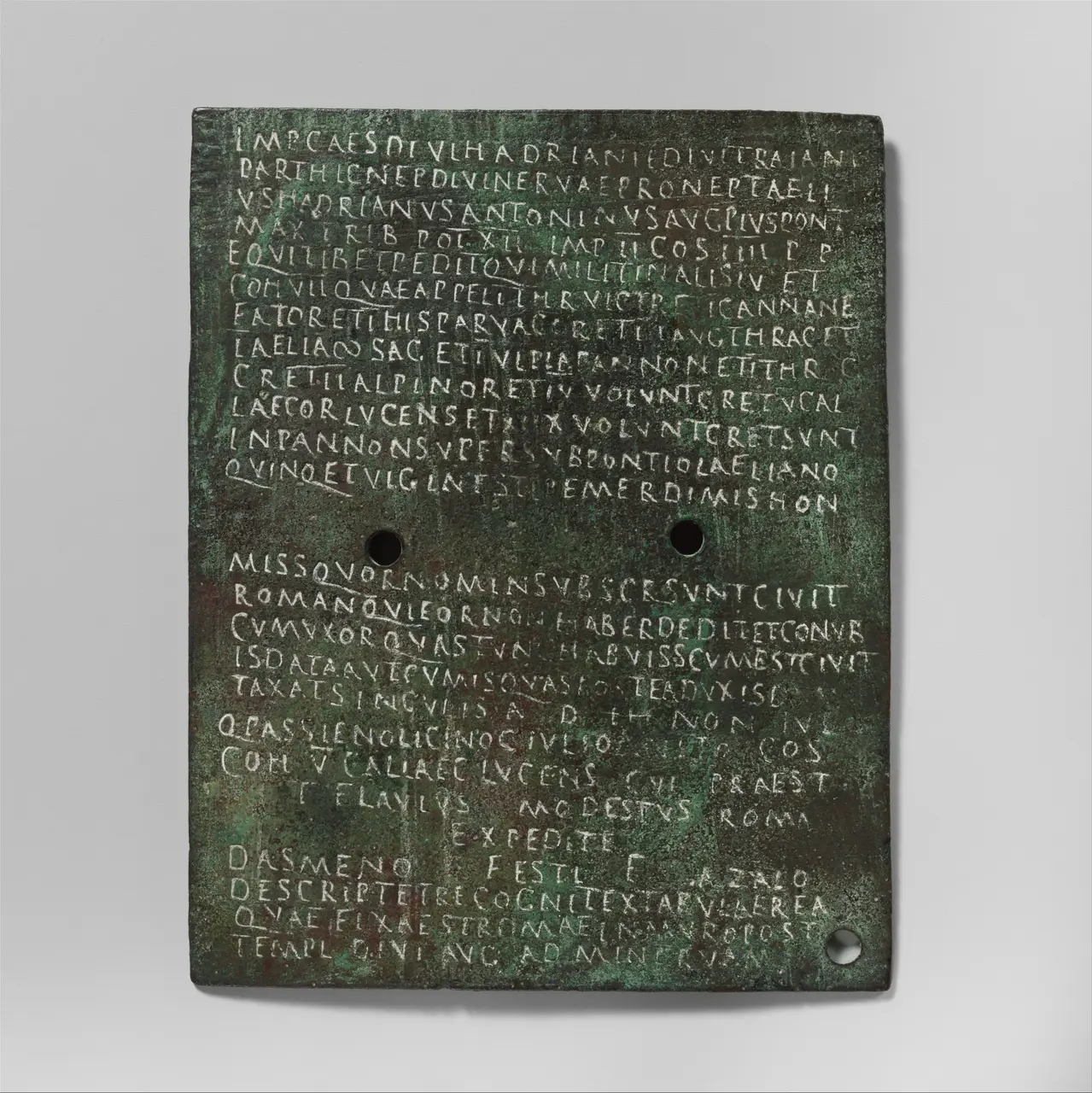 The outer face of the first tablet of Dasmenus's diploma, about AD 149, with the whole grant and, in its last three lines, the same address on the wall in Rome. Metropolitan Museum of Art, Rogers Fund, 1923, public domain.
How a Roman military diploma was made
Antonius's name was on the master tablet with everyone else's, but a bronze copy was made only for a veteran who asked for one, and most specialists think he paid for it himself. Every copy was engraved in Rome, sometimes on second-hand metal. Some second-century diplomas were cut from the inscription plates of old honorary statues, with the new text engraved over the old on the inside, where nothing showed once the leaves were shut.
The form was borrowed from the sealed wooden tablets Romans used for legal documents. The authentic text went on the two inner faces, and the outer face of the first leaf repeated all of it for everyday use. The leaves were closed face to face and bound with wire passed through two holes. Seven witnesses then sealed the wire on the outside of the second leaf, with their names cut beside the seals, and a bronze cover called the capsula protected the wax. Anyone who doubted the outer text could break the seals and compare it with the inner one.
Lot 141 is the complete second leaf, its inner face cut in a quick, slanting hand and the witness names on the outside in steadier capitals. The wire and the wax have gone, but traces of the capsula remain in the channel down the middle of the outer face, and three more fragments of it come with the tablet. So do the well-preserved bronze strips that closed the gap between the rims of the two leaves, which are unique.
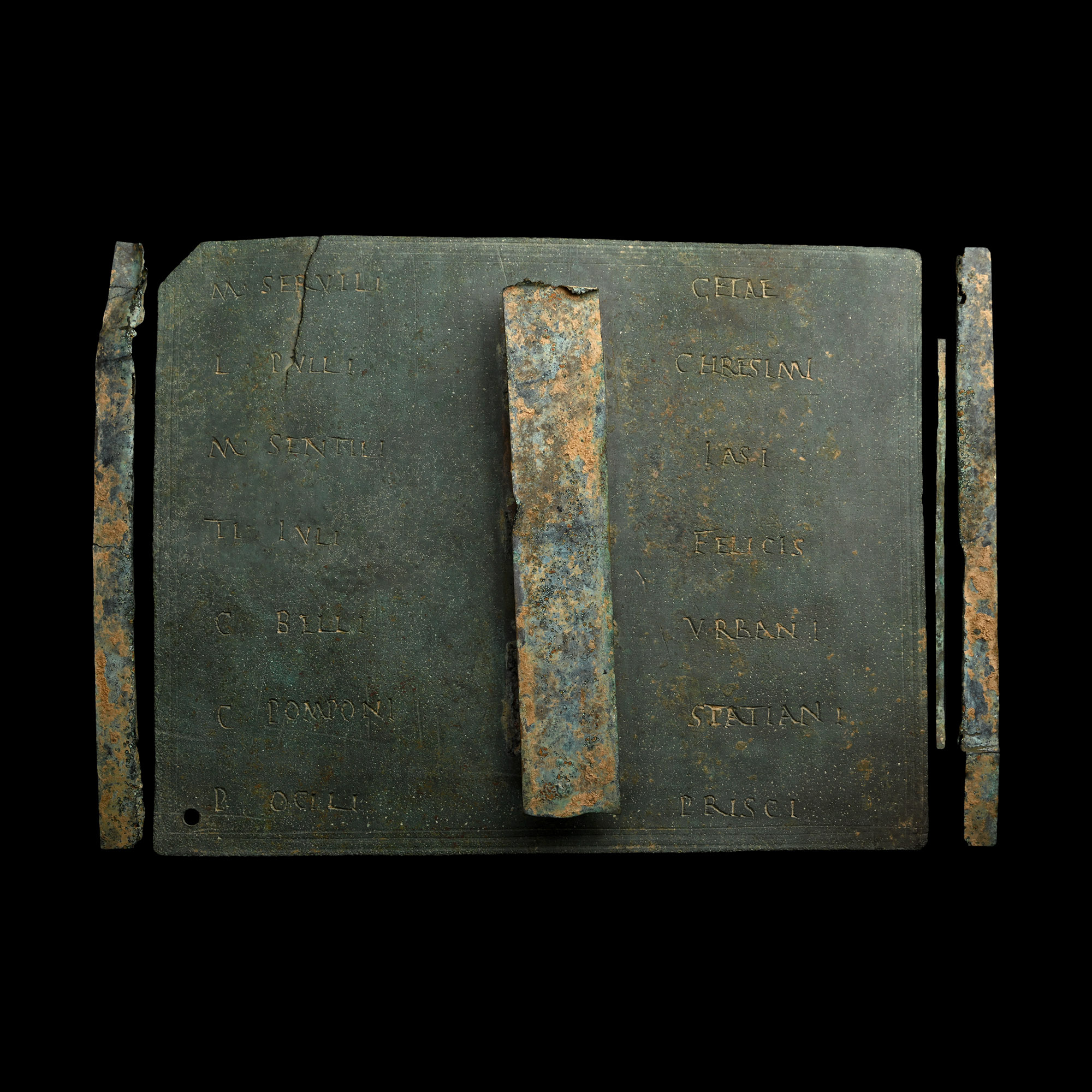
Seven names run down the outer face on either side of the seal channel, from Marcus Servilius Geta at the top to Publius Ocilius Priscus at the bottom. By the second century the sealing was done in Rome by sworn witnesses from a standing pool, and the same men turn up on tablet after tablet. Five of Antonius's seven had sealed the Met's diploma nine years earlier, on the papers of an infantryman in Pannonia, and four of them sealed another Misenum fleet diploma in 160.
The wall behind the temple
Until about 90 the master tablets hung on the Capitol. Domitian's rebuilding there moved them, and every later diploma gives the new address at the temple of the deified Augustus. The temple stood on the level ground between the Capitol and the Palatine, where it has never been excavated. Domitian rebuilt it after a fire and dedicated it in 89 or 90, with a shrine of Minerva close by, the "ad Minervam" of the address.
"You often see him, Cosmus, in the recess of our Pallas and by the threshold of the New Temple," the poet Martial wrote at the end of the 80s, of "an old man with staff and wallet", a beggar got up as a Cynic philosopher: "He is no Cynic, Cosmus. What then? A dog." Pallas is Minerva and the New Temple is Augustus's, the same two buildings the diplomas name.
Antoninus Pius restored the temple again, and coins dated to 158 and 159 show it with eight columns and the legend TEMPLVM DIV AVG REST, "the temple of the deified Augustus, restored". Antonius's copy was checked against a wall at the back of a building the emperor was advertising on his coinage that year.
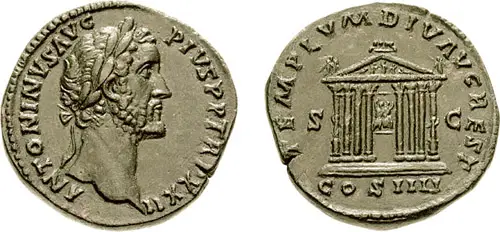 A sestertius of Antoninus Pius struck in 158 or 159, with the eight-columned temple of the deified Augustus, the statues of Augustus and Livia seated inside, and the legend TEMPLVM DIV AVG REST. Photo: Classical Numismatic Group, CC BY-SA 3.0, via Wikimedia Commons.
A public bronze in Rome stood within reach of anyone who wanted the metal. "Bronze can outlast time just as easily as stone," the epigraphist Werner Eck writes, "if people permit it to do so." Buried bronze survives where iron rusts away, and a diploma was private, kept out of sight, and melted down only once its owner stopped valuing it. Even so, Eck puts the share of diplomas that survive at between 0.3 and about 1 per cent. The December sale has five, from lot 141 down to a scrap 28 millimetres across, lot 1311, whose letters still give the address: [R]OMAE IN ... [AV]G AD M[INERVAM].
A diploma fragment from Domitian's last year
Lot 139 is a fragment 48 millimetres across with five lines of well-engraved letters, and the third line is enough to date it: IMP XXII COS XVII gives Domitian his seventeenth consulship, which he took up on 1 January 95. He was murdered on 18 September 96 without holding an eighteenth, so the grant falls in the twenty months between, a few years after the rebuilt temple and its wall were dedicated.
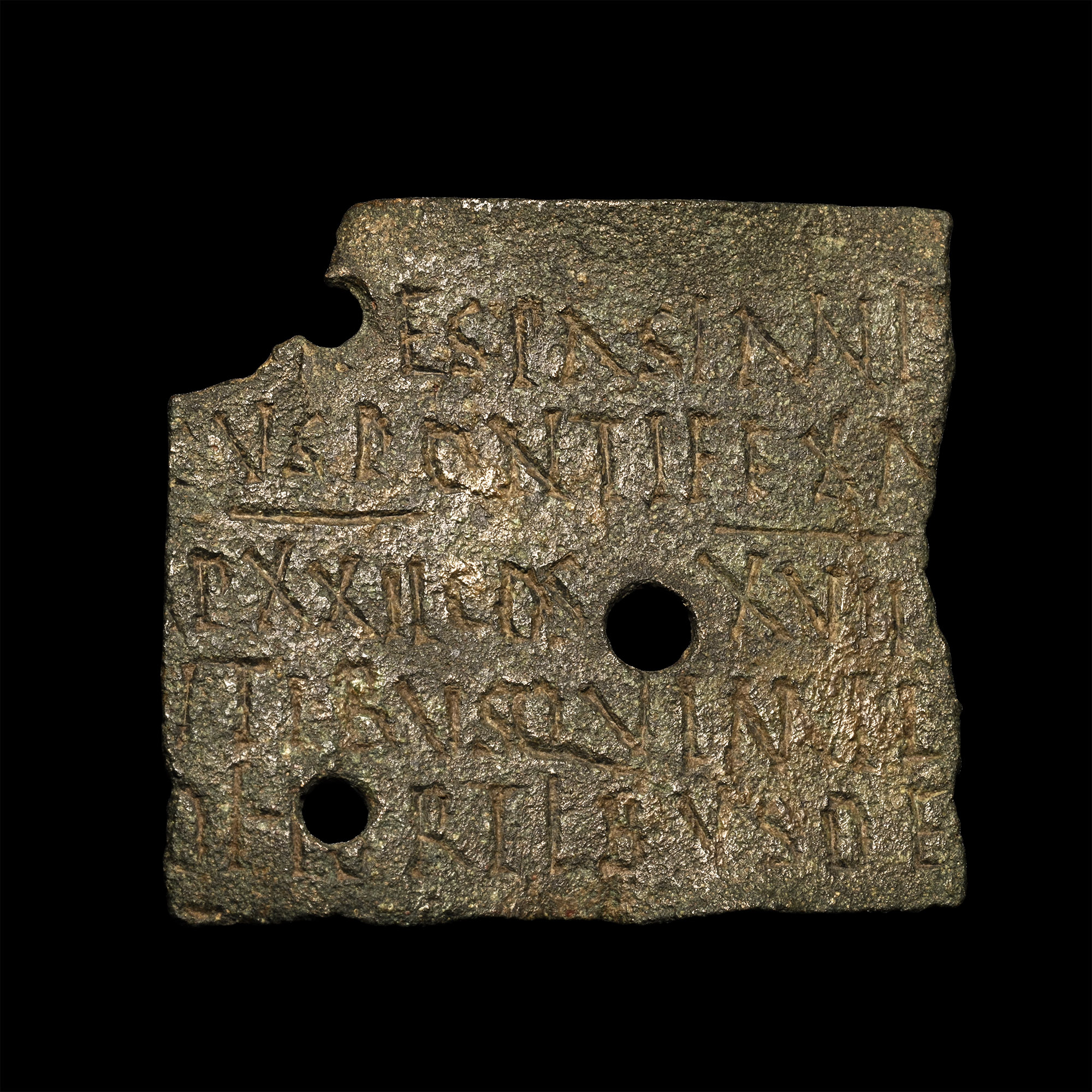
The diploma was issued to a soldier of a cohort, an auxiliary unit probably of Moesia superior, on the middle Danube in modern Serbia, and its last line speaks of ten cohorts. A complete diploma for that province, dated 12 July 96 and now in the National Museum in Belgrade, lists one cavalry regiment and ten cohorts, and the fragment could well be another copy of the same grant.
Of its three holes, one is original, a binding hole with the letters spaced round it, and the other two were made when the bronze was later reused. Ten weeks after the Belgrade grant Domitian was dead, and the Senate, Suetonius says, decreed "that his inscriptions everywhere should be erased and all memory of him abolished."
A captured emperor and a dedication to Artemis
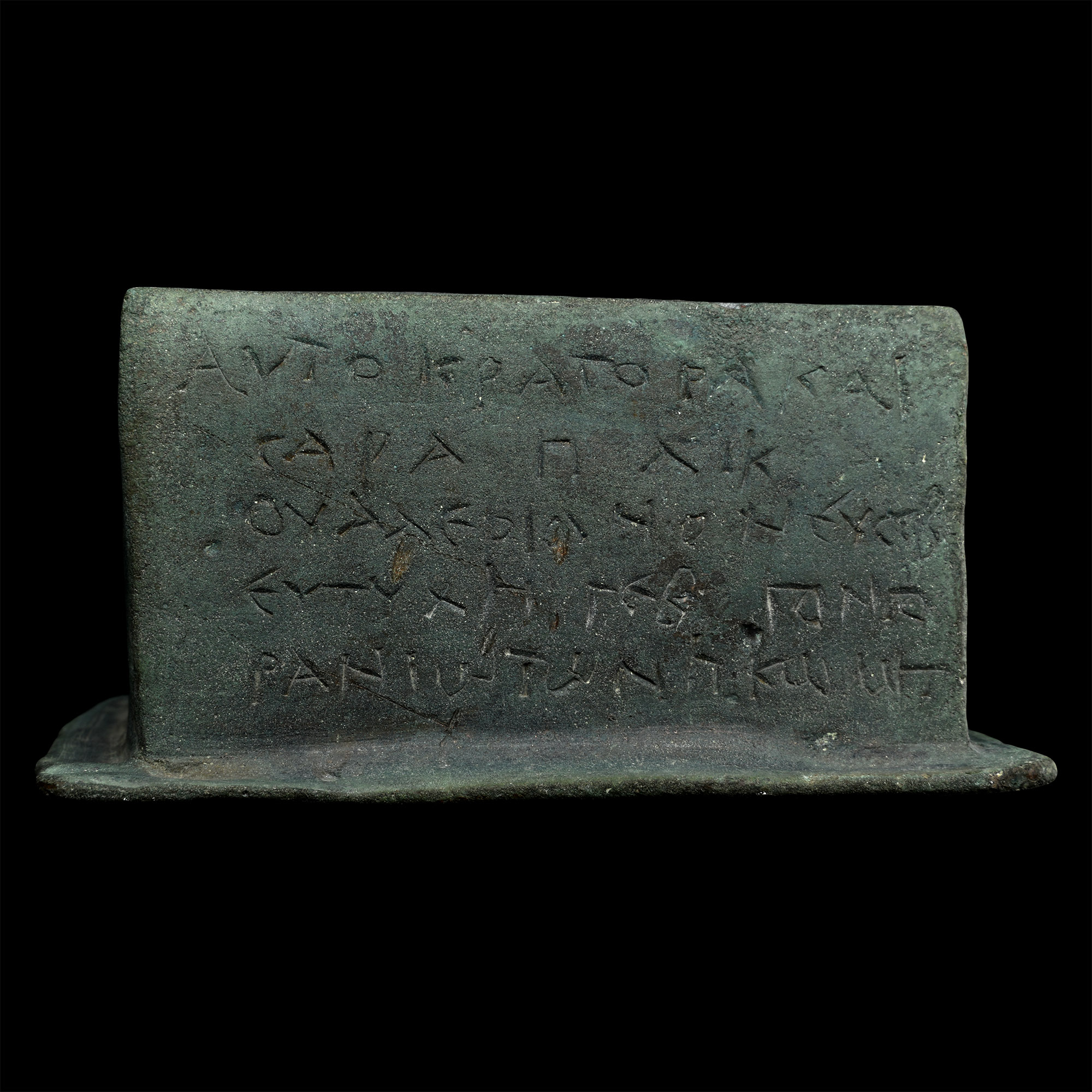
In 260 the Persian king Shapur I captured the emperor Valerian near Edessa and had the victory carved on the cliff at Naqsh-e Rustam, and Valerian died a prisoner. Rome did not condemn him for it, and nothing suggests that his son Gallienus ever had his father's name chiselled off inscriptions, so it stayed where it stood, on bases like lot 138.
The hollow bronze plinth is 12.8 centimetres high and weighs just over a kilogram, with five lines of Greek cut hastily into one side: "To the Imperator Caesar P(ublius) Licinius Valerianus, pious and good-fortuned Augustus ... the village of the Raniotes." The emperor's name is in the accusative, the form a Greek base used for the person whose statue stood on it, and the marks left by the standing statuette are still visible on top. Cities of the Greek East honoured Valerian's family on full-size marble bases, and this is a village's version in bronze, the base of a statuette used by devotees of the imperial cult and an important document of Valerian's time.
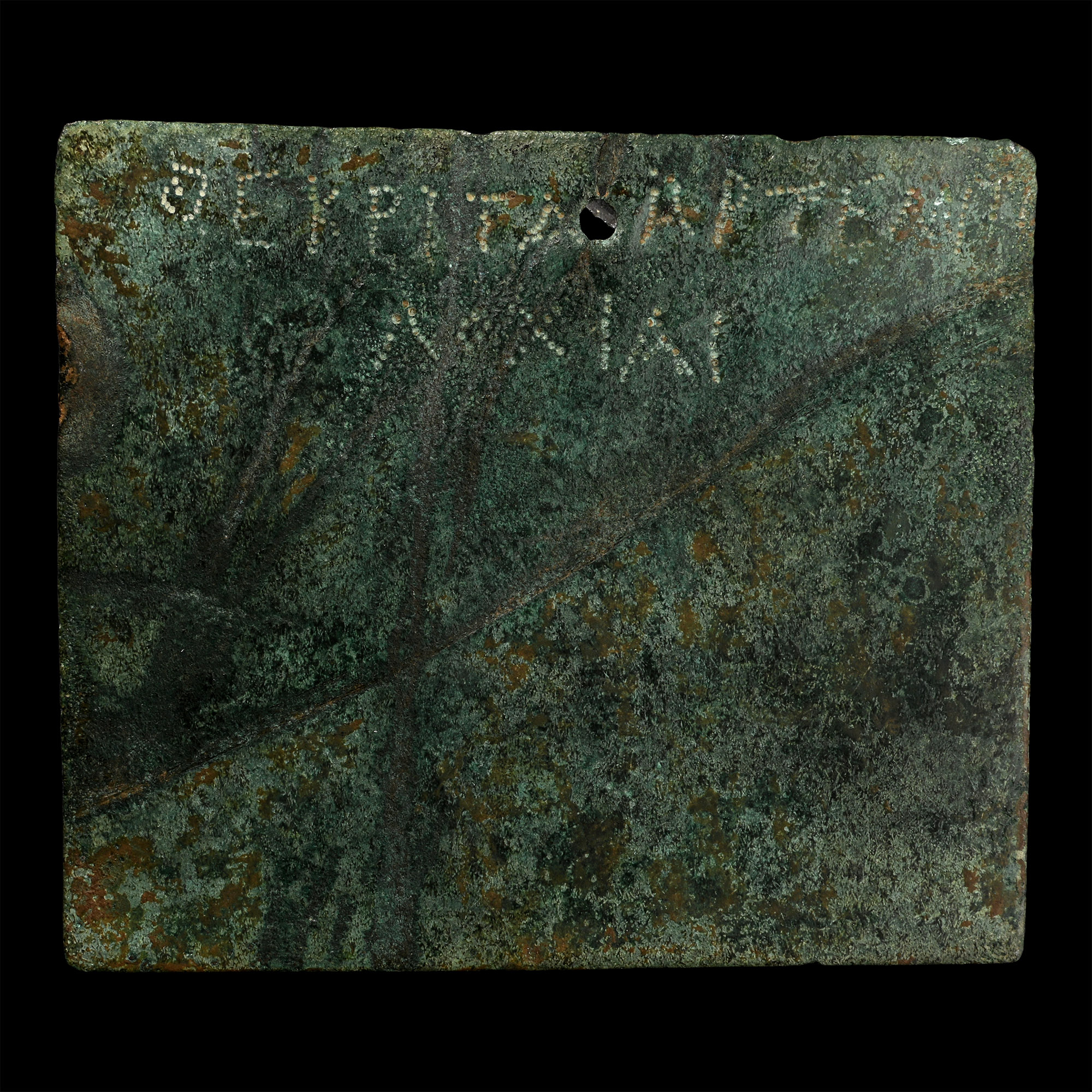
Thekrita's plaque is some six centuries older than the plinth, and every letter on it is a line of punched dots, the theta a dotted circle with a dot at its centre: ΘΕΚΡΙΤΑ ΑΡΤΕΜΙ… ΛΟΧΙΑΙ, "Thekrita, to Artemis Lochia", with the verb left out as short Greek dedications usually leave it. Lochia means "of childbirth", and this is Artemis as protector of pregnant women and women in labour. The plaque was pierced at the top for hanging, and a ledge on the back shows it was once soldered onto something.
In an epigram in the Greek Anthology a woman called Themistodice gives Artemis her gown because the goddess, "coming in gentle guise without thy bow", held her two hands over her in her labour, and the poem ends by asking Artemis to see "this baby boy of Leon's grow great and strong".
Thekrita's dedication hung where anyone who came to the goddess could read it, while nobody was meant to see the inner face of Antonius's second leaf. Once the wire was through and the seven seals were on it, it stayed shut unless someone challenged his right to the grant, and nothing records that anyone did. The wire has gone and the seals with it, the first leaf is in Edinburgh, and the face that was meant to stay closed is the one in the first photograph.