Home > Stories by TimeLine Auctions
Stories by TimeLine Auctions
The Sultan's Signature: How Mahmud II's Tughra Ended Up on Three Metres of Green Silk
In the lower field of a lime-green silk hanging almost three metres wide, framed by embroidered swags and a bow in the rococo taste, sits a monogram worked in gold thread: three tall uprights, two nested loops sweeping off to the left, a long tail. It is the tughra of Mahmud II, sultan of the Ottoman Empire from 1808 to 1839, and once you know how, you can read it: Mahmud Khan, son of Abdülhamid, ever victorious.
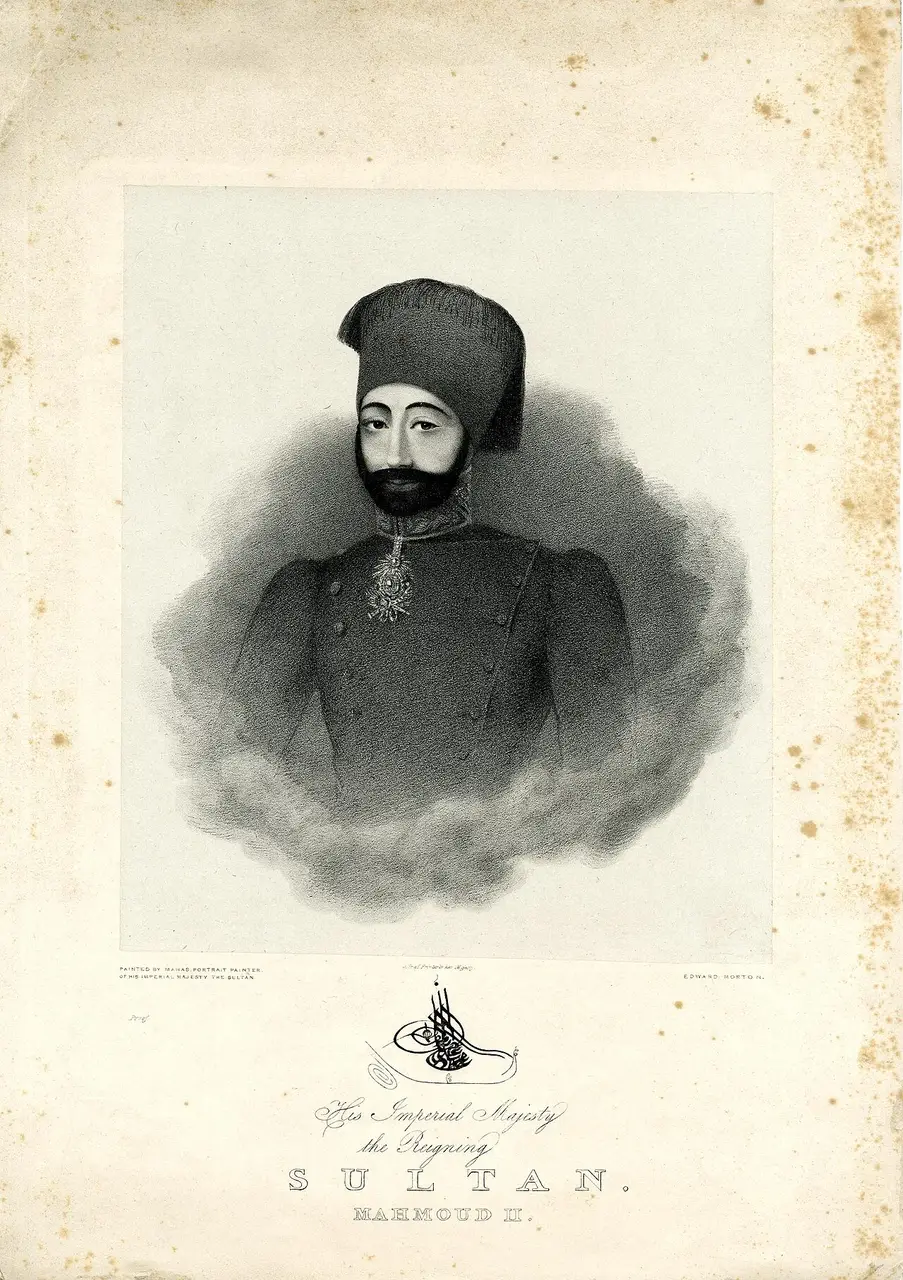 Sultan Mahmud II, his tughra printed beneath the portrait. Lithograph by Edward Morton after Manas, the sultan's court painter. Public domain, via Wikimedia Commons.
What a tughra did
The tughra was the sultan's signature in the fullest sense: a calligraphic cipher of his names and titles that validated whatever carried it. It stood at the head of decrees and land grants, on coins, public monuments and ships of war; late in the empire's life it spread to passports and postage stamps, and its official use ended only in 1922, with the deposition of the last sultan. The form had been essentially fixed since the reign of Mehmed II in the fifteenth century; what changed at each accession was the names inside. The sultan did not draw it himself. That was the work of the nişancı, a high officer of the imperial chancery, for whom the cipher was a specialist calligraphic art; on the grandest documents it stood a foot and a half tall.
Copying the design was never the hard part, and the state knew it. Imperial documents were granted publicly at court, and forging one carried the death penalty: the tughra's security lay in the law, not in the pen. Forgery got through even so. When Irene Beldiceanu-Steinherr went through fifty-one documents claiming to date from the reigns of the first three sultans, she found thirty-four to be fabrications, every one of them from a single celebrated sixteenth-century collection of chancery models.
On a firman, the tughra stood above every word it empowered. On the hanging catalogued for TimeLine's sale this September, it sits near the foot of the cloth, under 17.8 kilograms of silk and silver thread given over to prayer.
The lamp that is the Prophet
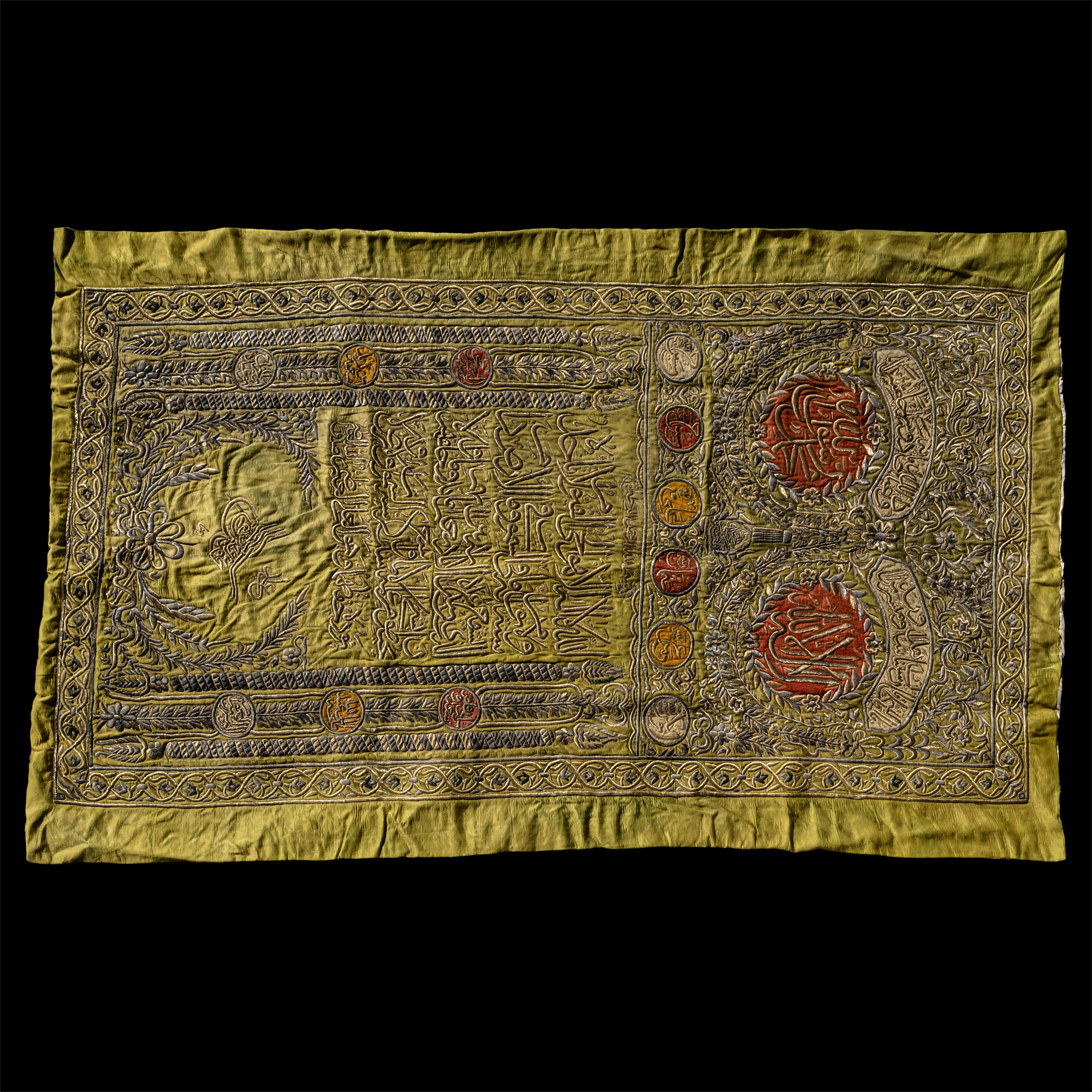
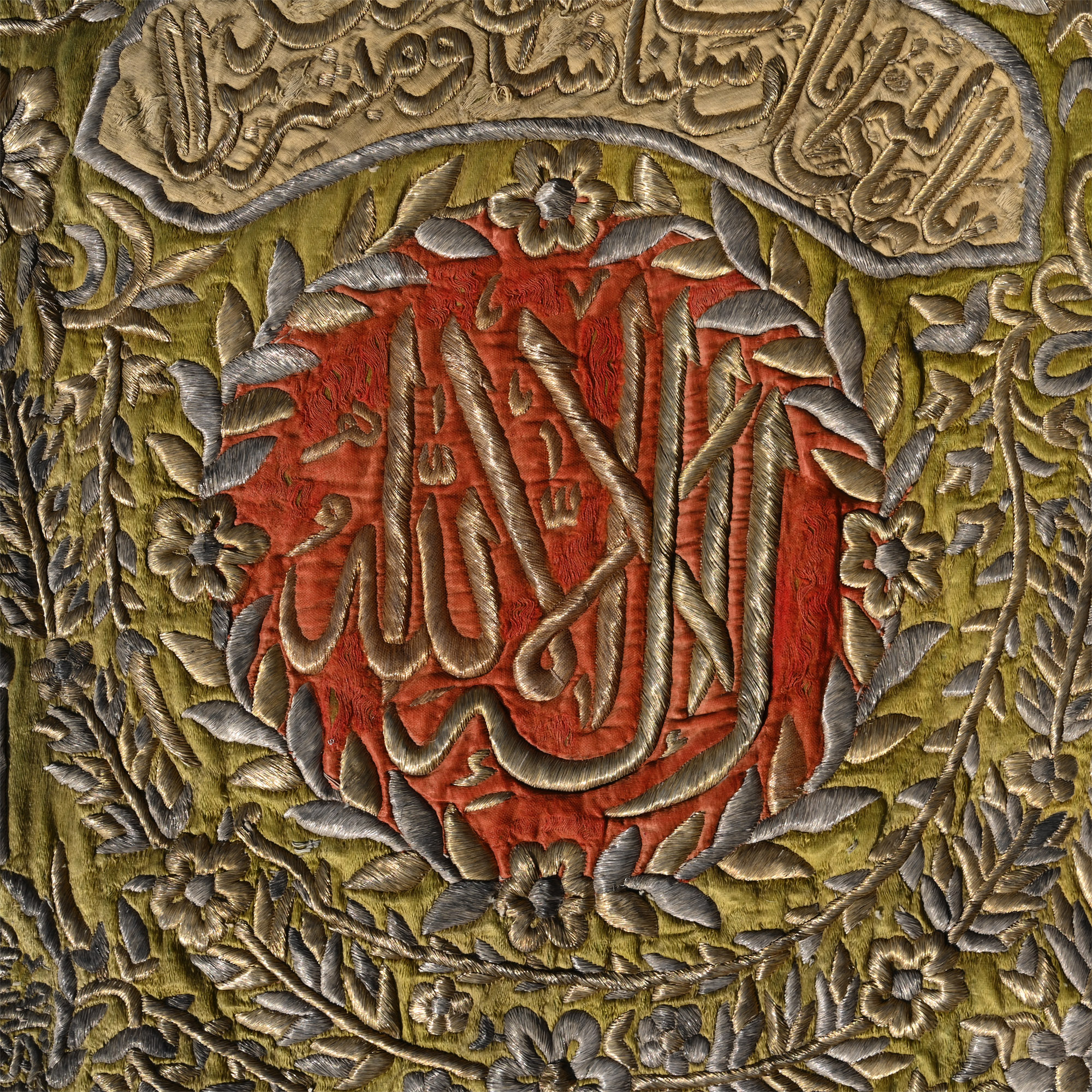
The panel is worked edge to edge in silver and silver-gilt thread, couched in pairs over cords and card templates so that the metal stays on the surface and the lettering rises in relief. The central panel, in thuluth, the monumental cursive of mosque inscriptions, names the four Rashidun caliphs, Abu Bakr, Umar, Uthman and Ali, together with the Prophet's grandsons Hasan and Husayn. The shahada fills six roundels above; the names of the Companions of the Prophet run through the lower part; two large red-silk roundels, tied together by an embroidered tassel, carry the sultan's signature a second time. Naming the four caliphs in a mosque's dominant roundels became a Sunni Ottoman habit in the years when the empire's great rival was Shiite Safavid Iran; Hasan and Husayn complete the set here, as they do on the eight great medallions of Hagia Sophia. It is Sunni orthodoxy, stated as decoration. Through six side panels runs the Throne Verse, "God, there is no god but He, the Living, the Self-subsisting; slumber seizes Him not, neither sleep," one of the most often inscribed texts in Islamic art, set on epitaphs and amulets for protection. The occultist al-Buni advised writing it on a shroud, so that the dead would not suffer in the grave.
Two cartouches of Qur'anic text sit inside an embroidered mosque lamp, and the expected verse there, the one on most of the enamelled glass lamps in the world's museum cases, is the Light Verse: "God is the light of the heavens and the earth; the likeness of His light is a niche, wherein is a lamp." The nearest sibling of this panel, a red-ground hanging offered at Bonhams in 2013, carries exactly that. This one carries something more pointed: surah al-Ahzab 45 and 46, the verses in which God addresses the Prophet through a chain of titles, witness, bearer of good news, warner, summoner to God and, last, siraj munir, "an illuminating lamp." Set those words inside a lamp and the image reads itself. On this silk, the lamp is the Prophet.
The sultan behind the signature
Mahmud II came to the throne in 1808 out of palace violence that killed both his cousin Selim III and his half-brother Mustafa IV, and spent the next three decades pulling power back to the centre. In June 1826 he destroyed the Janissary corps, the empire's centuries-old infantry, in a purge the official record calls the Auspicious Incident; thousands died. He broke the provincial dynasts, put the bureaucracy into frock coats and the fez, and founded the empire's first official newspaper in 1831. The Tanzimat reform edict was proclaimed by his son Abdülmecid months after Mahmud's death in 1839: the father had done the groundwork while declining, to the end, to put limits on his own authority.
He was also a trained calligrapher, with a surviving panel in his own hand in jali thuluth, the large display script, worked in the technique the Ottomans called zerendud, overlaid with gold. That detail sharpens the colophon embroidered on the Bonhams sibling: "The servant of God Mahmud ibn Abd al-Hamid wrote it." Whether the sultan really penned the calligraphic model for an embroidery workshop, or was credited by courtesy, is open; the signature formula allowed either. With this sultan the claim was at least believable.
Made for the Holy Cities, priced in London
After 1517, when Arabia came under Ottoman control, the sultans took the title Servant of the Two Holy Cities and paid for it annually. Each year a caravan called the surre, "the purse," left Istanbul for Mecca and Medina carrying sacks of money for the poor and embroidered textiles for the shrines, signs of sovereignty as much as gifts. The Ka'ba's black cover was renewed every year; the hangings of the Prophet's Mosque at Medina were replaced every few years, or, as the traveller Johann Ludwig Burckhardt recorded in the early nineteenth century, "when a new Sultan ascends the throne." The retired ones went back to Istanbul to cover the tombs of sultans and princes. Topkapı Palace still holds more than six hundred of these textiles and their fragments.
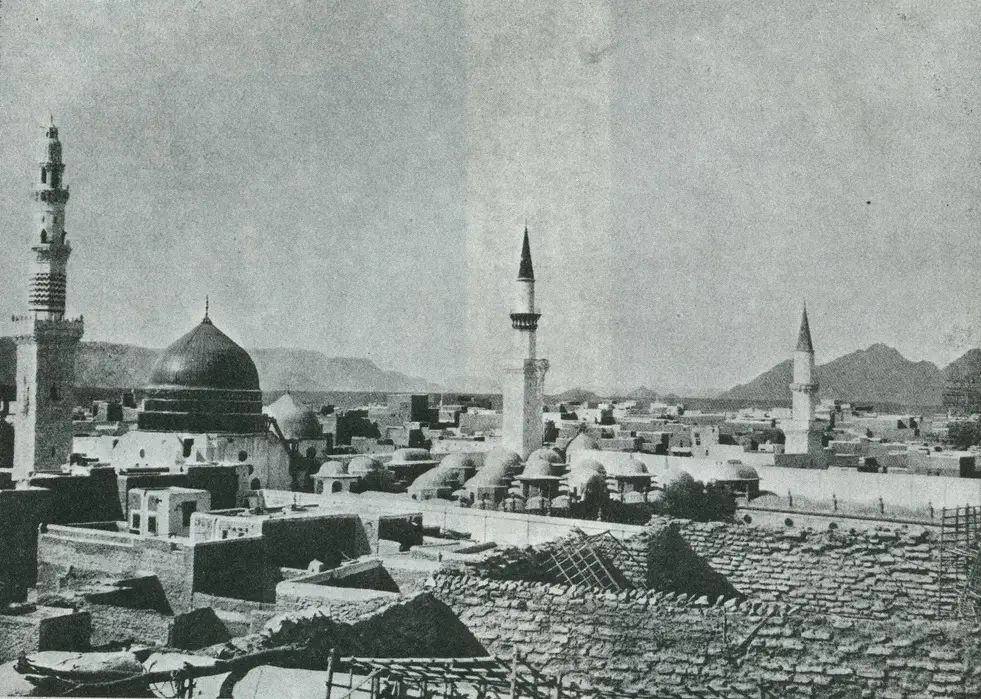 The Prophet's Mosque at Medina in 1908, the dark dome standing over the tomb of Muhammad. Hangings like this panel travelled here from Istanbul with the annual caravan. Public domain, via Wikimedia Commons.
Where this panel belongs is written into its choices. Black grounds went to Mecca and the Ka'ba; green leans toward the Prophet's city and the imperial dead, a tendency rather than a rule. The programme runs Prophet-centred from lamp to Companions, and the format is wrong for a door curtain: those run taller than wide, and this is the reverse. Bonhams catalogues the near-twin black-ground type, made under Mahmud's son Abdülmecid, as "a curtain made for the Tomb of the Prophet, Medina." Our own catalogue commits only to "panel," and the caution is deliberate: whether this silk, with its rococo swags and bows, hung along a grille, over a doorway, or lay across a cenotaph is unresolved. Its register is not. Ground, format, programme and signature all belong to the imperial gifts sent south in the sultan's name.
The panel had been in a British private collection since before 2000 when it came up at Bonhams in London on 6 October 2008, three weeks after Lehman Brothers collapsed, with an estimate of £80,000 to £120,000. It did not sell. That estimate belonged to the Islamic art market at its pre-crash peak. The class has since found its level. The red-ground sibling, almost the same size, carried an estimate of £15,000 to £20,000 at Bonhams in 2013; a comparable curtain at Dreweatts in 2020 was bid to £9,500 and went unsold. TimeLine's estimate for lot 352, £15,000 to £20,000, is where these things now trade.
Which leaves almost three metres of silver-gilt embroidery, made in the name of the sultan who destroyed the Janissaries and put an empire into the fez, priced at the level of a mid-range family car. Six weeks out from the sale, exactly one person has it on a watch list.
TimeLine Auctions, 21st August 2026