Home > Stories by TimeLine Auctions
Stories by TimeLine Auctions
Two Gods, One Table
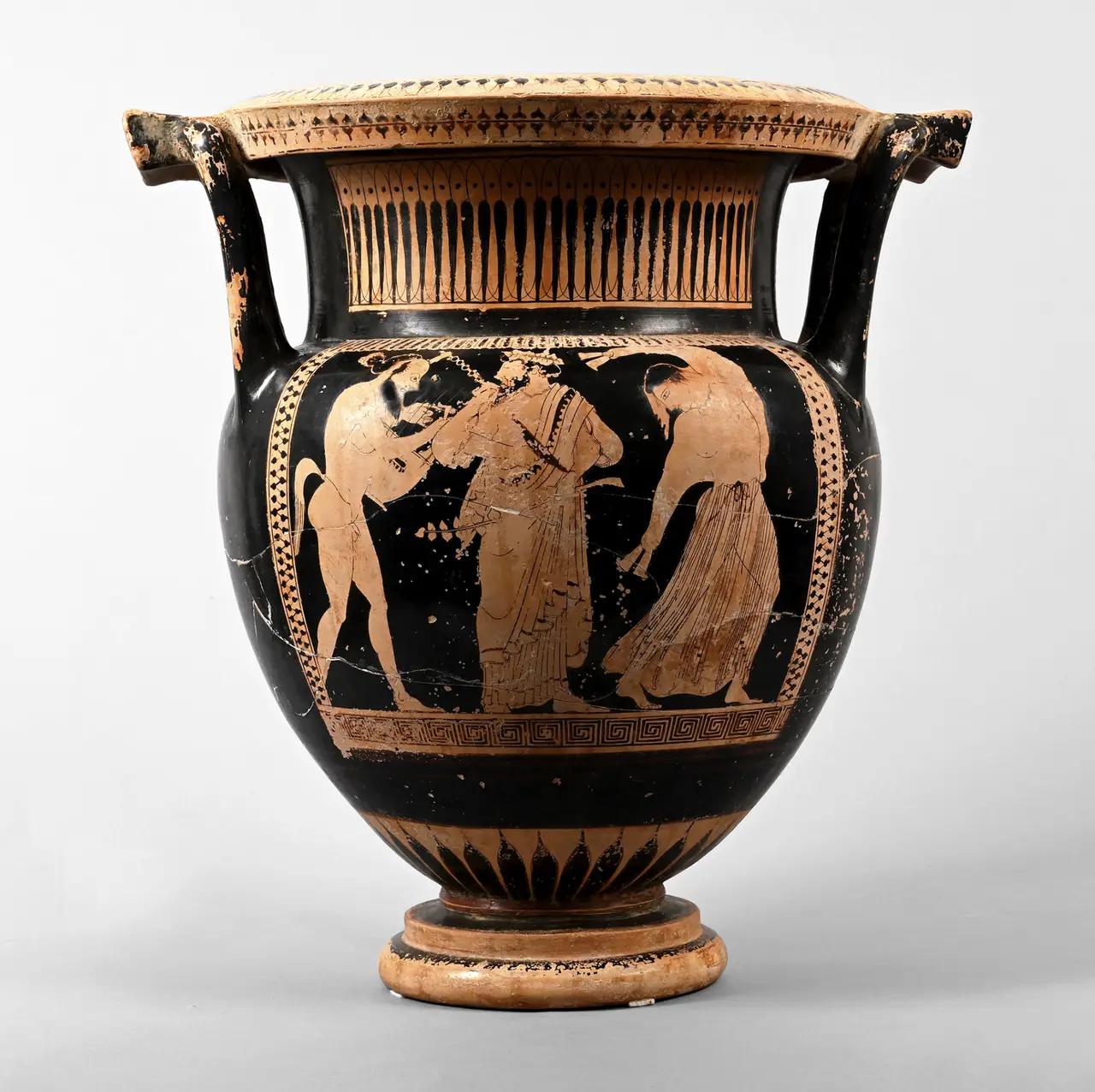
On one side of the vessel, a young woman rides a bull toward the sea while a bearded man watches from the shore. On the other, the god of wine stands motionless between a satyr playing a lyre and a woman lost in dance. Two scenes of divine power, painted on opposite faces of the same wine-mixing bowl.
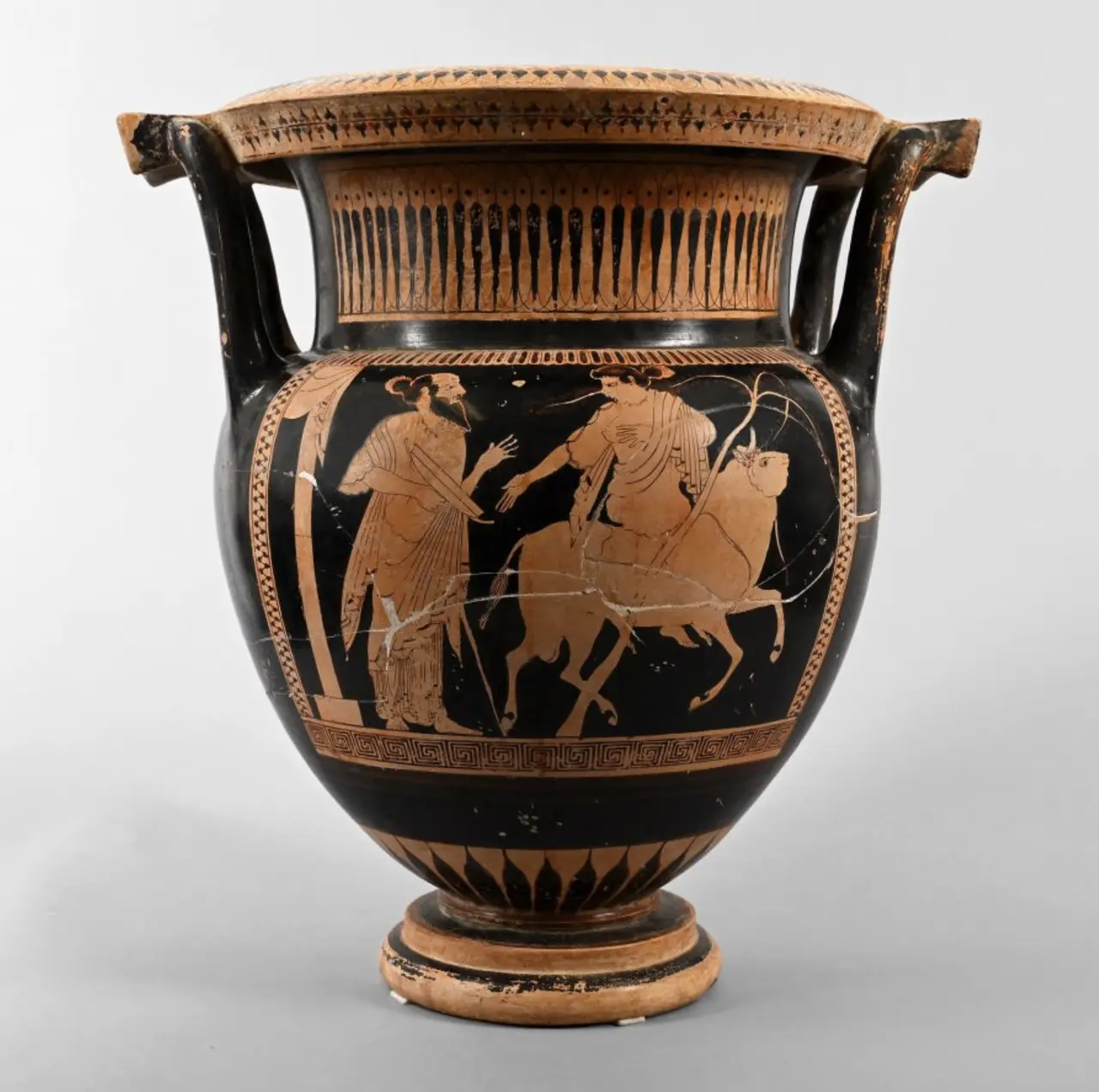
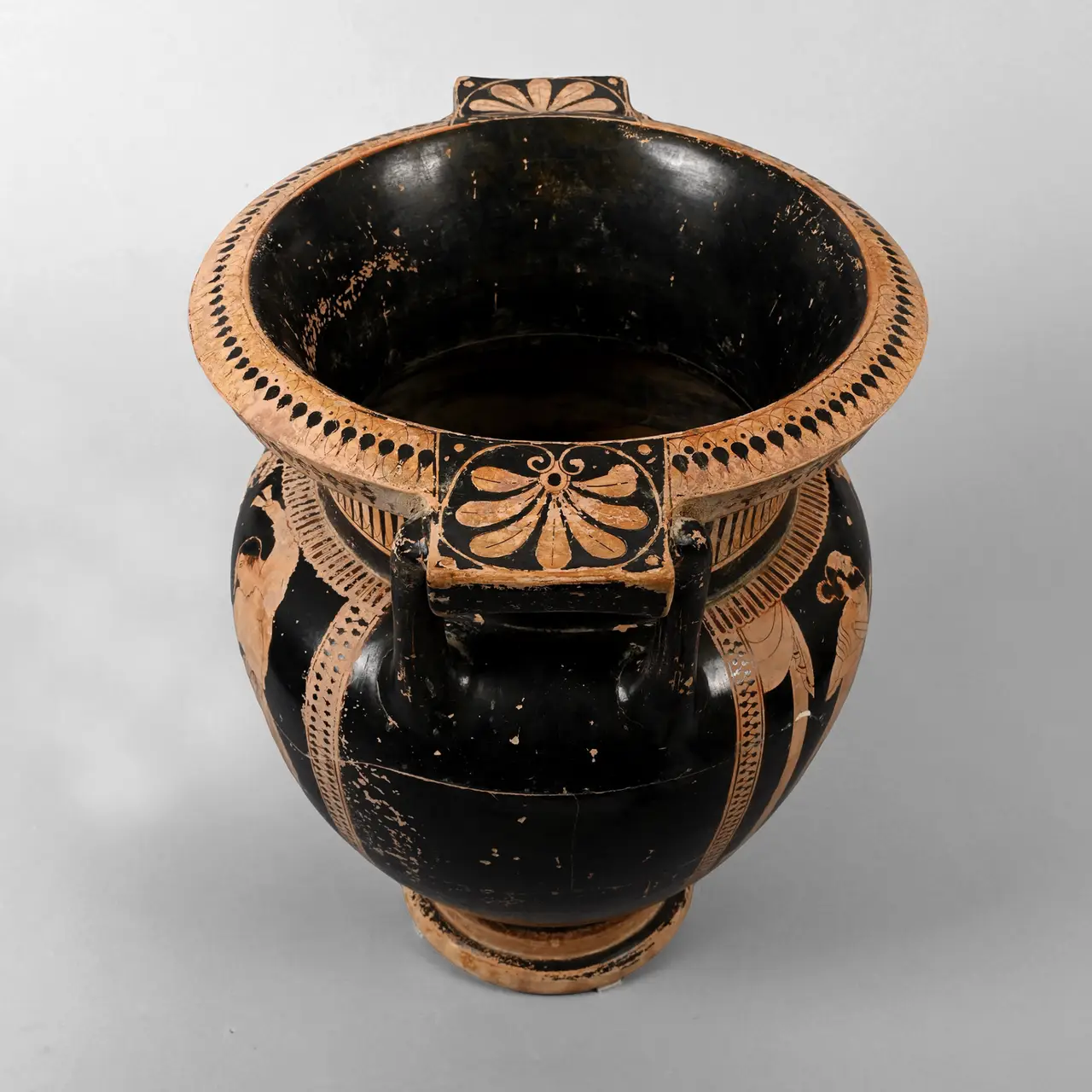
The krater is Attic red-figure, dated to the fifth century BC, and stands 44.5 centimetres high. It weighs close to six kilograms: a wide-mouthed column krater with a flared and stepped foot, strap handles opening into columnar legs, and the familiar decorative programme of its shape. Tongue-pattern borders run around the neck and lower body, palmettes cover the handle plates, and a meander groundline supports the figures. Some restoration is visible, with repair lines across the body.
Side A depicts Europa's abduction. In the myth, Zeus approaches the Phoenician princess in the form of a white bull while she plays on the beach at Tyre. She caresses the animal, then climbs onto its back; the god plunges into the sea and carries her to Crete, where she will bear him three sons, among them Minos. What the painter has chosen is the moment just before the sea. Europa is already mounted, the bull already moving, the bearded bystander (her father Agenor, or a companion) still watching from the shore. She wears a himation that has slipped to reveal one breast and holds a frond in one hand, turning back toward the figure she is leaving. The exposed breast and the forward momentum of the animal mark this as a scene of erotic seizure; the draped composure of the bystander sets a counterpoint of stillness.
Side B belongs to a different god. A robed male figure stands at the centre, a wreath in his hair, flanked by a nude satyr with a lyre and a dancing woman holding instruments in both hands. This is a Dionysiac triad: the wine god between members of his retinue. The wreath appears to be laurel rather than the ivy more usually associated with Dionysos, and the lyre is an instrument we expect from Apollo's sphere rather than the aulos that typically accompanies satyrs. Whether this reflects a workshop habit or a deliberate choice, it pulls the scene toward the decorum of an actual drinking party rather than the wildness of ecstatic ritual.
The pairing is not accidental. A column krater existed to hold wine mixed with water at the symposion; servants ladled the diluted mixture into guests' cups from its wide mouth. Dionysiac imagery on kraters was common, the god's presence on the vessel consecrating the drinking. But the Europa scene on Side A gives the programme a second axis. Zeus acts through physical force, seizing a mortal and carrying her across the sea. Dionysos acts through his gift: wine, music, the loosening of the body into dance. Both are scenes of divine power overcoming human composure, and both would have been visible across the table as the wine went round, each side catching the light in turn.
The two scenes share an interest in the boundary between control and surrender. Europa turns back, still composed, still holding her frond, but she is already on the bull and the bull is already moving. The maenad on Side B has given herself over entirely to the rhythm, her body in active motion, instruments raised. Between them stands Dionysos, still, robed, presiding. The painter has distributed energy and stillness carefully across the vessel: the rushing animal and the composed bystander on one side; the dancing figures and the motionless god on the other.
The decorative syntax is consistent with Attic column-krater production of the earlier fifth century BC, and a comparison is drawn to Boardman's Athenian Red Figure Vases: The Classical Period (1989), figure 39. The piece is accompanied by an academic report by Dr Jacques Chamay and was sold at Hampel Fine Arts, Munich, in September 2012, from a German private collection. It will be offered as lot 88 in our antiquities auction on 2 June 2026, with an estimate of £30,000–40,000.
TimeLine Auctions, 25th May 2026