Home > Stories by TimeLine Auctions
Stories by TimeLine Auctions
Up to 15,000 Roman Coins Recovered from a Field in North Wales
Two metal detectorists, David Moss and Ian Nicholson, have recovered as many as 15,000 Roman silver coins from a field in North Wales, packed into two clay pots and buried about 20 inches below the surface. The hoard weighs more than 60 kilograms and is now at National Museum Cardiff, where staff are cleaning, cataloguing, and identifying the coins. Their assessment is expected in 2026.
The find may be the largest Roman coin hoard recorded in Wales. Anthony Halse, chairman of the South Wales and Monmouthshire Numismatic Society, has said it could be the biggest such find in the country. The museum has put its previous Welsh record at around 10,000 coins, found near Chepstow in the 1990s; nearly 6,000 came from Sully, in the Vale of Glamorgan, in 2008. Across Britain the count still falls short of the Frome Hoard, the more than 50,000 coins lifted from a single pot in Somerset in 2010.
Moss, 36, from Cheshire, and Nicholson recovered the two vessels in August 2025 after about six and a half hours of digging, and the find was made public in October. "It truly felt like a sign, a rainbow came out, and persistence paid off," Moss said.
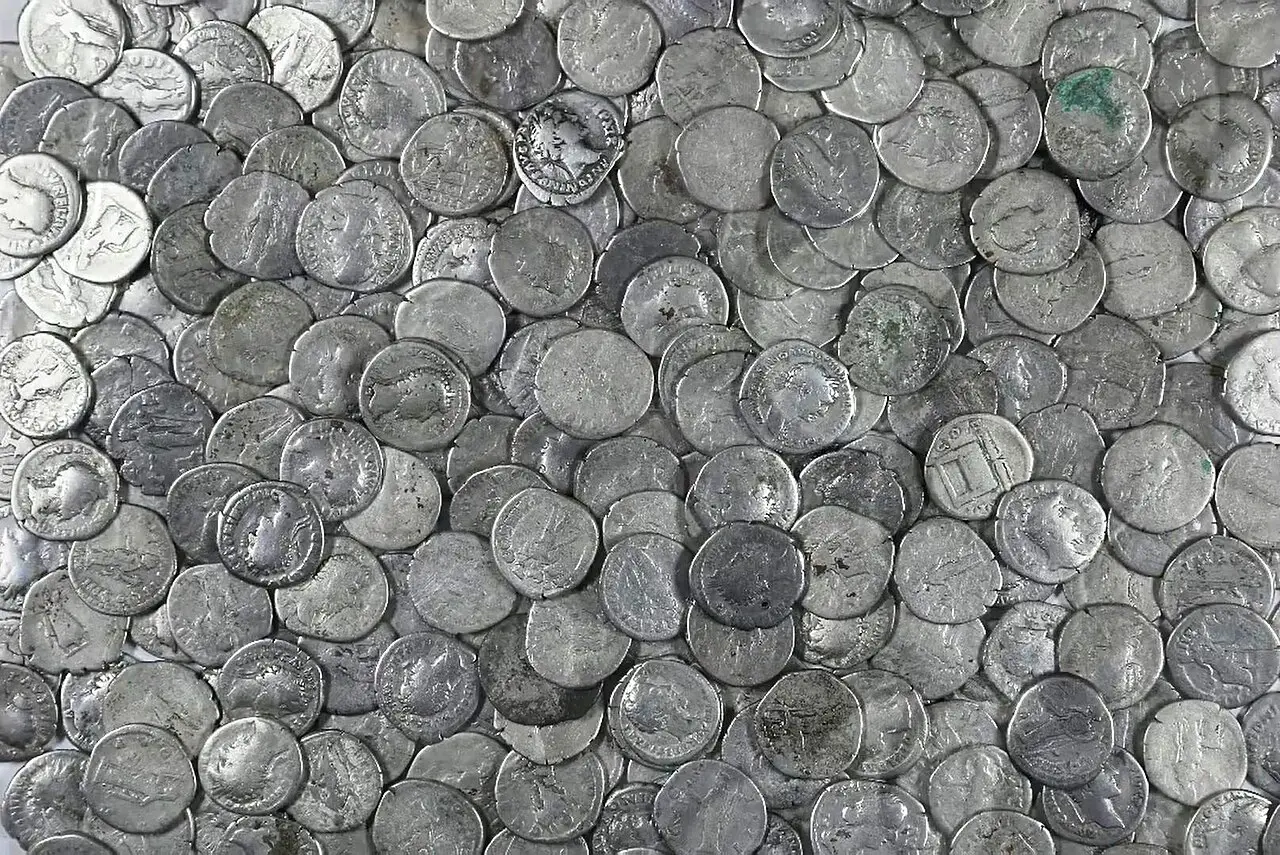 A hoard of Roman silver denarii of the kind that makes up much of the North Wales find. This separate group of 1,753 denarii was found at Cichobórz, Poland. Photo: Gabinet Numizmatyczny D. Marciniak, CC BY 3.0, via Wikimedia Commons.
This was not Moss's first hoard from the area. In the same part of North Wales in 2018, he and another detectorist found a smaller group of 2,733 coins, studied at the museum by Alastair Willis, its senior curator of numismatics, and dated to around AD 270; most had been buried during the reigns of the breakaway emperors Postumus and Victorinus. The new hoard holds the same two coin types: denarii, the standard silver coin of the early empire, and silver-washed radiates, debased third-century coins named for the radiate crown on the emperor's portrait, with a thin silver coating over a base-metal core. To fix when this group went underground, museum staff will identify its newest coin, since a hoard cannot have been buried before its latest piece was struck. That date is not yet established.
Why so much silver was left behind is the harder question. Halse has suggested the coins might have belonged to a Roman soldier or soldiers who buried their wealth for safekeeping and never came back for it. Hoards from Roman Britain are also tied to spells of unrest, or to deposits lost for reasons the coins do not record. The museum's work may narrow when the hoard was buried; it is less likely to settle why.
Under the Treasure Act 1996, finds of this kind must be reported to a local Finds Liaison Officer within 14 days. A coroner decides whether the hoard qualifies as treasure; if a museum then seeks to acquire it, the independent Treasure Valuation Committee sets a value, and any reward is divided between the finder and the landowner.
Roman silver coins and small hoards reach specialist salerooms regularly, TimeLine's among them, though a group of this size would normally enter a public collection rather than the market. For now, the date the coins went underground, and any answer to who buried them, rests on a single piece: the latest coin in the two pots.
TimeLine Auctions, 27th June 2026