Home > Stories by TimeLine Auctions
Stories by TimeLine Auctions
What Remains of an Official
The arms are gone at the shoulder and the right leg below the knee, with neither loss being accidental. The figure is made of wood, 55.7 cm high, and stands now from head to mid-thigh, with the front of a kilt and the upper portion of an advancing left leg preserved. Where the arms ended, the surfaces are abruptly cut, the same is true of the right leg. These elements were likely never part of the same piece of timber. Old Kingdom sculptors, working with the short, often knotty native woods available to them, assembled large figures by joining separately carved limbs to a central block with dowels and resin glues. Wood holds, while organic adhesive does not, after four thousand years the joints have failed, and the figure has come down to us as the central block it began as.
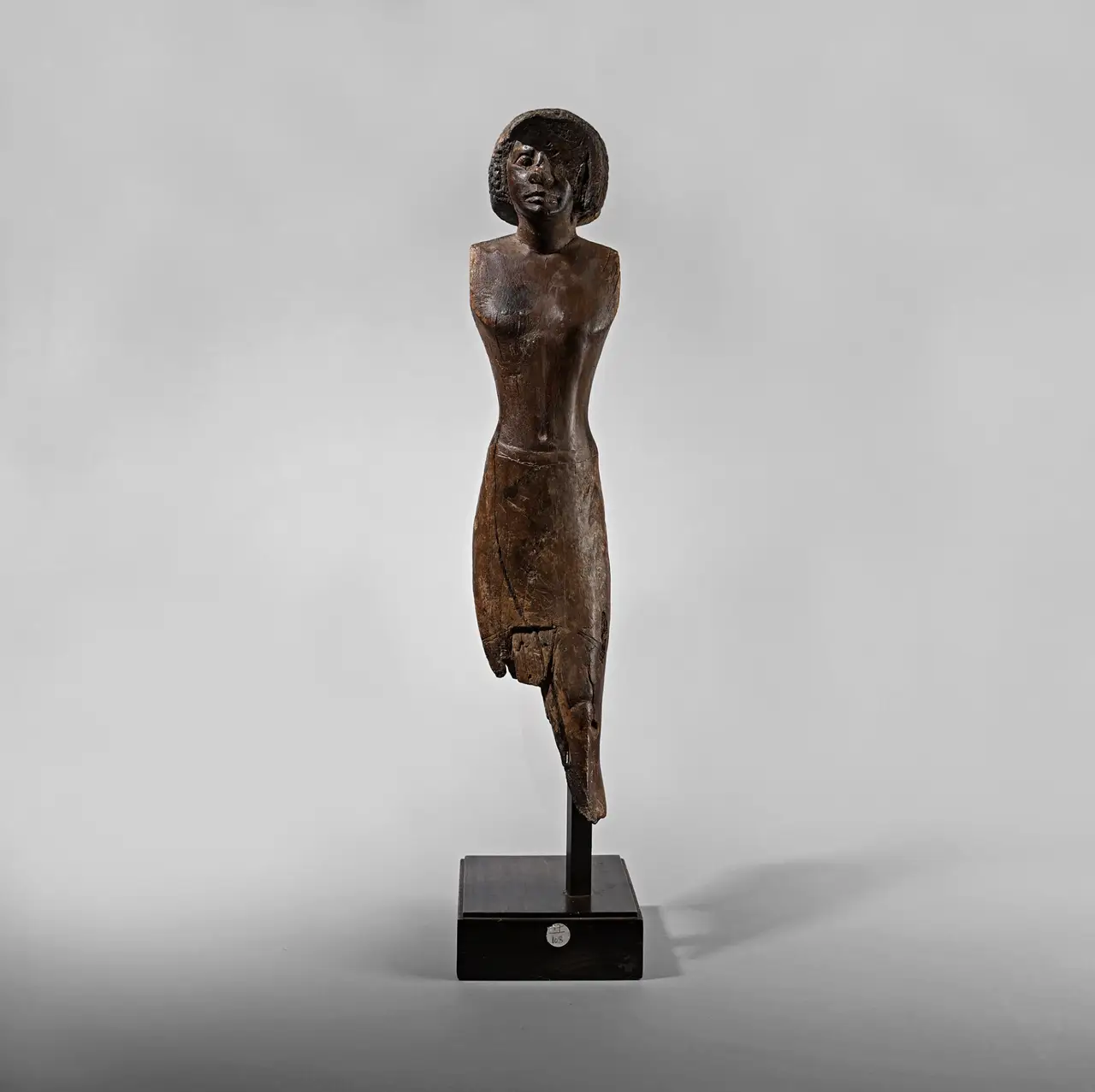
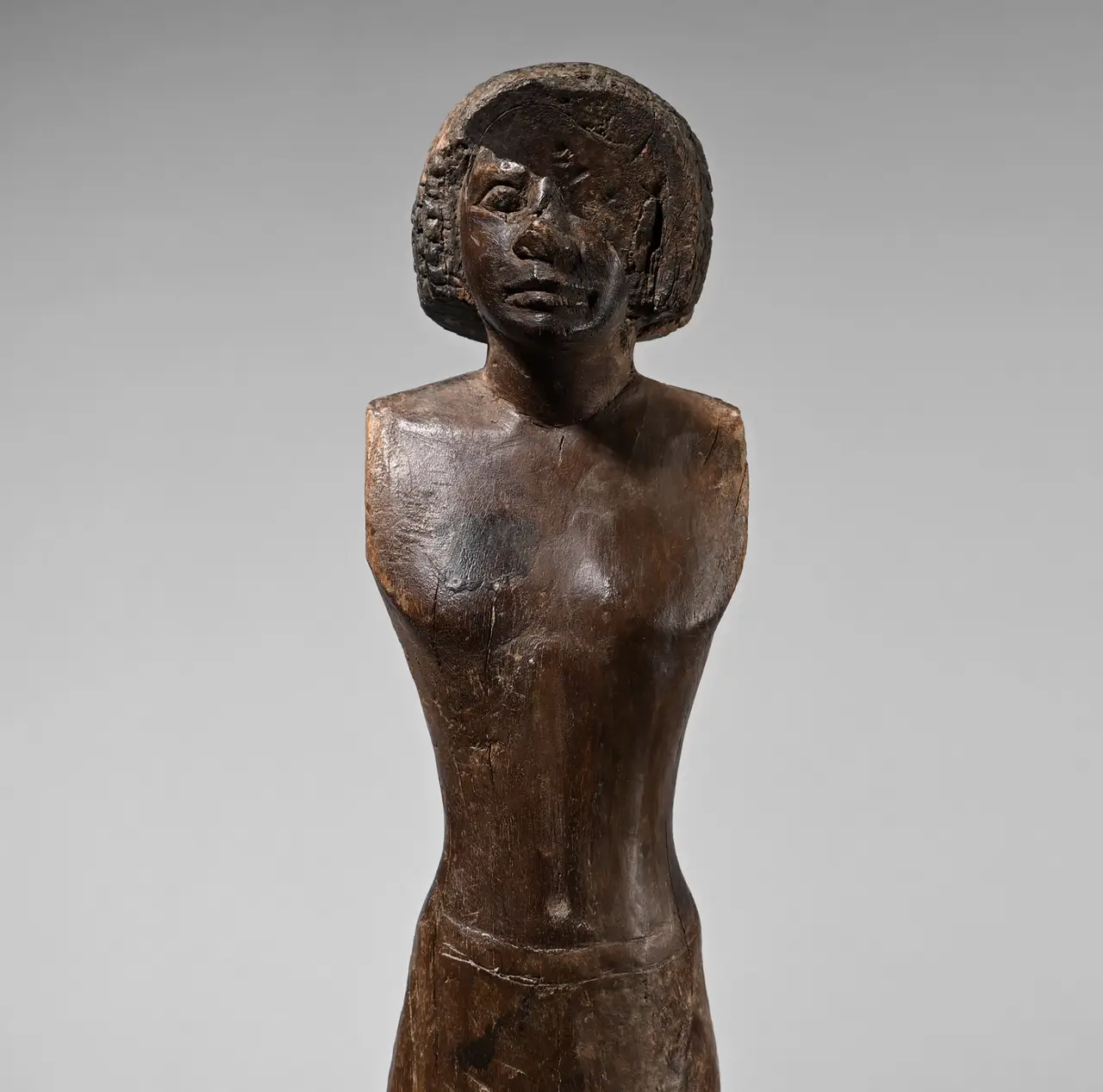
What remains is what was carved from one piece: a head, a torso, a kilt, the start of a stride. The body is slender, the waist is long, the chest unmuscled, the shoulders narrow rather than wide. The pose is slightly asymmetrical, with the line of the hips, the set of the head, neither quite squared. This is the style of late Old Kingdom male portraiture. By the 5th and 6th Dynasties, Egyptian sculpture had moved away from the broad-chested, idealising bodies of the pyramid age; private statuary instead favoured a leaner, more expressive figure, sometimes slightly off-axis, with the weight of meaning shifted to the face.
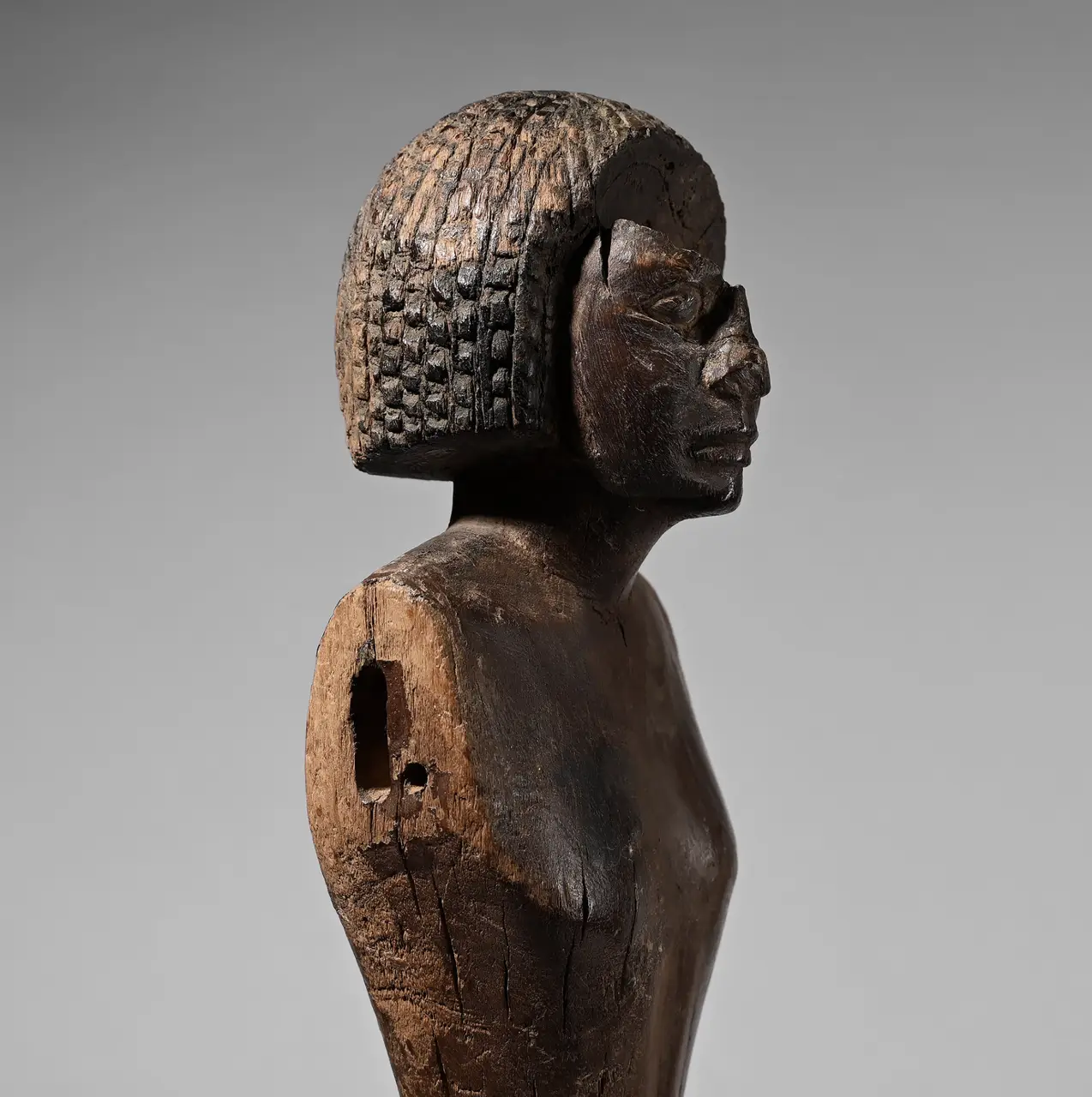
The face is intact, with a rounded wig covering the ears, composed of echeloned rectangular curls: a standard mark of high private status in this period, framing the head in stepped, layered horizontals. The mouth is broad, the lips finely outlined and rounded at the corners. Traces of polychrome survive in the recessed areas of the surface; the figure was originally coated in stucco and painted, and the dark grain we see now is bare wood, not the appearance intended.
The kilt deserves a sentence on its own. A short, knee-length wrap, it carries at the front a central tab a small rectangular panel projecting from the waist over the thighs. In earlier dynasties the kilt with central panel was a royal garment; its appearance on private statuary in the late Old Kingdom belongs to a wider pattern of the period, in which provincial officials and high administrators began to claim, in dress and in tomb decoration, prerogatives that had once been the pharaoh's alone. The figure is unnamed and uninscribed, so we cannot say who he was, but the kilt tells us at what level of the court he had wanted to be seen.
Two close parallels orient the piece. A fragmentary wooden figure in the Egyptian Museum, Cairo (Saleh and Sourouzian, no. 42) shares the slim waist, the rounded wig, the same alert face; a near-complete striding figure in the Louvre (Ziegler, no. 51) shows the type with arms and forward leg in place, and gives a sense of how this one would have looked when first set down.
The figure's modern history begins with the Altounian-Lorbet Gallery in Mâcon, run by Joseph Altounian (1889–1954) and Henriette Lorbet, and is believed to derive from the eleven-day Sotheby's sale of the Reverend William MacGregor's Egyptian antiquities in London in 1922: one of the major dispersals of the interwar trade. The current owner acquired the figure from Henriette Lorbet on 4 January 1967, and it has been in private hands since.
From the narrow shoulders the torso tapers inward through the small, unmuscled but well-defined chest to a long, high-set waist. The kilt picks the line up, curves outward to the hips, and falls in a single tapering plane to the surviving leg. The break at the right knee does not interrupt it. Shoulders, waist, hips, leg; each transition measured against the next, the figure carrying its full length as a single quiet vertical.
This wonderful piece is available in our upcoming Antiquities auction on the 2nd of June 2026 as lot 69, with an estimate of £40,000-60,000.
TimeLine Auctions, 17th May 2026