Home > Stories by TimeLine Auctions
Stories by TimeLine Auctions
When Mice Ruled Egypt: The Secret Art of the Tomb Builders
When Mice Ruled Egypt: The Secret Art of the Tomb Builders
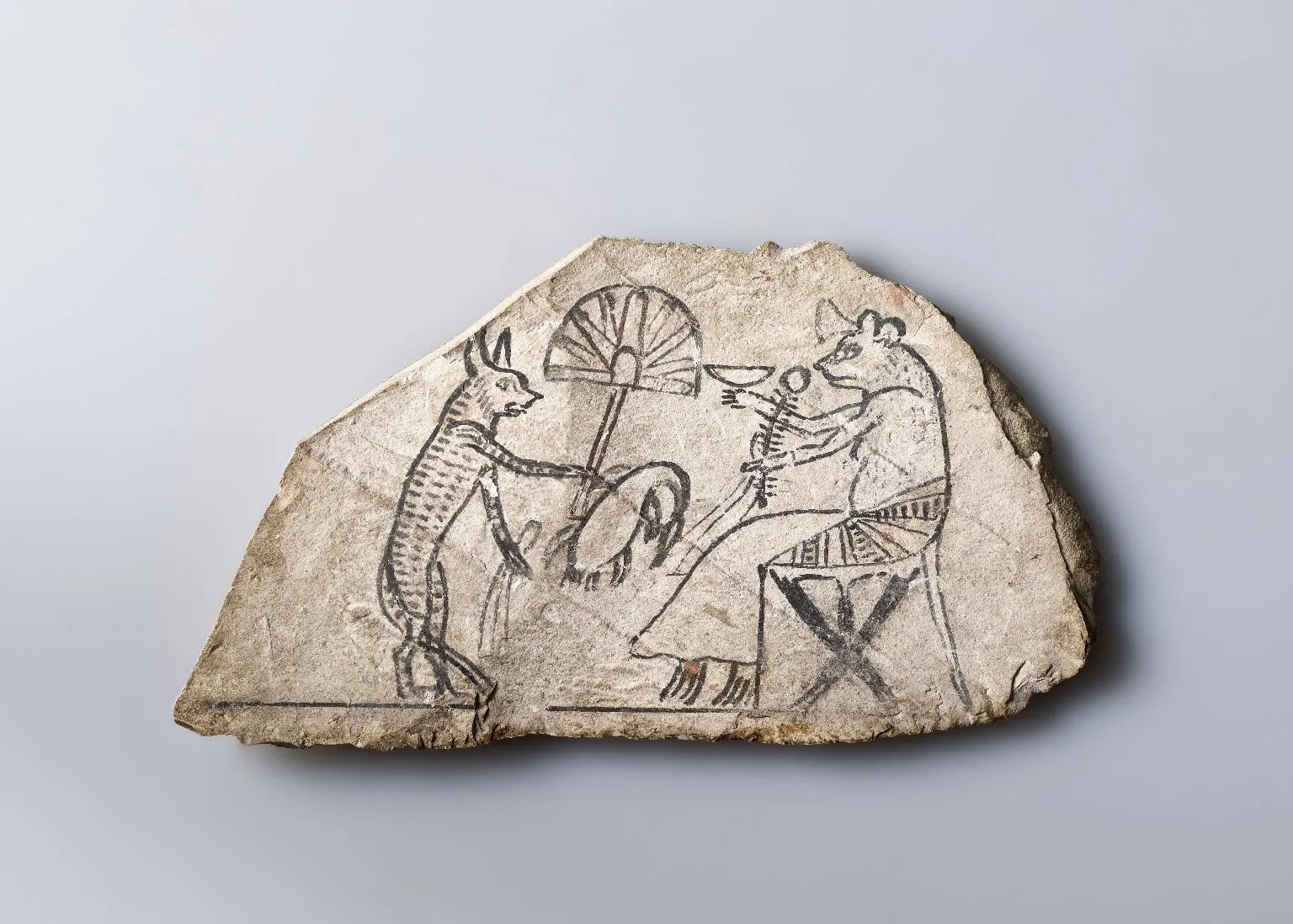
A cat, naked and servile, pours wine into a cup. A mouse, dressed in fine pleated linen, lounges on a chair with its feet resting on a footrest, accepting the drink with regal indifference. This scene, sketched in red and black ink on a palm-sized flake of limestone, was created sometime around 1200 BCE in a small village perched above the western bank of the Nile. The artist was one of the most skilled craftsmen in the ancient world, a man who spent his daylight hours decorating the tombs of pharaohs in the Valley of the Kings. By lamplight, on his own time, he drew something altogether different: a world turned upside down.
Life in the Village of the Tomb Builders
The village was called "Set Maat," the Place of Truth. We know it today as Deir el-Medina. Nestled in a narrow valley on Thebes's west bank, this was a company town in the truest sense. The Egyptian state built it, maintained it, and paid its inhabitants' rations of grain, fish, and vegetables. In exchange, the villagers did the most sensitive work imaginable: they excavated, painted, and sealed the eternal resting places of the divine kings.
These were not ordinary labourers. Egyptologist Jennifer Miyuki Babcock, in her 2022 study Ancient Egyptian Animal Fables, describes the population of Deir el-Medina as "particularly sophisticated and, in part, literate." Some estimates suggest that literacy rates in this village far exceeded anything else in Egypt at the time. The workers kept meticulous records on flakes of limestone called ostraca (from the Greek word for potsherd), documenting everything from work schedules to laundry lists, from love poems to legal disputes. When the Institut français d'archéologie orientale excavated a rubbish dump known as "The Great Pit" in the early twentieth century, they recovered over 5,000 of these ostraca, offering an unparalleled window into daily life three millennia ago.
But among the inventory lists and scribbled prayers, the excavators found something unexpected: drawings of animals behaving like people. Cats serving mice. Lions playing board games with gazelles. A hippopotamus climbing a fig tree to pick fruit for a waiting crow. A mouse pharaoh charging into battle on a chariot, storming a fortress defended by cowering cats.
The Art of the Upside-Down World
When we hold one of these figured ostraca in the cataloguing room at TimeLine, what strikes us first is the quality of the line. The ink flows with confidence, the curves precise, the proportions elegant. These are not doodles by bored workmen; they are the products of hands trained in the rigorous canon of Egyptian royal art. And yet the subjects would never appear on a tomb wall.
The images depict what scholars call "role reversals." In the natural world, cats hunt mice. In these drawings, mice sit enthroned while cats fan them and dress their hair. The animals wear human clothing (or, pointedly, do not wear it: cats are almost always depicted naked, a deliberate marker of low status). They engage in elite activities depicted in the tombs of nobles: banqueting, hunting from chariots, making religious offerings, playing music at feasts.
For over a century, Egyptologists assumed these images were satire, a safe outlet for workers to mock their betters. The logic seemed obvious: here were labourers living under pharaonic authority, depicting the powerful as servile animals. Some scholars connected the imagery to the first recorded labour strike in human history, which occurred at Deir el-Medina during the reign of Ramesses III (circa 1155 BCE), when workers staged demonstrations at royal mortuary temples after their grain rations failed to arrive. The "Cat and Mouse War" depicted in the famous Turin Papyrus (Museo Egizio, Cat. 2031), in which mice armies storm cat-defended fortresses, seemed to confirm this reading.
But this interpretation has problems, as Babcock and others have noted. If the workers were openly protesting and staging sit-ins at temples, why would they need a covert visual language to express dissent? And the animal imagery predates the strikes by decades, if not centuries.
Fables for a Furious Goddess
A more compelling explanation connects these images to one of ancient Egypt's most important religious narratives: the Myth of the Distant Goddess.
In this story, the goddess Tefnut (daughter of the sun god Ra) becomes enraged and flees Egypt, transforming into a fierce lioness who wanders the deserts of Nubia. Without her, Egypt withers. The land grows barren. Cosmic order, known as ma'at, collapses. The god Thoth, taking the form of a baboon, is sent to coax her home. He does so not through force, but through storytelling, entertaining the angry goddess with fables about animals and their misadventures.
Several ostraca from Deir el-Medina appear to depict exactly this scene: a baboon seated before a cat (Tefnut in her feline form), clearly engaged in some form of exchange. Other ostraca seem to illustrate specific fables that Thoth narrates within the myth, including a story about a cat and a vulture who swear an oath not to harm each other's young (a tale with clear parallels to Mesopotamian fables like "The Snake and the Eagle" from the Babylonian Etana Legend).
The return of the Distant Goddess was celebrated annually in Thebes with festivals involving music, drunkenness, and, quite possibly, storytelling. Babcock suggests that these ostraca and papyri may have functioned as visual aids for narrators performing the myth, laid out on surfaces and pointed to as the tales unfolded. The palm-sized limestone flakes would have been easy to arrange and rearrange depending on which fables the storyteller chose to tell.
This reframing transforms the images from subversive grumbling into something more complex: religious art with a moral purpose. The topsy-turvy world where mice rule and cats serve was not a fantasy of revolution but a cautionary tale. "Through these stories, Tefnut understands the havoc that reigns over Egypt in her absence," Babcock writes. The images depicted disorder precisely so that order, the restoration of ma'at, could be understood as sacred and necessary.
The Mark of the Maker
The quality of draftsmanship on these ostraca varies enormously, from fluid masterpieces to wobbly attempts that suggest less skilled hands (or perhaps children practising). This variation reinforces their domestic origin. They were made in the village, during off-hours, by people with vastly different levels of artistic training. Some may have been preparatory sketches. Others were likely votive offerings, gifts to the gods deposited at local shrines. Still others may have been something like illustrated stories, passed around and enjoyed.
What unites them is their humanity. Looking at an ostracon depicting a mouse lounging while a cat fans it with a long-handled implement, we see not just technical skill but wit, imagination, and a sensibility that feels startlingly modern. The ancient Egyptians, it turns out, drew political cartoons three thousand years before Thomas Nast.
Holding History in Your Hands
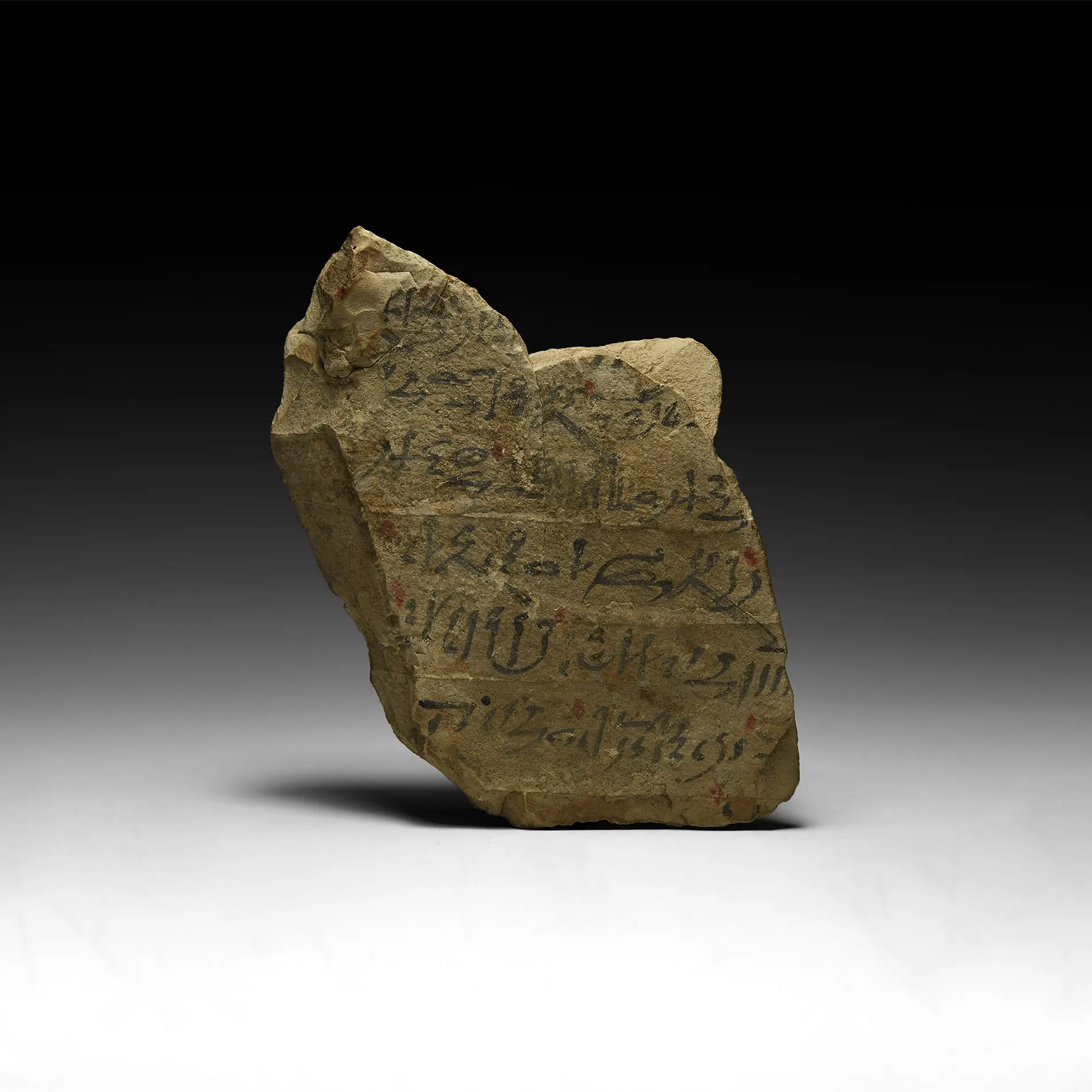
The majority of figured ostraca entered museum collections through nineteenth-century dealers in Luxor, long before systematic archaeology established precise findspots. Many pieces sold by TimeLine over the years share this trajectory: documented in early private collections, passed through generations, now available to collectors who understand their significance.
It is rare that objects this personal survive. Papyrus decays. Wood rots. But limestone endures. When we catalogue a figured ostracon, we are often looking at an image that remained buried in Theban sand for over three thousand years, protected by the same dry climate that preserved the royal tombs. The ink, made from carbon black or red ochre, remains vivid. Sometimes you can see where the artist paused, where the brush was reloaded, where a line was corrected.
These are not official monuments. They were never meant for eternity. And yet here they are, small windows into the imaginative lives of people who spent their careers preparing pharaohs for the afterlife but found time, in their own homes, to draw pictures of a world where the rules were reversed and even a mouse could be king.
Browse the Ancient Egyptian category in our current catalog to explore available ostraca, shabtis, and other objects from the Theban region. For questions about provenance or collecting Egyptian antiquities, contact our specialists.
TimeLine Auctions, 18th April 2026