Home > Stories by TimeLine Auctions
Stories by TimeLine Auctions
Where to Buy Real Egyptian Antiquities (and How to Know They're Real)
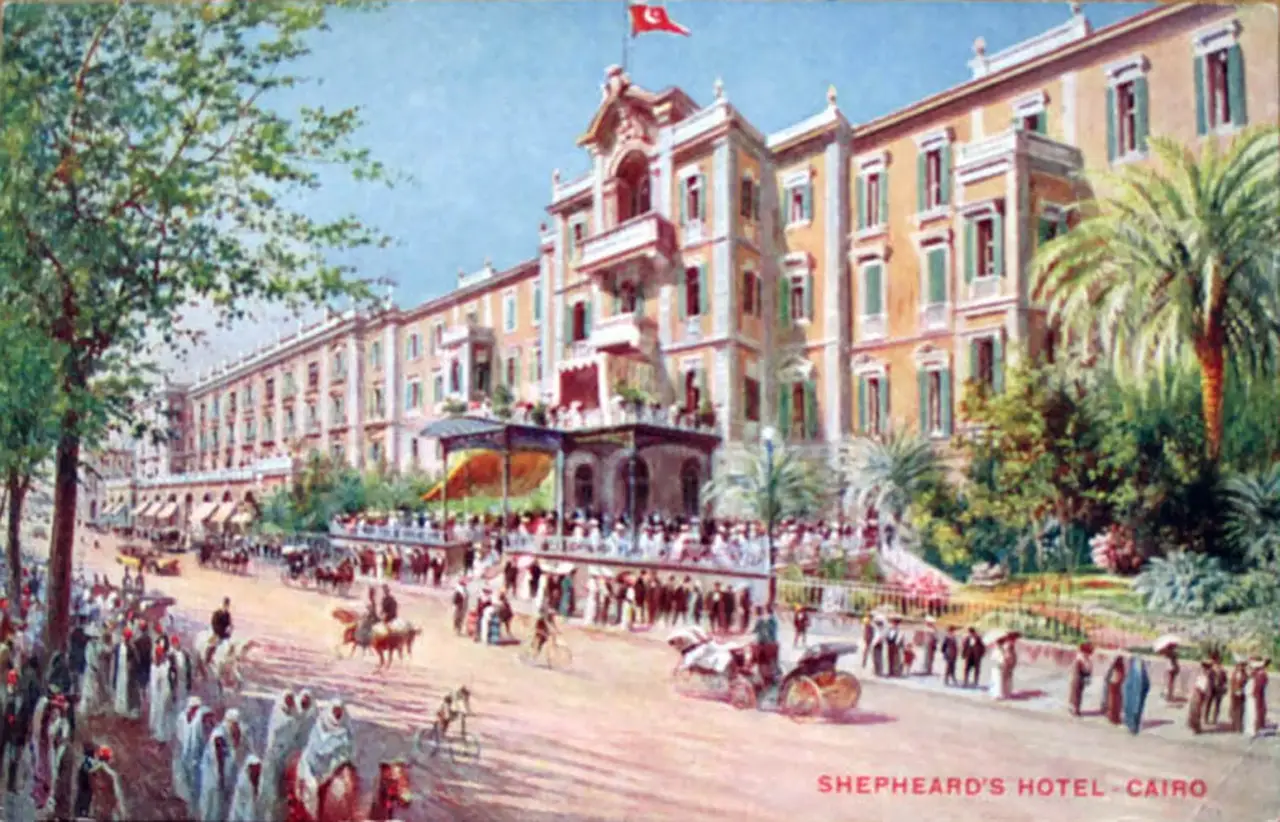 Shepheard's Hotel, Cairo, on a postcard of 1915. In the years of the licensed trade the antiquities business clustered around the hotel: dealers kept shops beside it, and R.H. Blanchard's stood in its garden. Public domain, via Wikimedia Commons.
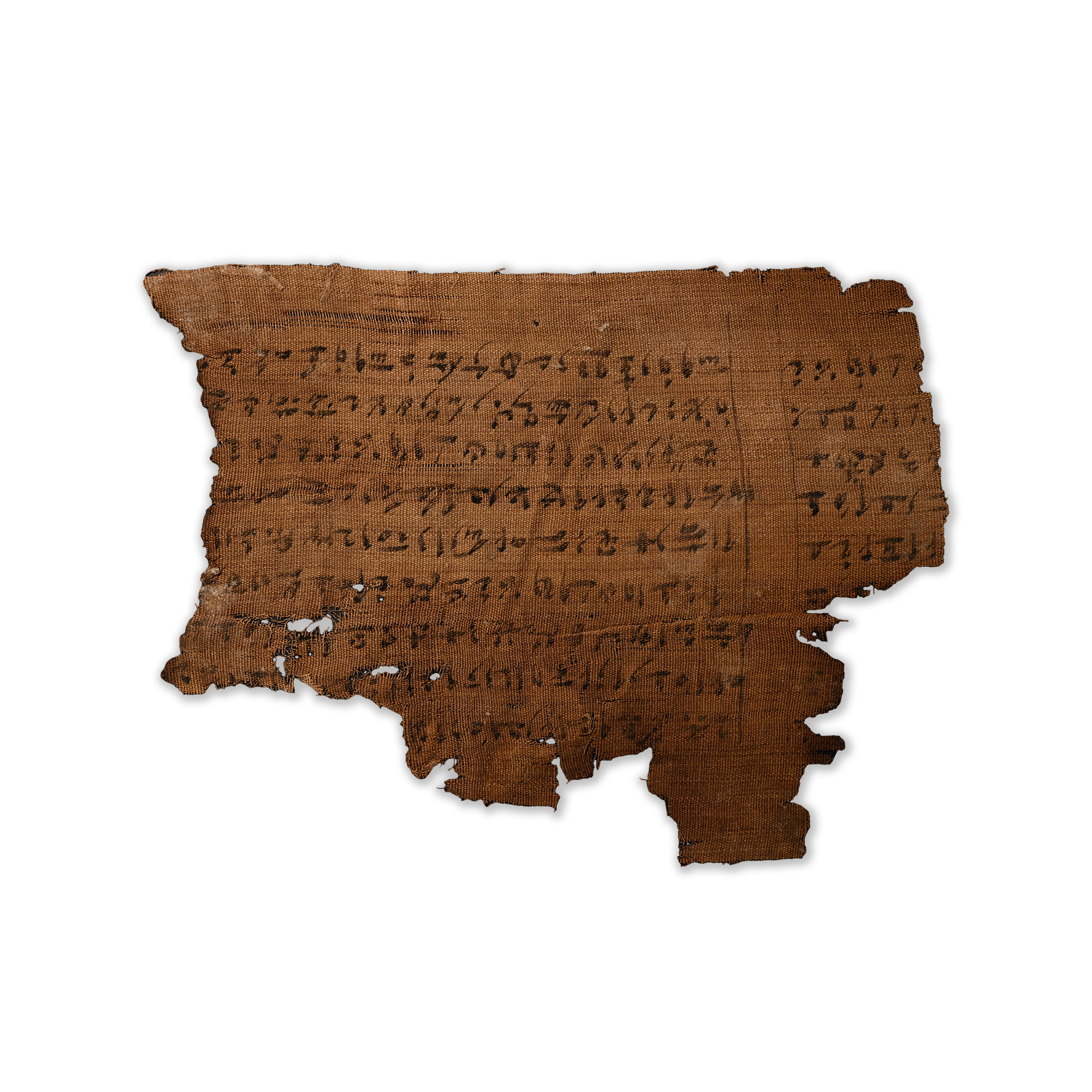
The first lot in TimeLine's auction of 8 September is a strip of linen, 22 centimetres wide, found pressed inside an eighteenth-century Bible. The ink on it is hieratic, the cursive script Egyptian scribes used when hieroglyphs were too slow, and it records part of Chapter 17 of the Book of the Dead, copied out for a woman named Ta-sherit-n-ta-ihet, daughter of Iset-em-khebit. Her father goes unnamed; funerary texts of the Graeco-Roman period traced descent through the mother. The fragment may have come loose at one of the mummy unwrappings staged as entertainment in the nineteenth century, crossed the Mediterranean in a traveller's luggage, and spent the better part of two centuries between the pages of scripture. The estimate is £500-700.
Anyone asking where to buy real Egyptian antiquities can learn most of the answer from that one catalogue entry. There is an object described precisely enough to be checked, with a date range rather than a false certainty. There is an ownership history, hedged exactly where the record runs out: "believed to be a souvenir acquired in the 19th century." There is a named researcher behind the reading of the text, Holly Lund, whose report was still in progress as the catalogue went to press. And there is a price that would not cover a month's rent in most British cities, for two-thousand-year-old ink spelling out an Egyptian woman's name.
The short answer: auction houses and established dealers
Buy from sellers who publish what they know and put their name behind it. In practice that means auction houses that produce a full catalogue entry for every lot, and specialist dealers, of whom the most established belong to trade bodies such as the Antiquities Dealers' Association in Britain or the International Association of Dealers in Ancient Art, whose codes of conduct commit members to checking what they sell. Either route now runs as much online as in person, and the venue matters less than the name: a timed online sale from an established house carries the same cataloguing and the same recourse as its saleroom.
A trusted source for Egyptian artefacts, in other words, is one that shows its working. The listing for a genuine piece tells you what the object is, when it was made, where it has been since it surfaced, and who has examined it, and the seller remains answerable for all four claims after the money changes hands. An object offered with none of that may well be ancient. The difficulty is that nothing but the listing says so, and when the day comes to insure it, sell it or leave it to your children, nothing will say so then either. Collectors pay for provenance because provenance is most of what they will one day resell.
Money is a smaller obstacle than most newcomers expect. The Egyptian section of TimeLine's 8 September sale runs to thirty-one lots; the lowest estimate is £200-300, and most of the section stays below £3,000.
Is it legal to buy Egyptian antiquities?
Yes. Buying, owning and selling Egyptian antiquities is lawful in Britain, Europe and North America, provided the object itself is legitimately on the market. The prohibition sits at the source: since 1983, no antiquity may be taken out of Egypt.
The date matters because the history behind it explains where everything now on the market came from. For most of modern history the Egyptian state itself sold antiquities. From 1889 the Egyptian Museum ran a sales room, the Salle de Vente, offering surplus objects with the export permit included in the price; Baedeker's guide for 1895 sent tourists there without a flicker, noting that in Room XCI "the visitor may purchase antiques, the authenticity of which is vouched for by the museum-authorities. A permit to export is given with each purchase." Beyond the museum walls the dealers did brisk business, just under a hundred of them licensed by the end of 1912, and foreign excavations worked under partage, the formal division of finds, which is how Flinders Petrie came to lay out his season's share each summer at University College London for the subscribers who had funded the digging. Law 117 of 1983 ended all of it. The trade inside Egypt was closed, dealers were given a year to wind up, and everything still in the ground became state property.
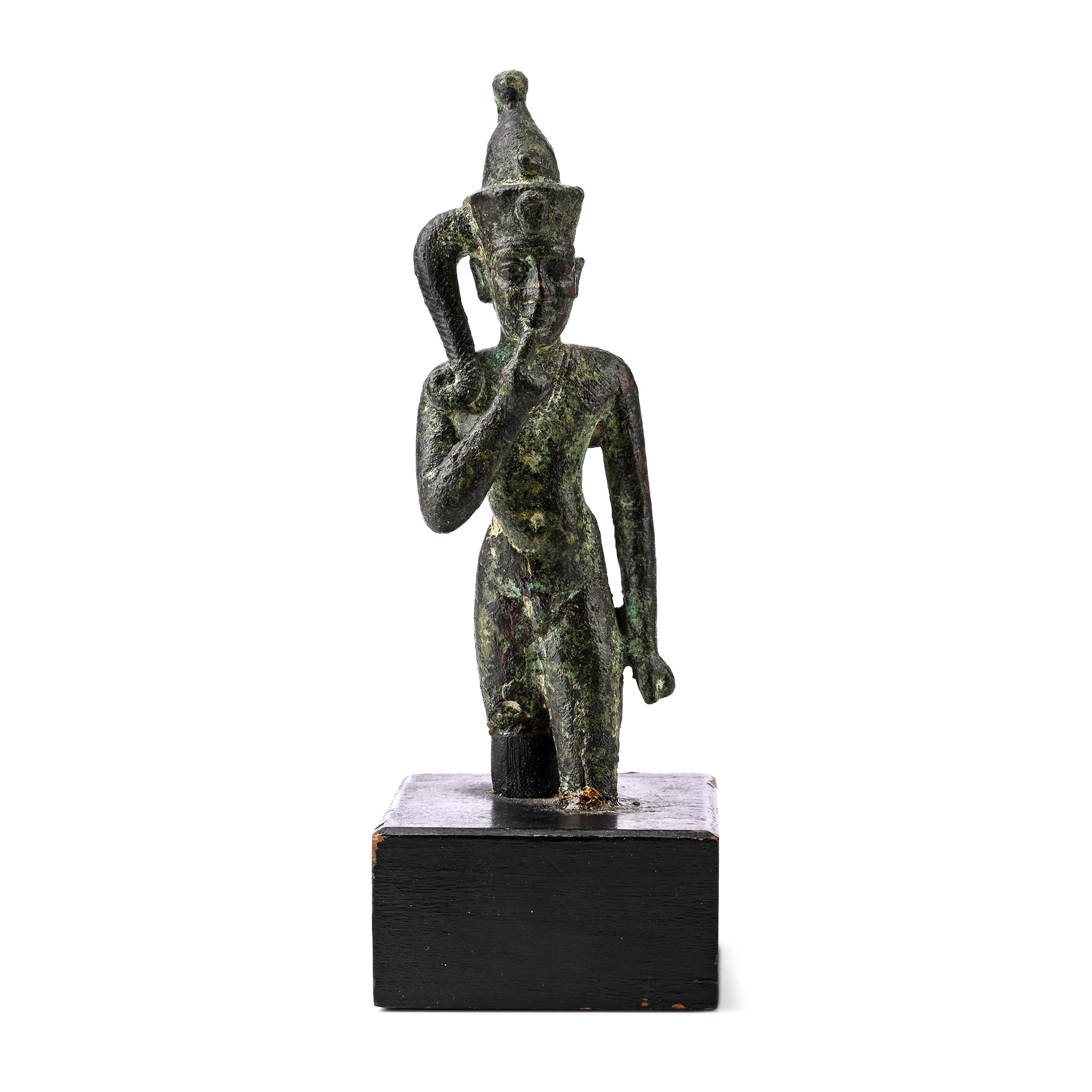
So the Egyptian antiquities legitimately for sale today are recirculating: pieces that left Egypt in the era of permits, sale rooms and divided finds, and have been moving from collection to collection since. One bronze in the September sale still wears the proof. A statuette of Horus as a child, hand raised to his mouth, sidelock of youth under the double crown, keeps its original base with the dealer's printed label still attached: "Blanchard's Egyptian Museum, Cairo, Egypt", the entry inked in by hand and finishing with "Guaranteed Genuine" above the signature R.H. Blanchard. Ralph Huntington Blanchard arrived in Egypt in 1905 with the American consular service and stayed to become one of Cairo's principal dealers; his "museum", as Fredrik Hagen and Kim Ryholt record in their study of the Cairo trade, was a shop in the garden of Shepheard's Hotel, where he traded from 1910. A century later the label is evidence: a legal purchase, from a licensed dealer, in the years when the trade was open.
For a buyer, then, the legal question folds into the historical one. What you need to know about any Egyptian piece is where it has been, and that is what a provenance is for.
What provenance actually looks like
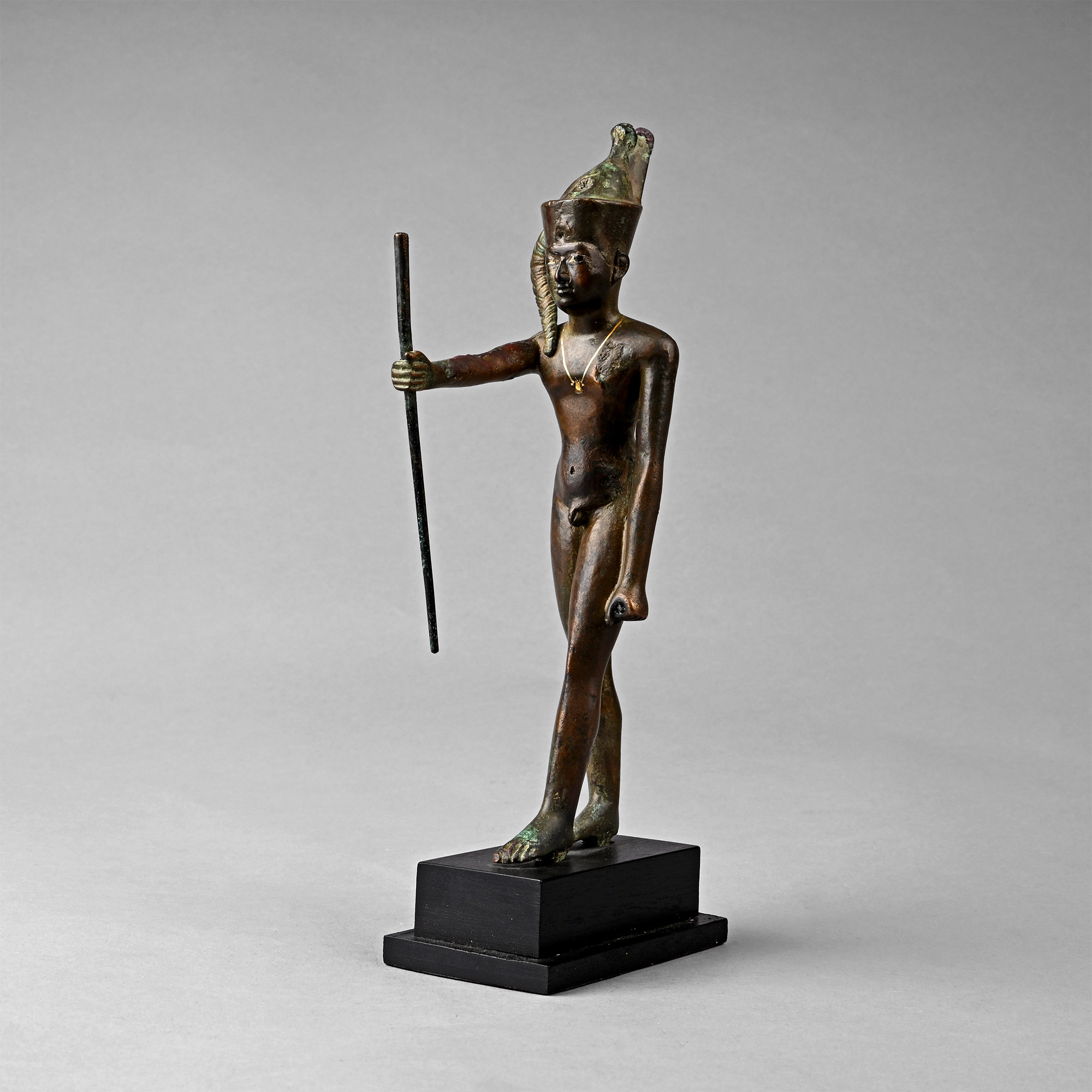
Provenance means ownership history, nothing more arcane than that. At the top of a sale it reads like a passport. The Egyptian section's chief bronze, a figure of Ihy, the child god of music and son of Hathor, 25 centimetres tall with its stand, naked, crowned, with silver-inlaid eyes and a gold necklace at his throat, comes with this itinerary: the Singer family collection in Germany from about 1962; a Geneva gallery in 1980; Christie's in London on 25 April 2015; a London private collection since. Copies of the Christie's catalogue pages accompany the lot, and the entry prints the certificate number of a search run against Interpol's database of stolen works of art. That is sixty years of documented whereabouts, each stage checkable.
Most objects carry less paper, and an honest catalogue says so plainly. A faience heart scarab elsewhere in the section is listed as "Ex Swedish nobleman's collection, early 20th century, reputedly from Petrie's excavations." Reputedly is doing real work in that sentence. The attribution is plausible, Petrie's finds having been dispersed to institutions and supporters across the world, but the trail rests on the family's say-so, and the cataloguer declines to firm it up. The hedge cuts in the buyer's favour twice over: it tells the truth about this scarab, and it tells you the same pen can be believed on the lots where the record is thick.
Between those poles run the standard formulas of the trade: "From a 20th century UK collection." "Acquired on the UK art market, 1990s." "From a North American gentleman's collection, 1990s." Dry as they sound, each is a dated claim a named business must stand behind, and each places the object in circulation decades ago. A plain line with a date in it outweighs a colourful story without one.
Professional buyers read the provenance line before they read the description, and it is a habit worth copying. The other habit is to keep everything once you have bought: invoice, catalogue page, certificates. Provenance is cumulative, and your receipt is its next line.
How do you know an Egyptian artefact is real?
Through documents, scholarship and comparison, and a good catalogue entry puts all three on display.
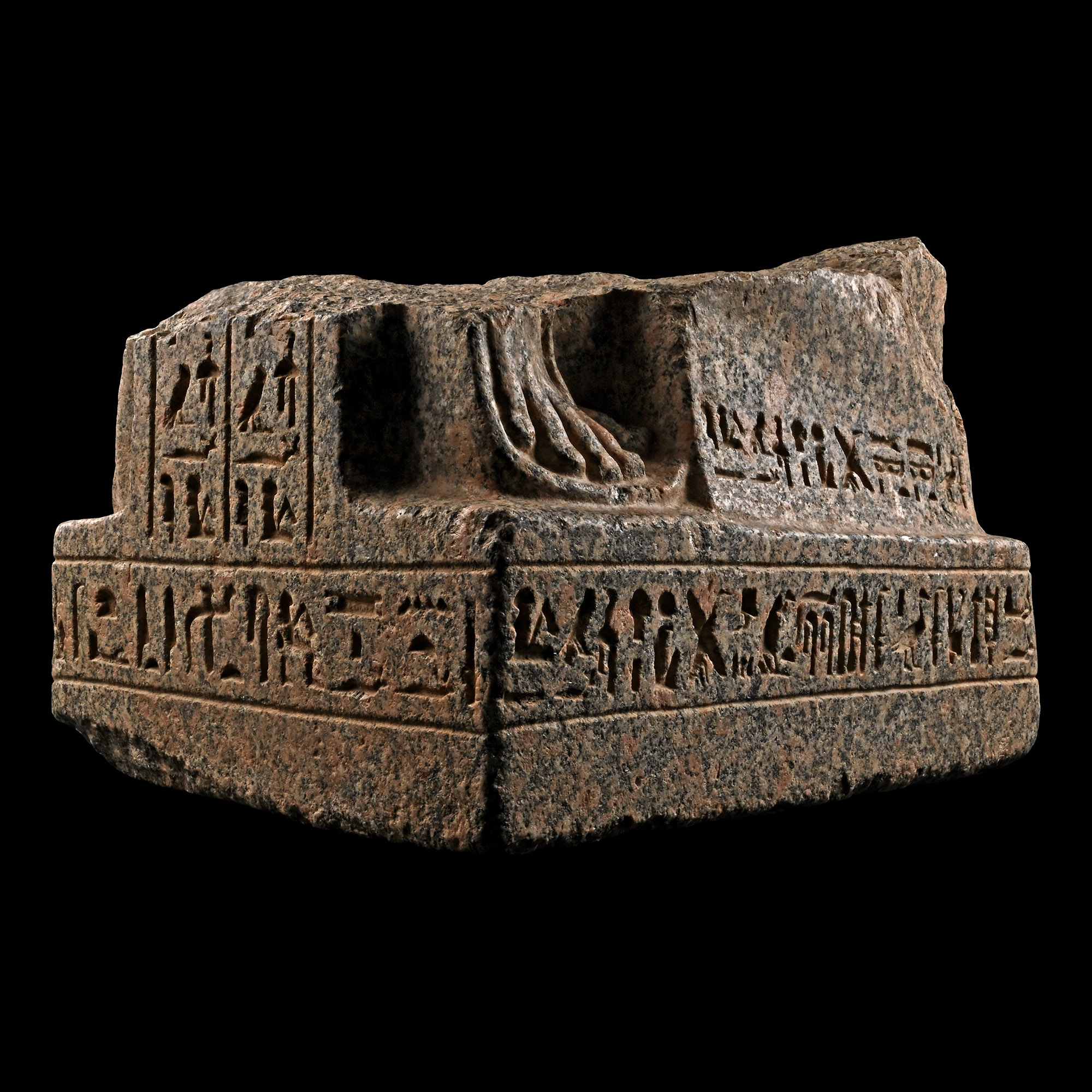
Scholarship is more present in salerooms than outsiders expect. The largest Egyptian object this September, a 140-kilogram reddish granite base from a kneeling statue of Prince Parahirwenemef, third son of Ramesses II and Queen Nefertari, preserves in its hieroglyphs a military title never recorded before, tpy n mšꜥ, "chief of troops", along with the first substantial evidence that the noblewoman Wadjet-khayty was the prince's wife. The Egyptologist Paul Whelan is preparing an article on it. Claims like those are an invitation to every Ramesside specialist alive to check the carving stroke by stroke; publication is exposure, and an object that courts exposure is an object its seller believes in.
Comparison does the quieter, daily work. The sale's Predynastic showpiece, a red-polished, black-topped jar of Nile silt coiled and burnished in the Naqada II period, well over five thousand years ago, is catalogued at 40 centimetres with its museum parallels listed by inventory number and size: 36.5 centimetres in Aberdeen, 33.6 in the British Museum, 35 at the Metropolitan. The type is understood, published and measurable, and this example sits at the top of its known size range. Where a piece has no parallels anywhere, caution belongs; where the parallels are printed beside it, the comparing has been done for you and can be redone against the museums' own databases in an evening.
Science is available where it applies. Fired clay can be dated by thermoluminescence, which measures the faint light released by radiation the material has absorbed since firing last reset it to zero; the technique has nothing to say about stone or bronze, which carry no such clock. That gap is why the paper matters more than the physics for most Egyptian material. In practice, authenticity is a judgement you delegate to a seller with expertise and a name to lose, and the sharpest question to ask any seller is what happens if a piece is ever shown to be wrong. An established house answers in writing, in its terms of sale, before you bid.
What your money buys this September
The Egyptian lots of 8 September cover more than four thousand years, from a Predynastic stone frog to a carved limestone funerary niche of Egypt's Coptic centuries, and their estimates run from £200 to £60,000.
Under £1,000: a blue-glazed faience pectoral painted with Anubis on his pedestal, £200-300. A small banded-calcite alabastron for perfumed oil, £300-400. A rock crystal locust, drilled for stringing in the New Kingdom, when the insect stood for regeneration, £400-600. A gold amulet of the cat goddess Bastet, eight millimetres tall and half a gram in weight, on the French art market by the 1920s, £500-700. Ta-sherit-n-ta-ihet's linen, £500-700. A black steatite wedjat, the healed eye of Horus worn for protection and recovery, £700-900. A pair of coffin eyes in alabaster and black glass, made to give a coffin a living gaze, £800-1,000.
Between £1,000 and £3,500 the objects grow and the names arrive. A diorite heart scarab, the amulet laid over a mummy's heart, the organ Egyptians expected to be weighed at judgement, £1,000-1,400. A faience New Year flask, its neck flanked by baboons of the kind that greeted the rising sun, £2,000-3,000. A green faience Nefertum, the lotus god, with his lioness mother Sekhmet in relief on his back pillar, £2,000-3,000. An eighteenth-dynasty serpentine jar of a form found at Thebes and Amarna, £2,500-3,500, and a Middle Kingdom granite official, seated, gripping a folded cloth on his thigh, £2,500-3,500.
Two shabtis in this band come with royal names attached. One, in brownish-black and white faience at £1,500-2,000, was made for Prince Khaemwaset, fourth son of Ramesses II, sem-priest of Ptah at Memphis and restorer of monuments a thousand years older than himself; Kenneth Kitchen called him perhaps the world's first Egyptologist. The other, blue-glazed at the same estimate, names a sem-priest Hor, plausibly the Hori who was Khaemwaset's own son: a similar shabti was found lying with the prince's in the Serapeum at Saqqara, the underground burial of the sacred Apis bulls, and recorded by Auguste Mariette in 1857. Father and son, if the identification holds, at £1,500-2,000 apiece.
From £8,000 the sale reaches its sculpture. A Ptolemaic bronze of the god Neferhotep, was-sceptre in hand, from a Belgian collection formed in 1949, £8,000-10,000. The black-topped vase, £8,000-10,000. The Ihy, £20,000-30,000. The Parahirwenemef base, £40,000-60,000.
And the names run the full length of the ladder: Ta-sherit-n-ta-ihet at £500-700, Hor and Khaemwaset at £1,500-2,000, Parahirwenemef at £40,000-60,000. An object carrying the name of a person who lived on the Nile is on offer here for the price of a mobile phone.
Advice for a first purchase
Go to the viewing. Auction viewings are free, cases are opened on request, and ten minutes handling a bronze teaches more than an evening of photographs: the weight surprises, and the surface has a texture no image carries. TimeLine's Egyptian material this September is lots 1 to 31 of the 8 September sale, on view beforehand and catalogued in full online, where reading costs nothing.
Read condition notes the way you now read provenance lines. The shabti of Hor says "repaired", in plain sight, with the estimate set accordingly; a seller who volunteers the repairs is showing you there is nothing that needs hiding.
And start where ancient Egypt itself was prolific. Amulets, scarabs and shabtis were turned out in quantity for three thousand years, which is why the genuine article begins around £200, and why the types are so thoroughly published that most claims can be checked from a public library.
Chapter 17, the spell on the linen that opens the sale, concerns divine knowledge and the transformation of the dead in the afterlife. It was copied onto Ta-sherit-n-ta-ihet's wrappings to see her through hers, and in a manner of speaking it has kept working: the linen has survived an unwrapping, a sea crossing and the better part of two centuries pressed in a Bible, and on 8 September it will carry her name, and her mother's, to whoever values them at £500.
TimeLine Auctions, 22nd August 2026