Home > Stories by TimeLine Auctions
Stories by TimeLine Auctions
Why Bronze Survived and Iron Didn't
In 1972 a man snorkelling off the Calabrian coast saw a bronze arm protruding from the sand. It belonged to one of two bronze warriors, the Riace Bronzes, who had spent something close to two thousand years on the seabed. They came up almost sound: silver teeth, copper lips and nipples, the muscles still legible under a thin skin of corrosion. Iron from the same kind of water behaves nothing like this. On many wrecks the iron has gone entirely. Where a sword or a tool once lay, the hard crust around it holds a clean, empty cavity in the exact shape of the thing that dissolved. Marine conservators have learned to read these voids: they X-ray the lump, drill a small hole, pump in epoxy resin, and chip the crust away to lift out an accurate cast of an object that no longer exists.
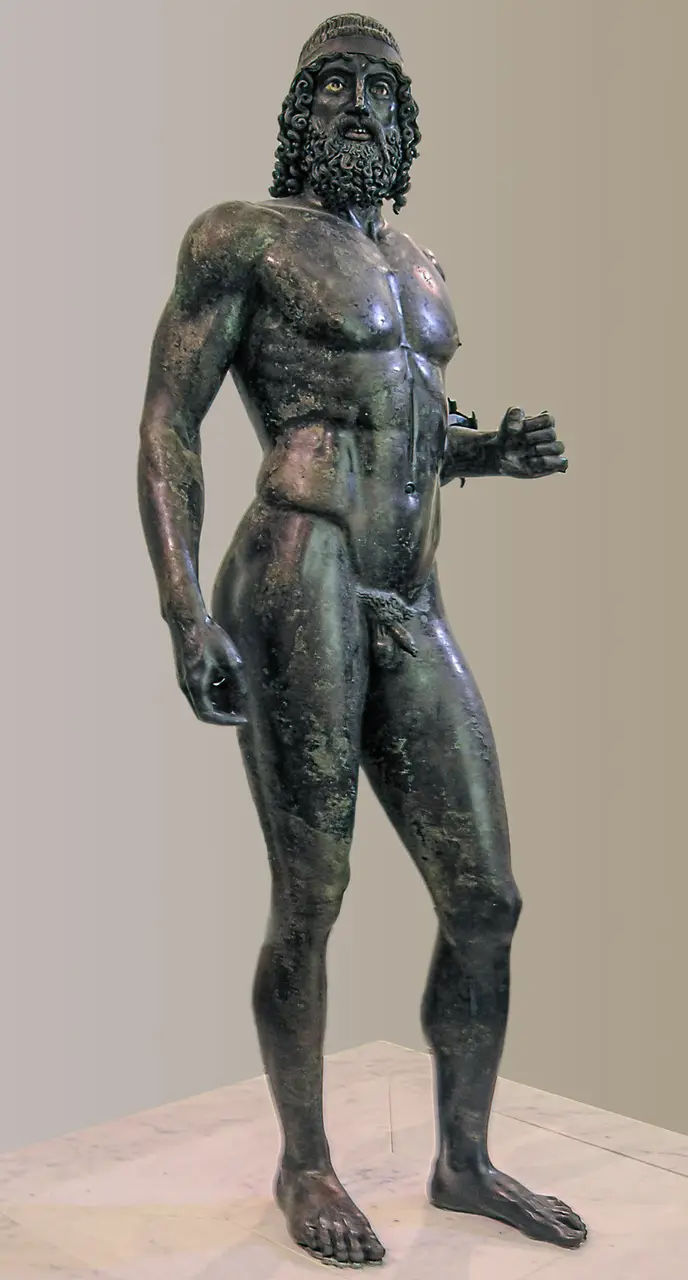 Riace Bronze A, one of the two Greek warriors raised off the Calabrian coast in 1972, cast around 460 BC. Museo Archeologico Nazionale della Magna Grecia, Reggio Calabria. Photo: Ismoon, CC BY-SA 4.0, via Wikimedia Commons.
Same sea, same centuries, opposite outcomes. The short explanation is that bronze is a noble, durable metal and iron a base, perishable one, and that is true enough to be misleading. The chemistry does favour bronze, and it favours it decisively. But chemistry is only one of three judges that decide what reaches a museum case, and the other two overrule it more often than the title of this article lets on.
The Skin and the Lump
Both metals are unstable the moment they are made. Smelting drags them out of the ores they came from, and, left alone, they slide back toward those ores. In dry air the slide is slow and stops at a tarnish. Add water and it turns into electrochemistry. A small battery sets itself up across the surface: an anode where the metal dissolves and gives up electrons, a cathode where oxygen mops those electrons up, and water in between to carry the current. Dissolved salt makes the water a better conductor and pushes the whole reaction along. The two poles can sit a hair's width apart on a single buried blade.
What happens to the dissolved metal next is the entire story. The ions coming off the anode have two possible fates, and which one they take decides everything. They can stay soluble, wash away, and let the metal corrode down to nothing, or to a faint stain in the soil. Or they can lock into something insoluble that clings to the surface, thickens, and slowly smothers the very battery feeding it. Copper takes the second road. Iron, in most ground, takes the first.
When copper corrodes it builds its skin in a fixed order. First comes cuprite, a red-brown copper oxide, laid down directly on the metal. Over that grows malachite, the familiar green copper carbonate, with blue azurite in drier conditions. In a tin bronze the tin gathers in the outer layer as cassiterite, a tin oxide, adding a further seal to the alloy that carries it. David A. Scott, whose Copper and Bronze in Art is the conservator's standard reference on this, describes corrosion that grows in register with the metal it is replacing, layer tracking layer, so that the shape is held even as the substance changes underneath. Carry it to the extreme and the copper can be gone completely. What remains, in Scott's words, is "a fragile relict of tin oxides that may look like a piece of bone," and yet the form is preserved. A green bronze in a display case may be more mineral than metal. It still looks like itself.
This is why the patina is the first thing anyone handling an old bronze looks at, and the hardest thing for a forger to get right. An even green or blue-green skin is the ordered corrosion that kept the object's shape, not dirt and not a finish applied for show. When we catalogue a small Roman bronze, half of what we are reading is the patina: whether it grew slowly and evenly in the ground, or was painted on last year.
Iron does the reverse, and does it with enthusiasm. Its rust is a whole family of compounds: orange-brown goethite and lepidocrocite for the bulk, dense black magnetite in the oxygen-starved interior, and, worst for a freshly dug object, a chloride-bearing form called akaganeite. The decisive difference from copper is physical as much as chemical. As J. M. Cronyn sets it out in The Elements of Archaeological Conservation, iron corrodes by losing metal from the surface, and the dissolved iron is mobile: it travels away from the object before it precipitates, and where it lands as oxide it takes up far more room than the metal it came from. The rust is bulky and it flakes. Because it never forms a tight film, it never smothers the battery, and the corrosion just keeps going, in Cronyn's phrase, "until all metal is converted to oxyhydroxides." Bronze grows a skin. Iron grows a lump, and then the lump eats the rest.
The void in the shipwreck crust is the endpoint of that process underwater. So is its equivalent on land: at aggressive sites the excavators sometimes find, where an iron object should be, only a hollow object-shaped cavity, the single trace left of the thing itself. And digging iron up, far from saving it, often kills it. Buried iron settles into a fragile truce with its surroundings; excavation breaks the truce by flooding the salt-laden crust with fresh oxygen. Objects that have kept a metallic core begin to weep, sweating orange tears of iron chloride that pull in moisture and restart the corrosion from inside. The akaganeite swells and splits the rust layers apart. The cruel detail, recorded again and again in conservation reports, is that the iron objects with some good metal left are the ones that tear themselves to pieces on the shelf, while the ones already corroded hollow sit quietly. Cast iron raised from the sea can be worse: as the trapped metal reacts, recovered cannon have been known to crack apart, and to grow hot enough doing it to steam.
One thing in that account should give a bronze owner pause. The villain in iron's post-excavation collapse is chloride, common salt, and bronze has a door that the same key opens. Beneath a sound-looking green patina there can be a layer of cuprous chloride, a waxy compound conservators call nantokite, lying dormant until it meets damp air. When it does, it hydrolyses, throws off hydrochloric acid that attacks the fresh copper underneath, and in the process makes more of itself. Marcellin Berthelot identified the cycle in 1894, and the name it goes by is honest enough: bronze disease. The dense chloride converts to bulky pale-green powders, the swelling cracks the object from within, and, untreated, the reaction can reduce an apparently solid bronze to a heap of light green dust. The cure is dull and reliable: keep the air dry, below about 35 per cent relative humidity, and the cycle has nothing to feed on. Bronze is not immortal. It is far better defended than iron, and it shares iron's one great enemy.
Same Metal, Different Dirt
If the metal were the whole story, every iron object would rot and every bronze would keep its shape. Neither is true, because the ground gets a vote, and its vote often carries. Scott puts the point plainly: the environment as such matters less than the exact chemical species in it, and those species can flip the expected outcome.
Fiskerton, an Iron Age timber causeway in the Lincolnshire fens, shows the swing inside a single site. Iron tools dropped into the permanently waterlogged layers came out barely touched, their forging marks still sharp, because once the trapped water has used up its oxygen the setting turns reducing and the corrosion cell has nothing to run on. The same kinds of object from the upper, aerated levels of the same site were severely corroded and broken. Depth decided their fate, not the metal. Waterlogged ground that starves iron of oxygen can hold it for thousands of years; it can even coat it in a protective blue film of vivianite.
Water alone is not the rule, though, or bogs would be kind to everything. Peat is acidic, often around pH 4, and anaerobic, which makes it superb for organic things and ruinous for inorganic ones. The bog that gives back a two-thousand-year-old body with its skin and stomach contents intact has dissolved that same body's bones, and any bronze or iron buried with it, with the same acid. Best preserved is always a question of best preserved for what.
At the opposite extreme, taking the water away shuts the cell down altogether. This is why the driest places keep metal best, and why the iron dagger from Tutankhamun's tomb came out without rust after more than three thousand years. The dagger had two things in its favour: a bone-dry tomb, and a blade of meteoric iron, naturally alloyed with about eleven per cent nickel, which resists corrosion far better than smelted iron of the period would have.
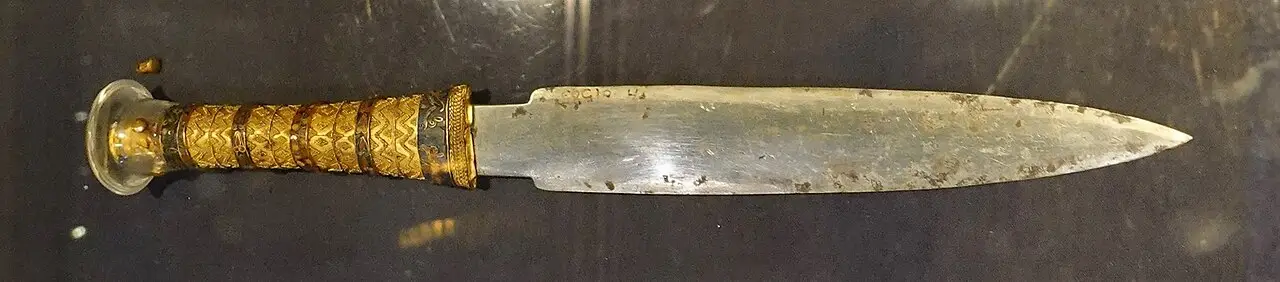 The dagger from Tutankhamun's tomb, its meteoric-iron blade still bright after more than three thousand years, with a gold hilt. Egyptian Museum, Cairo. Photo: Olaf Tausch, CC BY 3.0, via Wikimedia Commons.
Most ground is neither bog nor desert but damp, aerated, and mildly acidic, which is the worst case for both metals and the ordinary fate of most buried things. Soluble products wash away, iron goes to a lump or a stain, and even bronze can be stripped of its patina. On one assessment, two-thirds of the soils of England and Wales are rated poor for the survival of buried base-metal objects. Nor does airless mean safe: in waterlogged anaerobic deposits, sulphate-reducing bacteria attack iron and lead through the sulphide they produce. Copper slips even this, because copper is toxic to the bacteria. At almost every turn the same property that protects copper finds one more way to protect it, and iron finds one more way to fail.
Why So Few Bronze Statues Survive
So far the title holds: bronze's chemistry beats iron's, and the right ground can save either. But walk into the bronze gallery of any large museum and a different fact presses in. There is so little there. A handful of full-size Greek bronze statues, when the written sources describe them in their thousands. Pliny put three thousand statues at Olympia alone, and credited the sculptor Lysippos by himself with some fifteen hundred bronzes. Salvatore Settis, surveying what is left, counts "only about one hundred more or less undamaged Greek bronze statues of significance in the world," and notes that almost all of them have surfaced in the last 120 years, most of them dragged up from the sea.
The chemistry did not do this. People did. Bronze survived as a material precisely because it was so easy to melt down and recast, and that is exactly why bronze objects did not survive. A statue was a standing reserve of valuable metal. When it fell out of favour, or its city fell, it went into the furnace and came back as coin, weapons, or a newer statue. This happened in antiquity as readily as later: a fourth-century inventory from the Athenian Akropolis already lists damaged votive bronzes marked down to be melted. What the recyclers missed, the lime-burners often took, feeding marble sculpture into kilns for quicklime. We know most of the famous works of Greek sculpture only through the Roman copies in marble, which is why so many of them lean on an awkward tree-trunk strut: the marble needs that support to stand, and the lost bronze originals never did.
The bronzes that did come through are, almost without exception, the ones that fell out of the human economy by accident. The Riace warriors and the Artemision god went down in shipwrecks. The Delphi Charioteer was knocked by an earthquake into a drain and buried. Four bronze statues survived at Piraeus because someone stacked them in a storeroom and the building burned when Sulla sacked the port in 86 BC, sealing them in before anyone came back. The bronze rider at the centre of Rome's Capitoline survived for the dullest of reasons: medieval Rome thought the emperor on the horse was the Christian Constantine, not the pagan Marcus Aurelius he actually is, and so left the only complete Roman imperial equestrian bronze standing while others went to the crucible.
Iron met the same end from the opposite direction. It was cheap, came from local ore almost everywhere, and was worked until it wore out and then forged into something else. An old iron tool was not treasure to be hoarded; it was raw material to be reused, and normally only small fragments ever escaped that cycle. Both metals, then, were destroyed wholesale by human hands. Bronze because it was too valuable to leave alone, iron because it was too cheap to keep. What sits in the cases is the residue of three filters working in series: which metals resist corrosion, which objects escaped the furnace, and which of those came to rest somewhere kind, a wreck, a grave, a destruction layer, a bog.
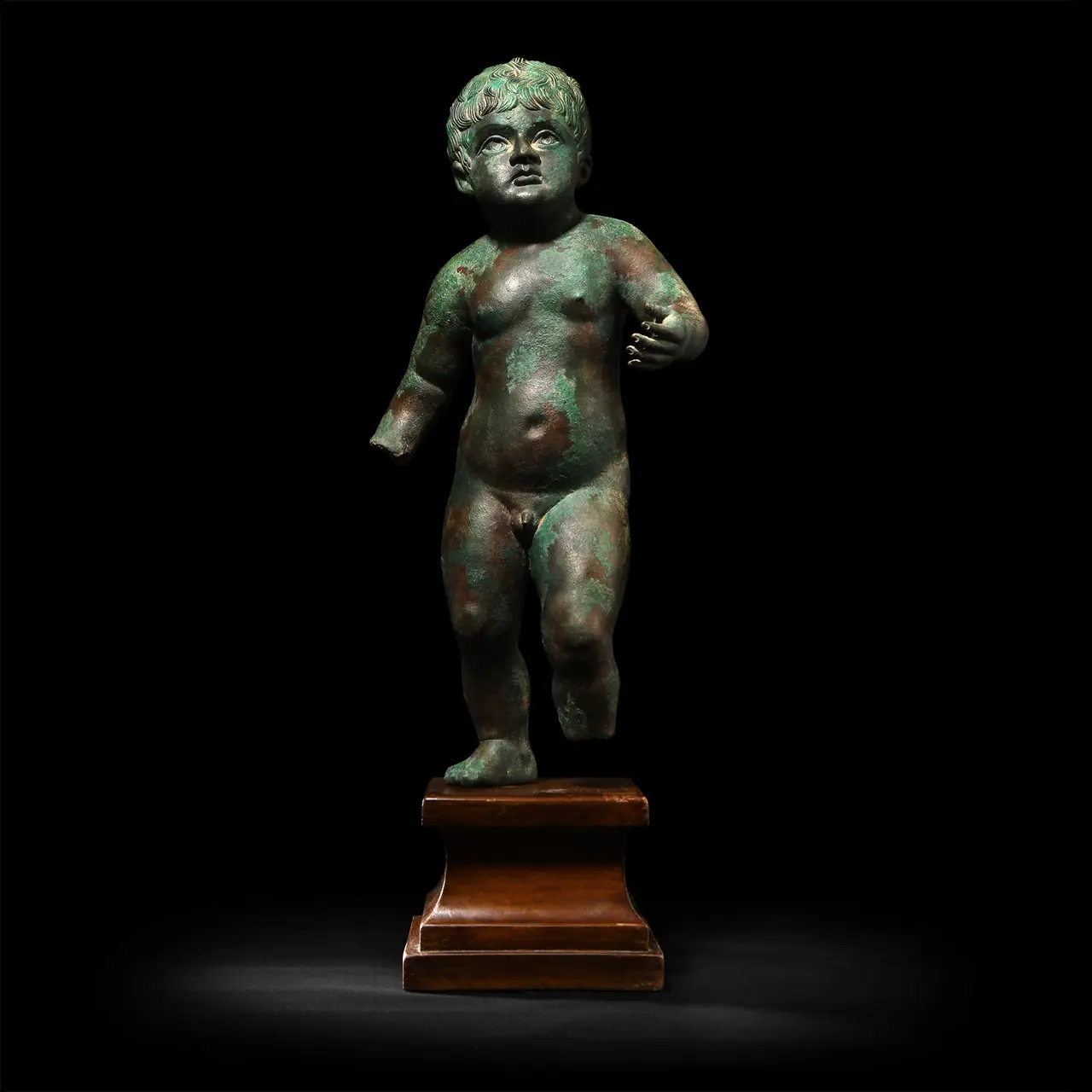
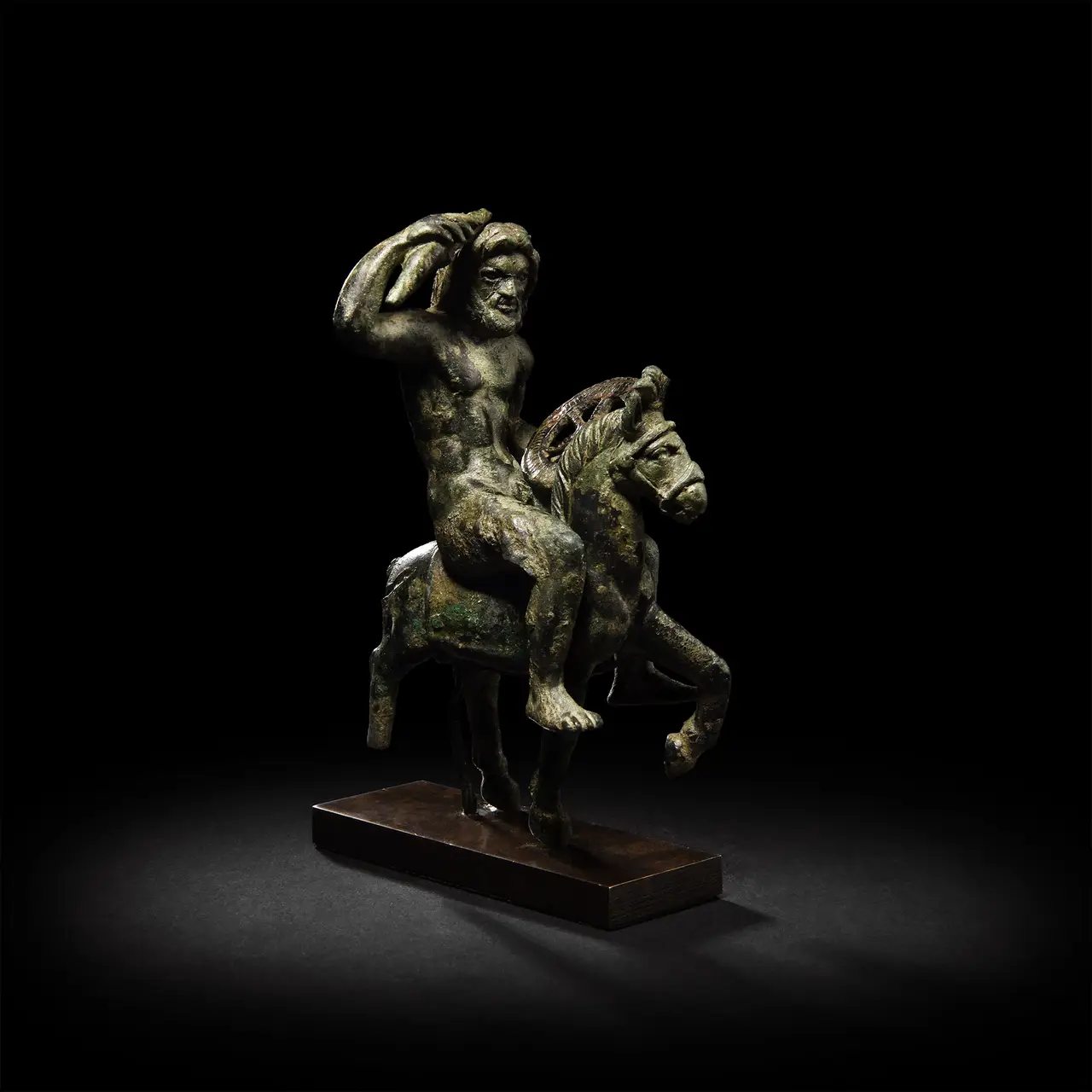
It also sets the shape of the antiquities market. The grand bronzes are nearly all accounted for, sitting in national museums with their own recovery stories. What circulates instead, and what a collector is likely to handle, is the small bronze that was never worth melting on its own: a votive figurine, a fibula, a steelyard weight, a lamp, a coin. These came through in the same way and for the same reasons as the statues, just below the threshold that made melting worthwhile, and the green patina that tells their story is the same one the Riace warriors wear.
The Pillar That Shouldn't Be Standing
In a courtyard in Delhi stands a column of iron that has refused, for some sixteen centuries, to do what iron is supposed to do. The Iron Pillar is more than seven metres tall and weighs over six tonnes, forge-welded from blooms of wrought iron some time around AD 400, and it carries almost no rust. For a long time it was treated as a marvel without an explanation. The explanation, when it came, turned out to be plural. The metallurgist R. Balasubramaniam traced the resistance chiefly to phosphorus: the ancient smelters used no lime, so their iron kept a high phosphorus content, around a quarter of one per cent, which over time builds a thin, self-repairing film of iron phosphate across the boundary between metal and rust. Delhi's sharp wet-and-dry cycle helps the film mature, and slag trapped in the forge-welded metal plays its part too.
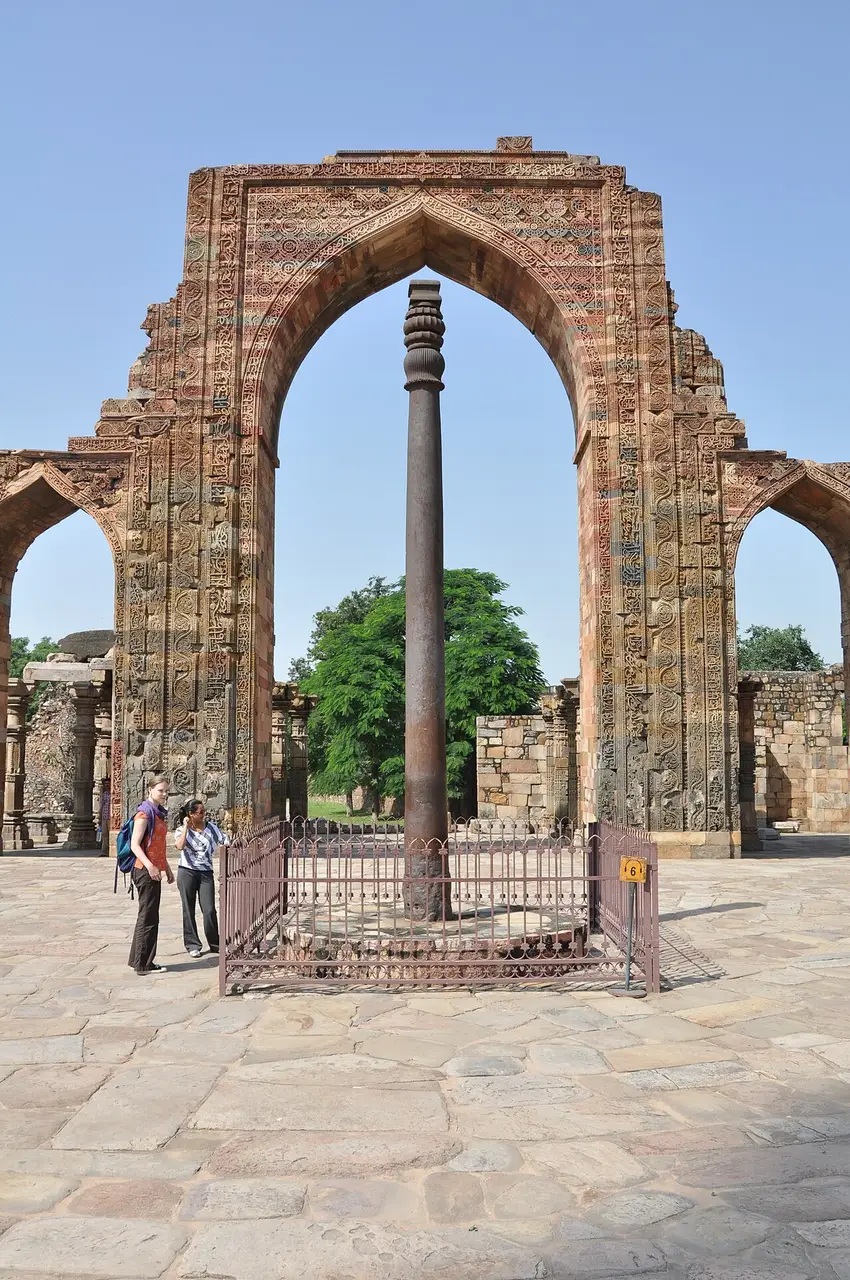 The Iron Pillar in the Qutb complex, Delhi, forge-welded around AD 400 and over seven metres tall, still almost free of rust. Photo: Aiwok, CC BY-SA 3.0, via Wikimedia Commons.
It is not magic, and it is not quite immortality either. Iron sampled from the pillar and taken out of Delhi's climate begins to rust like any other, and the buried base of the column, sitting in damp soil, shows real corrosion. Specialists still argue over how much credit goes to the phosphorus, how much to the climate, and how much to the sheer mass of the thing. The pillar makes the right closing point, which is that none of this was ever a law. Bronze tends to keep its shape and iron tends to lose it, for reasons that are real and chemical and worth knowing, but the tendency is a matter of odds, and the odds can be beaten. An iron column that should long since have been a rust-stain in the ground has instead stood in the open Delhi air since around AD 400, and metallurgists are still standing in front of it, working out exactly why.
TimeLine Auctions, 10th July 2026