Home > Stories by TimeLine Auctions
Stories by TimeLine Auctions
Why so many ancient coins survived
A worn Roman silver denarius, close to two thousand years old, can be bought today for less than the cost of dinner out. By most reasonable expectations it should not exist at all.
Most ancient coins did not survive. Once an issue went out of use its metal was always worth more than its face value, and the simplest thing to do with old coin was to melt it down for the next one. Numismatists who reconstruct ancient output from the dies that struck it generally assume that only a small fraction of one percent of what was minted is still with us. Whatever escaped the crucible then faced two thousand years of soil chemistry, ploughing, fire, flood, and the attention of anyone who happened to dig it up. And yet a late Roman bronze in collectable condition is an ordinary purchase rather than a museum-grade rarity, and a beginner can own a coin handled in the reign of Constantine for a few pounds. Two things account for that. One is the sheer volume that was made. The other is the durability of the metals chosen to carry it.
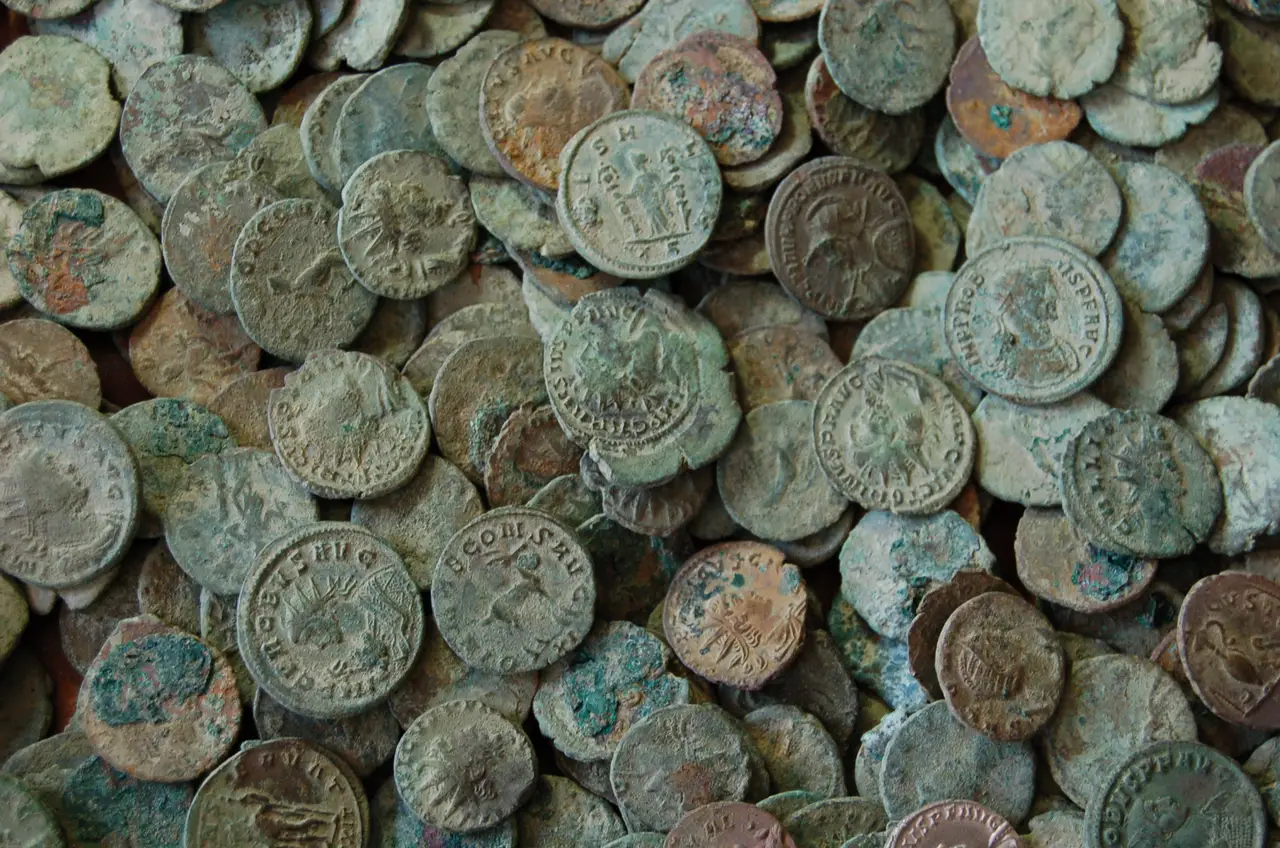 Part of the Frome Hoard, over 52,000 Roman coins lifted from a single buried pot in Somerset in 2010 and now in the Museum of Somerset. Photo: Portable Antiquities Scheme, CC BY-SA 2.0, via Wikimedia Commons.
How many coins were made
Greek and Roman cities ran on coin to a degree that surprises modern readers. A single Greek polis might strike silver as much for civic pride as for trade, and the Hellenistic kingdoms paid their armies and built their fleets in precious metal. Money was the working tool of public life rather than an occasional luxury.
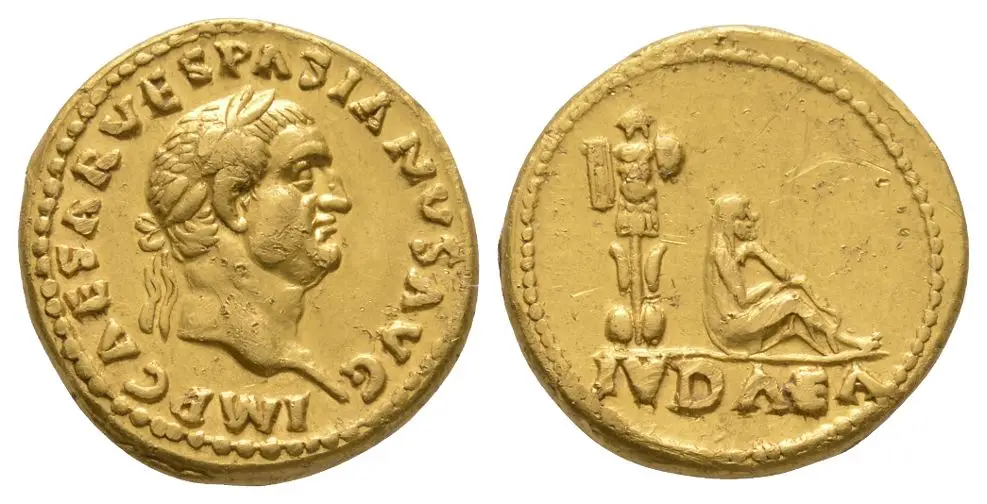
Roman imperial and provincial mints together turned out coinage on an industrial scale. No mint ledgers survive, so the figures come from modelling production against the dies that have come down to us, and those models put annual output across the empire into the tens of millions of coins, far higher in the busiest reigns and the busiest metals. Silver denarii alone were struck in quantities that kept a standing army of several hundred thousand men in pay, year after year, for centuries. At the top of the system sat gold, issued in far smaller numbers but to the same exacting standard, like the aureus Vespasian struck to advertise the defeat of Judaea.
Further east the scale was larger still. Song-dynasty China cast its money rather than striking it, pouring molten bronze into moulds for the round coins with a square central hole. At the height of production in the 1070s and 1080s, government mints were turning out something on the order of six billion cash coins in a single year. A survival rate well under one percent still leaves an enormous residue when it is applied to numbers like these.
The metals that lasted
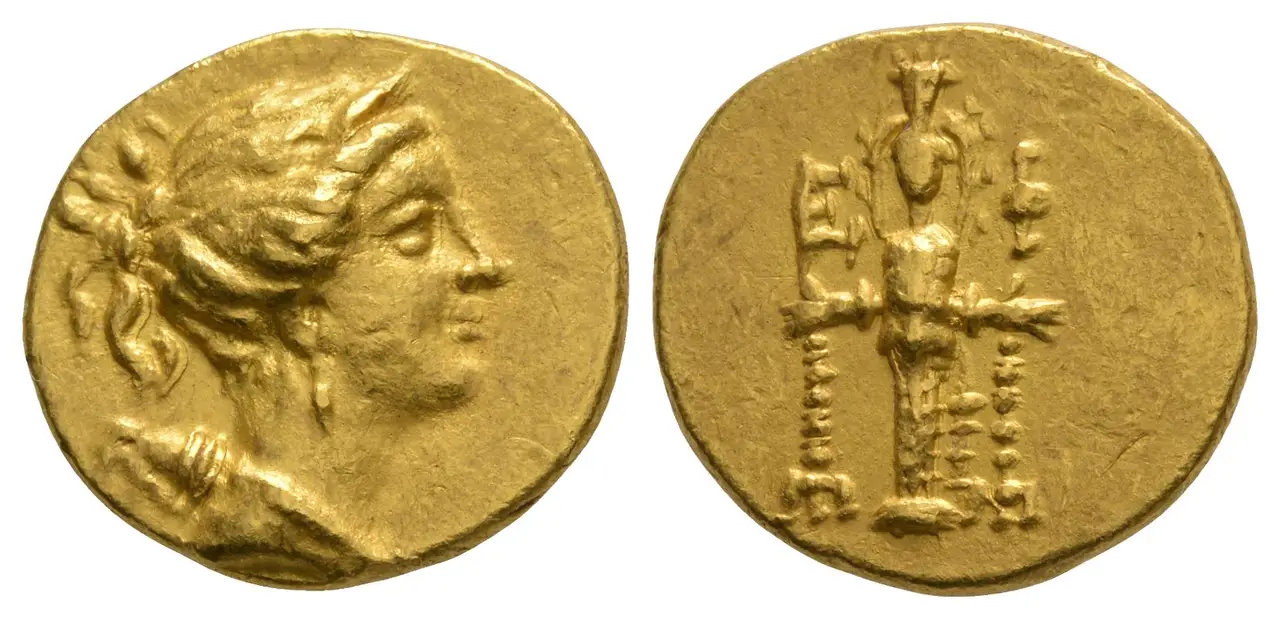
The choice of metal was not arbitrary, and it largely decided what would still be here to collect. Gold is almost chemically inert. A gold stater can lie unprotected in damp ground for two thousand years and come up essentially as it went down, the surface bright and the detail crisp. This is why ancient gold, though it was always the scarcest coinage, reaches the saleroom in a condition that silver and bronze of the same age rarely match.
Silver tarnishes and takes a dark tone, but the tone tends to seal the metal beneath it rather than eat into it, and a careful clean recovers a usable surface. Much of the silver in collections carries an old cabinet tone that collectors prize and leave well alone. Copper and bronze are more reactive and usually emerge crusted in green or brown corrosion, the familiar look of a base-metal find, yet they are durable enough to last. That is why the bronze coinage of the later empire fills auction catalogues today and underwrites the whole affordable end of the field. Iron is the exception. It can rust to flakes within a few centuries in poor ground, and iron coinage is correspondingly scarce in the surviving record, a reminder that survival is partly a question of chemistry.
What survival means for the collector
All of this has a happy consequence for the private collector. Ancient coins are among the most accessible antiquities anyone can own. They were made in quantity, they survived in quantity, and the market for them is deep and long established, so a legible bronze of a Roman emperor can cost a few pounds while the same cabinet might also hold a piece that took a specialist years to track down. Few other fields let a beginner start for the price of a paperback and still keep rarities in reserve to grow into.
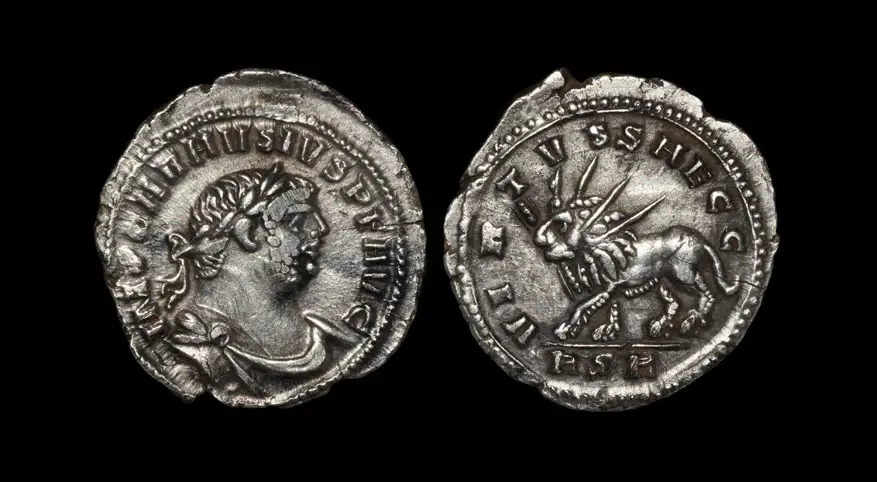
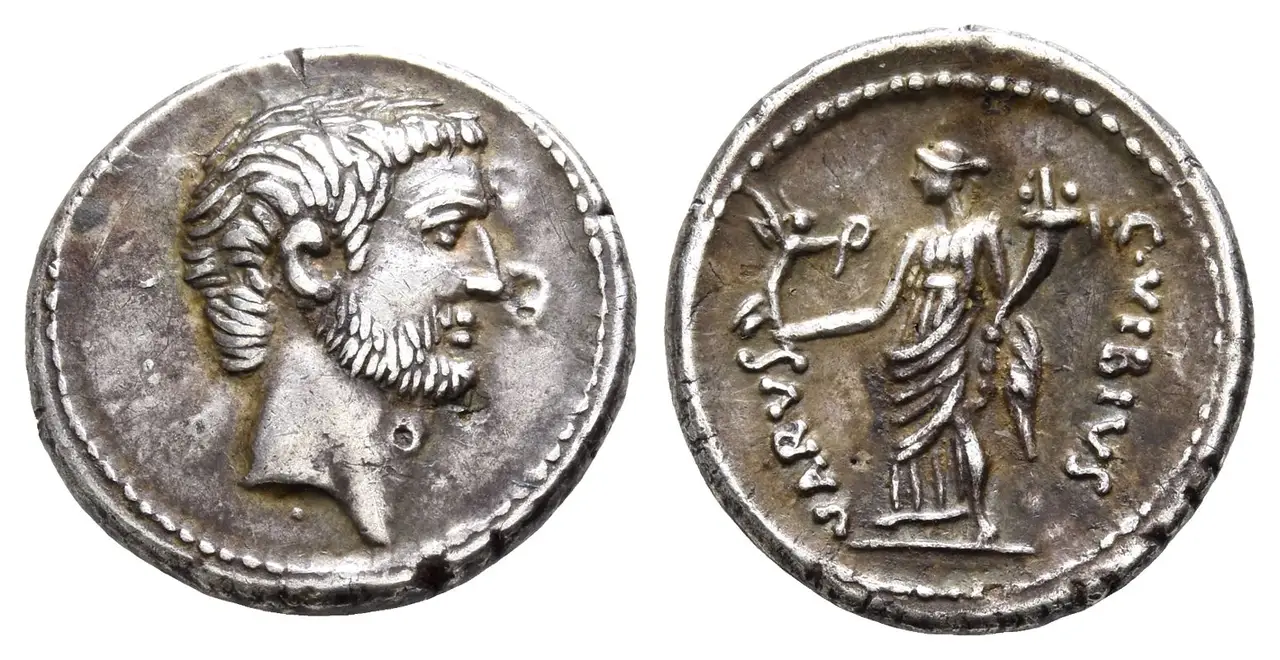
Private collecting has also done real work for knowledge. In England and Wales the Treasure Act and the Portable Antiquities Scheme have turned the metal detector from a threat into a recording instrument: hoards are reported, plotted, and published, and the find spot that gives a coin its history is preserved. A great many catalogued coins carry the note "this coin" against an entry in the standard references, the trail of an object that passed through scholarship on its way through the market. The rare radiate denarius of Carausius below is one of them, recorded with the Scheme long before it reached a saleroom.
The role of hoards
Almost every coin in a collection today was, at some point, lost or hidden. Casual losses feed the record, the stray drop from a market purse or the coin that rolled into a doorway, but the bulk of surviving material comes from hoards. There were no banks in the modern sense. Temples could serve as places of safe deposit, yet a wealthy temple in a great city was the first thing an invading army made for. Most people did the obvious thing and put their savings somewhere private: under a floor, between rocks, beneath a tree, or inside a sealed pot.
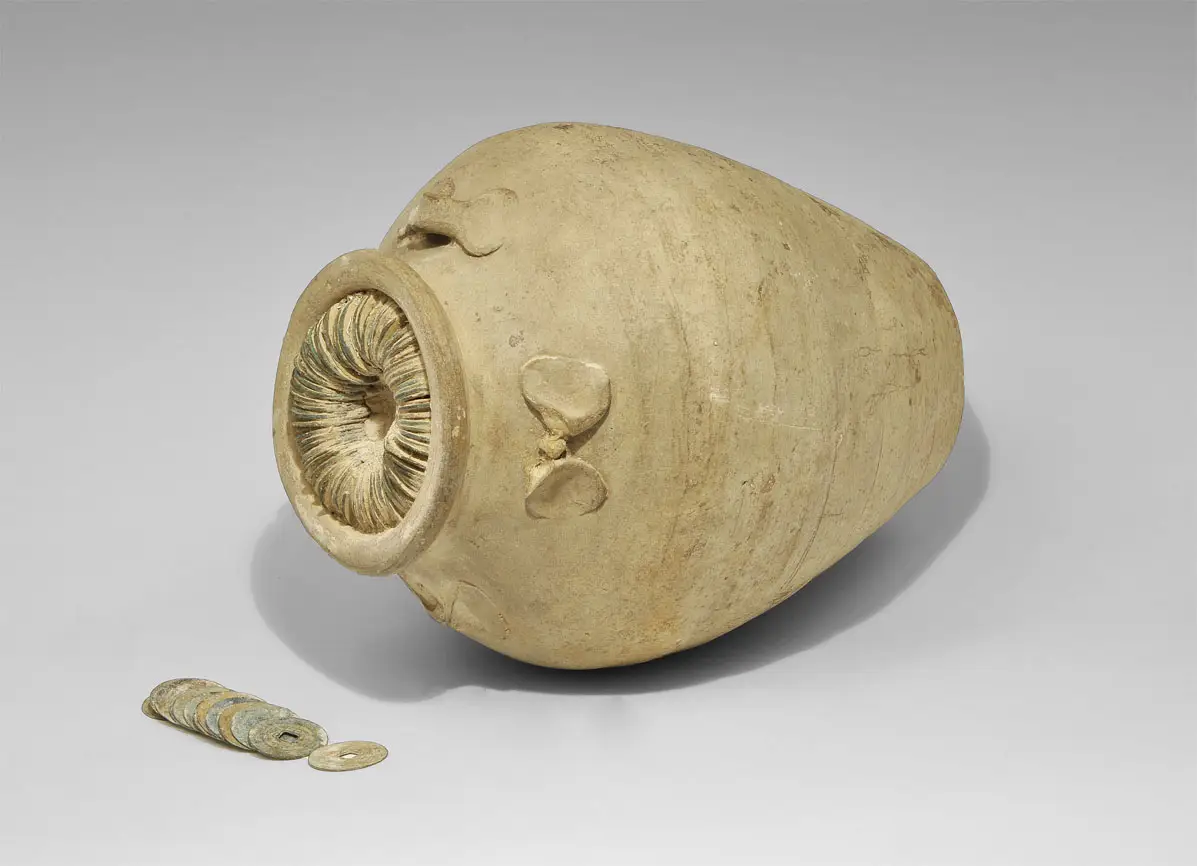
When such a deposit is recovered, its character usually places it in one of three kinds. A hoard can be the working money of its moment, the offering left at a holy place, or the long savings of a household. Each leaves a different signature in the ground.
Circulating hoards
A circulating hoard captures the cash that was actually changing hands when it went into the earth. Its make-up matches what was in everyday use, so these finds tend to date narrowly and to read like a purse or a pay packet buried in haste during a raid or the rumour of one. A scatter from Great Ellingham in Norfolk shows the type well. About twenty-five silver denarii of the later first and second centuries, from the reigns of Trajan, Hadrian, and Marcus Aurelius, were spread across a ploughed field as the fabric purse that held them rotted and the plough dragged them apart. A legionary of the period drew around three hundred denarii a year, so the group is on the scale of a single month's pay. There is no small change among it, which would be odd for a casual loss but normal for saved wages. The silver denarius was the coin that filled those purses, the everyday wage of soldier and citizen alike for the best part of three centuries.
At the other extreme is the Tomares hoard, found by construction workers near Seville in 2016. Nineteen amphorae held something like fifty-three thousand bronze coins, close to six hundred kilograms of metal, all struck within a single tight window between 294 and 311 AD in the names of Diocletian, Maximian, and their colleagues in the Tetrarchy. Many of the coins seem barely to have circulated, which has led some scholars to read the deposit as a state reserve rather than private savings, perhaps tax revenue or coin held against a payment that was never made. Full publication has been slow, almost a decade on, so the reading stays provisional.
Votive hoards
A votive hoard was never meant to come back. The coins were offerings, placed at a shrine, a spring, a grave, or some other spot set apart as sacred, and the defining thing about them is intent: the giver expected the deposit to stay where it was put. Sometimes the objects were bent or broken first, to mark them as withdrawn from use. Charon's obol, the coin laid on the mouth of the dead to pay the ferryman across the Styx, is the same idea on the smallest scale.
The richest example now being excavated is the sanctuary at San Casciano dei Bagni in Tuscany, an Etruscan healing shrine that stayed in Roman use into the fifth century AD. Since 2021 its sacred pool has given up thousands of coins, a tally that later seasons pushed past ten thousand, lying among bronze statues, jewellery, and gold-leaf offerings left by the sick in hope of a cure.
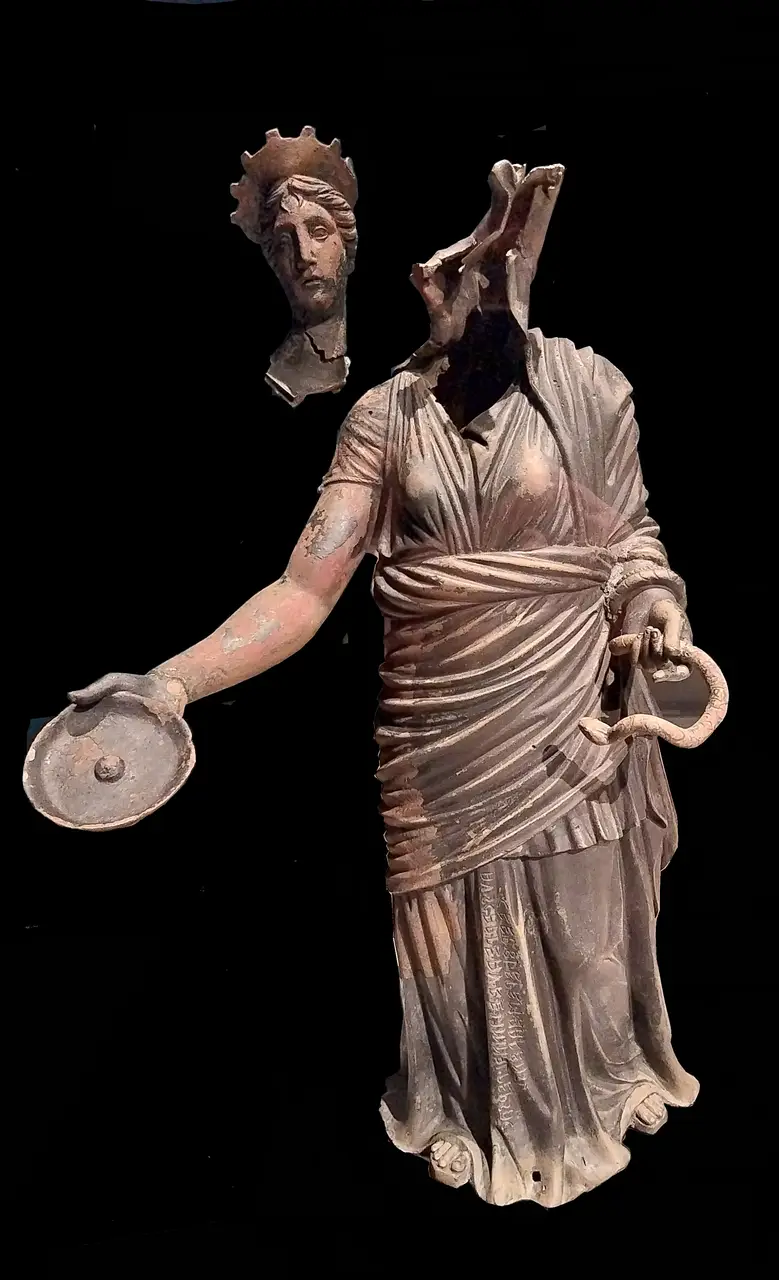 A bronze figure offered at the healing sanctuary of San Casciano dei Bagni in Tuscany, where statues and coins lay sealed for centuries in warm mud. Photo: Udimu, CC BY-SA 4.0, via Wikimedia Commons.
What sets the San Casciano coins apart is their state. The pool is fed by mineral-rich water at about forty-two degrees, and an offering dropped into it was sealed quickly under warm mud in a near-airless setting. Where base-metal coins almost always come out of ordinary ground under a heavy green crust, these have kept their original colour, brown bronze and bright silver, much as they looked when they slipped from a votary's hand. Numismatists rarely get to study Roman bronze in anything close to its minted state.
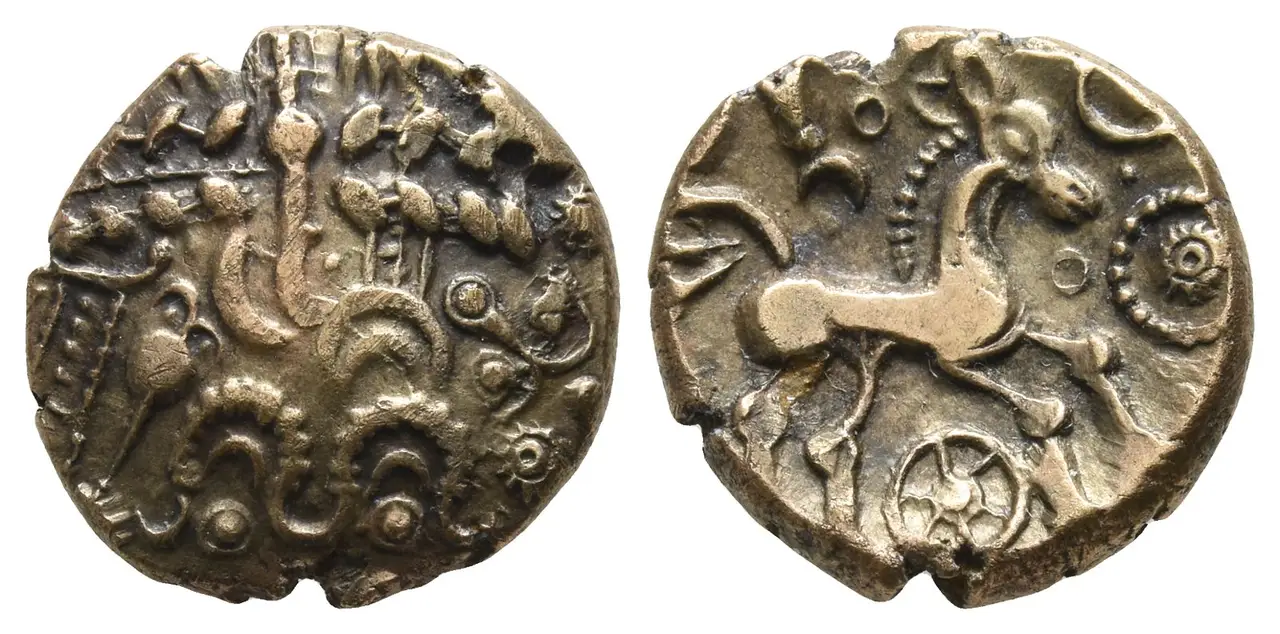
The line between an offering and an ordinary cache is not always sharp. Many Iron Age coin deposits across temperate Europe, found at the edges of enclosures, in bogs, and beside springs, can be read either as gifts to the gods or as wealth hidden for safekeeping, and opinion has shifted as the context around each find has been studied more closely. The gold staters of the British tribes, struck in the century either side of the Roman conquest, turn up in exactly these ambiguous settings.
Savings hoards
A savings hoard is what most people picture at the word treasure: wealth set by over years or decades, hidden somewhere private, and meant to be retrieved. The signs are recognisable. The coins span a wide range of dates. Higher denominations dominate, and small change is largely missing. Often other portable wealth keeps the coins company, jewellery, fragments of plate, ingots, because in any society where metal was valued by weight a heavy gold chain was as much a savings instrument as a purse of coin. A coin could even be worn as one, mounted in gold and hung at the neck, value and ornament in a single object.
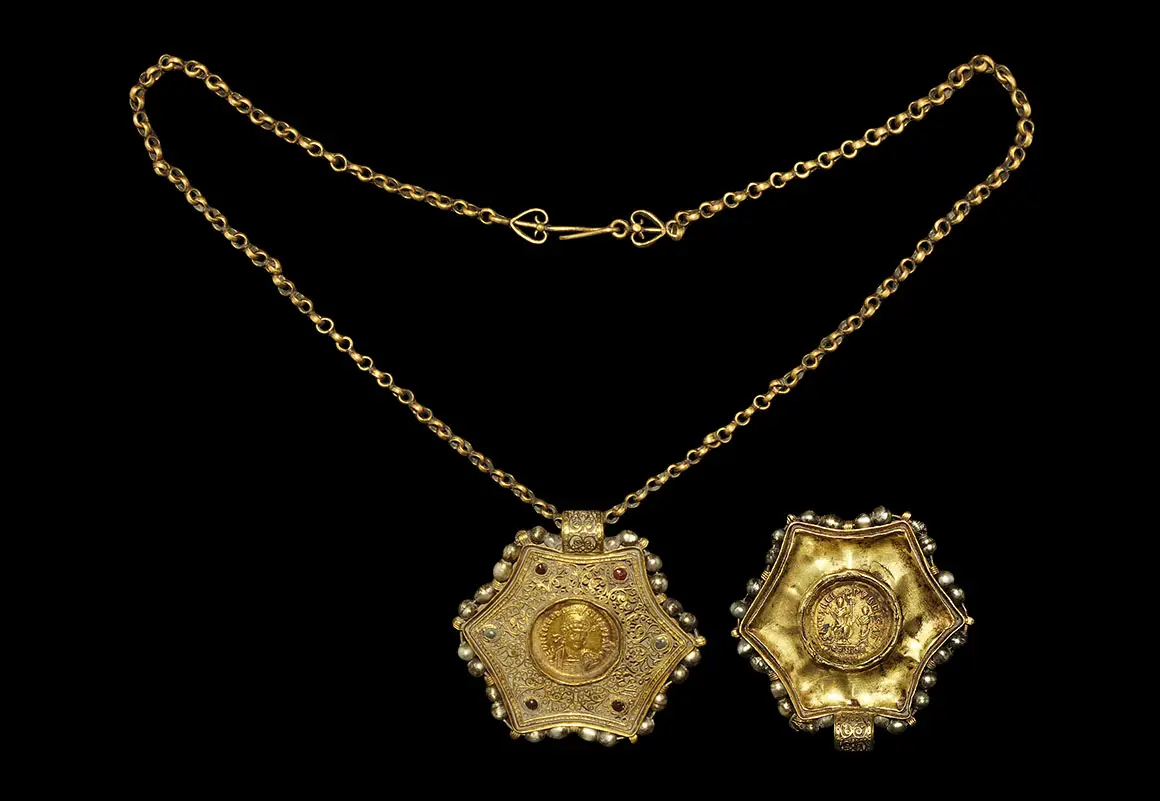
Viking-age hoards lean hard in this direction, mixing struck coin with hacksilver, cut arm-rings, and the broken-up metalwork of looted churches, all of it currency by weight. The instinct is the same one that buried a pot of denarii: put the wealth where no one else can find it, and remember the spot.
The Hoxne hoard, lifted from a Suffolk field in 1992 and now in the British Museum, is the textbook case. It held 569 gold solidi, more than fourteen thousand silver coins, mostly siliquae, and around two hundred objects of gold and silver: spoons, ladles, a gold body-chain, and pepper pots worked as figures. The coins run down to the reign of Honorius, the latest struck around 407 to 408 AD. They had been packed into a wooden chest by category, some stacked, some wrapped in cloth, some in their own small boxes, the orderly work of a household stowing its wealth over time rather than the jumble of a panicked sweep. The solidus was the standard late-Roman gold coin, struck to a fixed weight across the western mints, and a chest like this one held them by the hundred.
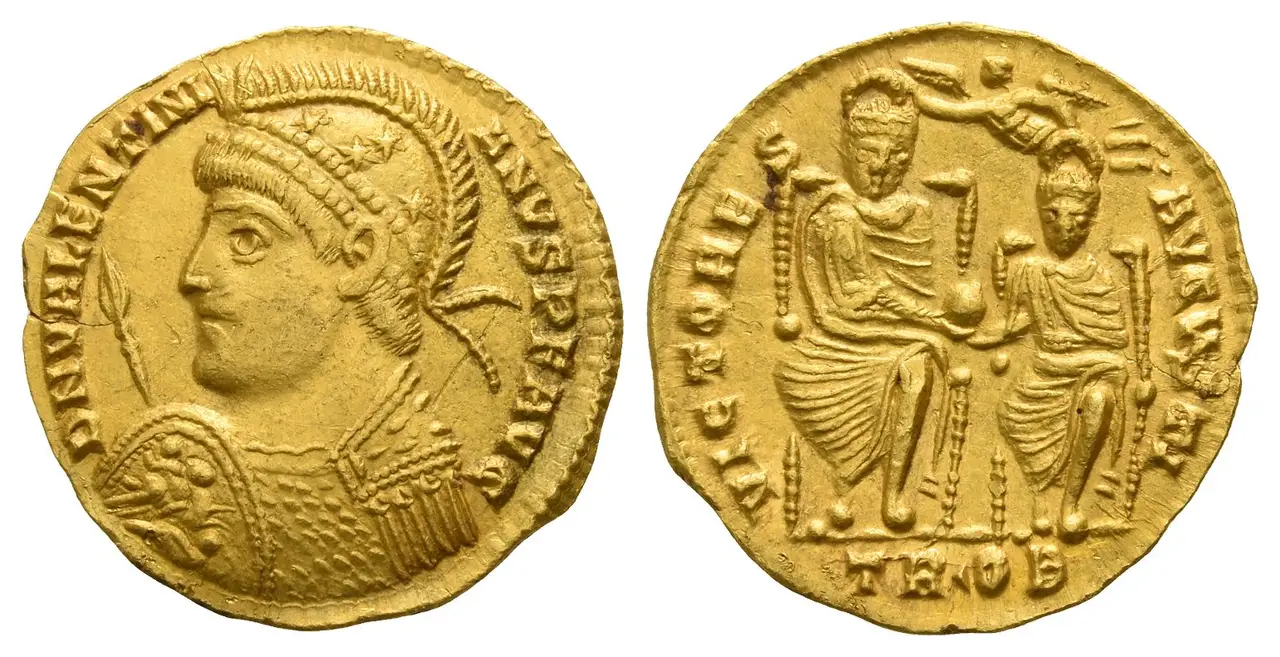
The date of the latest coin says something. Britain in the early fifth century was slipping out of Roman administration, and hoards from these years are common across the old province. Whoever buried the Hoxne chest meant to come back for it. They did not. Every named hoard in every museum is there because its owner never returned, and the long survival of ancient coinage, the reason a two-thousand-year-old denarius can sit in an ordinary collection today, rests entirely on that failure.
TimeLine Auctions, 4th July 2026