Home > Stories by TimeLine Auctions
Stories by TimeLine Auctions
Wolf's Tooth and Cross: Viking Amulets on the Edge of Conversion
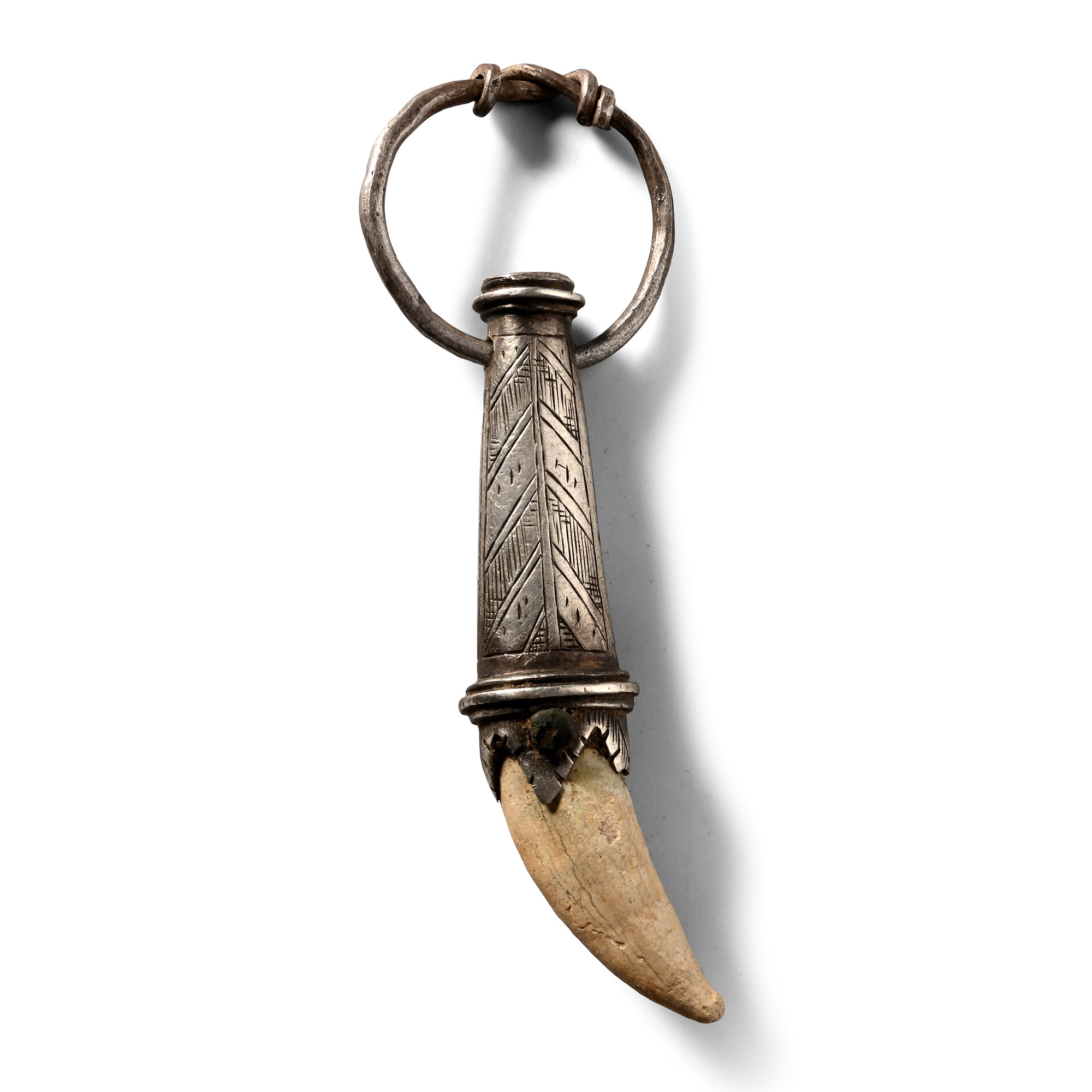
A silver sleeve about the length of a finger, engraved down its taper with rows of chevrons and cross-hatching, a raised collar at each end and a plain ring at the top for a cord. At the bottom, gripped in a serrated silver band and held by a single rivet, hangs a curved tooth the colour of old ivory. The sleeve is 85 millimetres long and weighs a little over sixteen grams. The tooth is a carnivore's canine. The catalogue calls the whole thing a Viking silver pendant set with a wolf's tooth, dates it to the tenth or eleventh century, and puts it at £300 to £400. Fifteen people are watching it, which is more than any other lot in the sale.
It is the cheapest of four silver pendants in our sale of 8 September that came out of the same northern world, and by that watch-count the most wanted. The other three ask more money and read, at first glance, as very different objects: a large filigree pendant the catalogue calls a tau cross, a small disc of scrolled silver wire, and a caged purple stone described as a magical amethyst. Set side by side, they are four things that could have hung, in some arrangement, on one woman's cord in Scandinavia around the year 1000, in the two or three generations when the north was becoming Christian and had not yet finished. None of the four has a find-spot; they come from old collections rather than excavations, which means the labels on them are the cataloguer's readings, tested against nothing but the objects themselves. Three of those labels do not survive a close look, and the closer you look the more interesting the object underneath becomes.
Dog or wolf
Start with the tooth, because the catalogue's own description quietly disagrees with its title. The heading says wolf. The line beneath says only "a canine tooth". A wolf's canine and a large dog's canine are hard to tell apart even for a specialist with the whole skull in front of him; from a single extracted tooth in a silver mount, it cannot honestly be called. Tõnno Jonuks, who has worked through the tooth-pendants of the Baltic, finds that the straighter examples resemble "a dog's or a wolf's canines" and sometimes match nothing living precisely. A bear's canine has a massive root; a boar's tusk curves hard. A plain curved single canine like this one points to a large member of the dog family, dog or wolf, and stops there.
The Norse would not have drawn the line much harder than the osteologists do. The Old Norse word hundr could mean dog or wolf as the sentence required; Snorri, describing Odin's battle-maddened warriors in Ynglingasaga, calls them "mad as hundar eða vargar", dogs or wolves, in a single breath. Aleksander Pluskowski, surveying the wolf in the medieval north, notes that specialists still cannot always decide whether a given piece of Norse animal art was meant for a wolf or a dog. Naming the tooth a wolf's is an interpretation laid over the bone. It is a defensible one, because the wolf was the animal that carried the charge.
And it carried a heavy one. The wolf in Norse thought sat at the end of the world. Fenrir, the bound wolf, was fated to break loose at Ragnarök and swallow Odin; Eiríksmál, composed around 954 for a dead Norwegian king, has it that no one knows "when the grey wolf will visit the abodes of the gods". Odin kept two wolves of his own, Geri and Freki, both names meaning "the greedy one", fed on the dead of the battlefield. His most extreme warriors were the úlfheðnar, the "wolf-coats", who in the poem Haraldskvæði of about 900 howled and shook their spears beside the bare-shirt berserkir; Sigmundr and Sinfjǫtli, in the Völsunga saga, put on wolfskins, spoke in wolf-voices and tore at their enemies' throats. To wear a wolf's tooth, if that is what a wearer took it to be, is to hang the animal of the end-times at the throat.
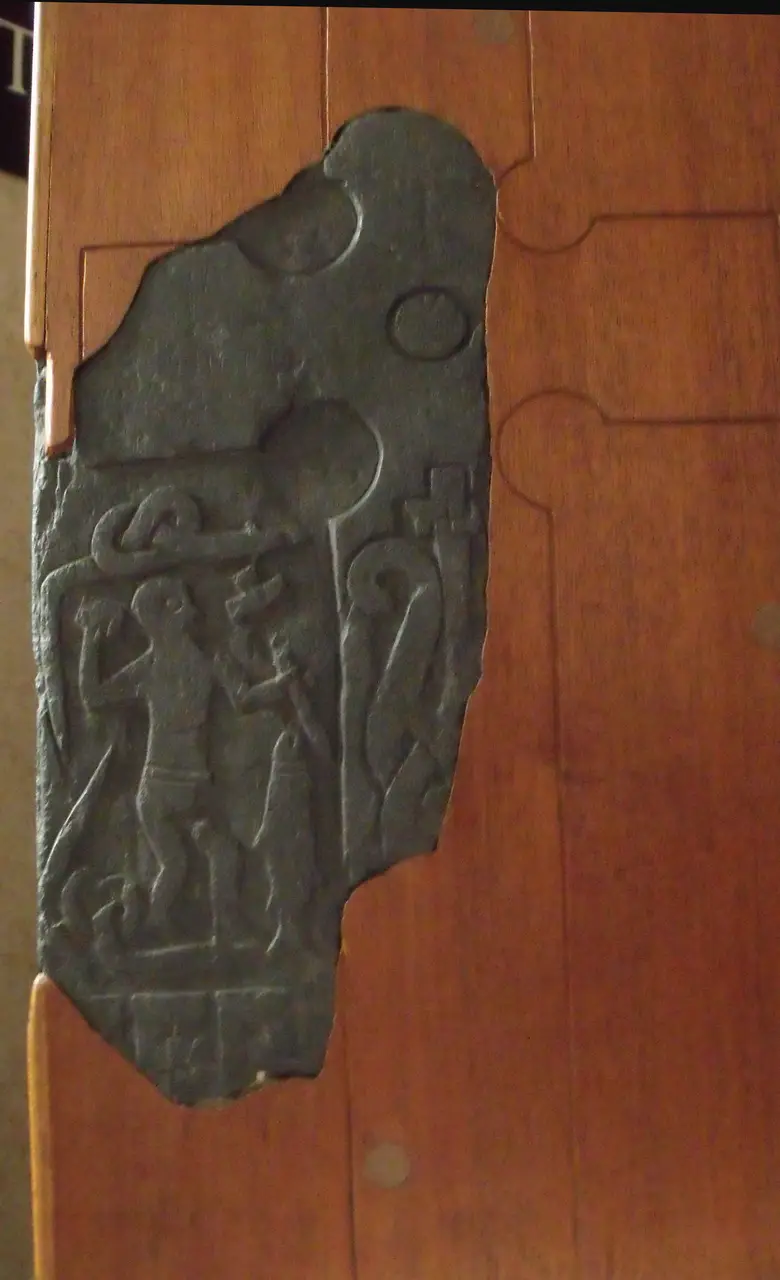 A tenth-century Christian cross-slab at Kirk Andreas, Isle of Man, carved with Odin and the wolf Fenrir and known as Thorwald's Cross. Photo: Malost, CC BY-SA 3.0, via Wikimedia Commons.
On Thorwald's Cross at Kirk Andreas on the Isle of Man, a Christian monument, a carved figure with a spear and a bird at his shoulder is being eaten, foot first, by a great wolf: Odin going down before Fenrir, cut on a cross-slab by a sculptor who had taken the new religion and still knew the old doom-story cold. The wolf's tooth belongs to that same imaginative world, the one the cross was slowly closing.
Whether a silver-mounted tooth was ever a Viking amulet at all is the harder question, and the honest answer is that we do not have another one. Bo Jensen's Viking Age Amulets in Scandinavia and Western Europe, the standard catalogue of the class, has no tooth type and no claw type; he draws the northern repertoire as metalwork and counts "the absence of bone amulets" among its features. The nearest worn tooth in a Viking setting is a boar's tusk from a grave in the Great Army's winter camp at Repton, and that was laid between the dead man's thighs, deposited rather than worn. Mounting a tooth in metal to hang it was done, but not here: cast-bronze and wire-wrapped canines turn up on women's breast-chains in Finland and Latvia, and the closest match to this object's actual construction is an Anglo-Saxon beaver tooth capped in gilt copper alloy in the Museum of Archaeology and Anthropology at Cambridge, which is the right idea two or three centuries too early and in the wrong metal. As a specifically Viking silver type, the tooth stands more or less alone.
The idea behind it is genuinely old, though it runs through Rome rather than the north. Pliny reports in the Natural History that the right canine tooth of the wolf was prized as a charm, and that a wolf's tooth was hung on children against the ailments of infancy. That the impulse is ancient says nothing about whether a tenth-century Dane had read Pliny; no line connects the one to the other. The pull of lot 298 rests on the wolf's place in Norse belief, and on the plain human habit of keeping a dangerous animal's tooth close, not on a Viking category, because there is no such category to rest on.
Belief you could wear
The four pendants are silver, and that is not incidental. Silver was the amulet metal of the Viking north; Jensen notes that silver amulets are common and occur in almost every type. The silver itself usually arrived as coin. Kufic dirhams, struck across the Islamic world and carried up the Russian rivers by the ton, were melted down at northern hearths; the metal of a Scandinavian amulet was very often an Abbasid coinage with the name of God on it. The silver should not be made magical in its own right, though: the idea that it carries protective power is later Norwegian folklore of uncertain date, not a Viking belief. Silver meant value and status, and it began as foreign coin.
They were also, almost certainly, a woman's things. Amulet-pendants come overwhelmingly from women's graves, several times as many from women as from men, and Jensen's cleanest statement of the imbalance is that it "may indicate that only women usually wore pendants". They hung at the throat on a short or long string, or from the belt. So the person on the edge of conversion wearing these objects, the one this piece keeps circling back to, is most likely a woman, and the pendants sat where a pendant sits, below the collarbone.
The harder question is what wearing one meant, and here Jensen's book argues against the reflex an object like the wolf's tooth invites. The temptation is to treat every Viking amulet as an illustration of a myth we already know, to see the tooth and reach for Fenrir and stop there. Jensen's project runs the other way: to take the amulets as objects that real people owned and handled and passed down, "closer to heirlooms than to standard commodities", sometimes so much a part of a person that they worked, he suggests, "in much the same way as do modern prosthetics", glasses or a pacemaker. Belief, in that account, is not a fixed creed stamped on the metal. It is something people did with things, and altered when their circumstances did: when the world changes, Jensen writes, the religious adapt. Across these two or three generations, the world was changing fast. Belief of this concrete kind can still be owned, as these four are about to be, as such objects regularly do in our early-medieval sales.
The edge of conversion
Christianity reached the north long before the north accepted it. A cross could turn up in Scandinavia as early as the sixth century, arriving as an import or an ornament. Organised mission came in the ninth: Archbishop Ebo to Denmark in 823, the monk Ansgar to the Swedish trading town of Birka in 829, where, in Anders Winroth's dry summary, his success "was otherwise underwhelming". The real turn came with kings. Harald Bluetooth of Denmark converted in the mid-960s and said so on the great Jelling runestone, which claims he "made the Danes Christian" and carries a carved figure of the crucified Christ; the stone, as Winroth reads it, is at least as much about Harald's power as about Christ's. Norway's conversion was a long and violent royal business running from the 930s to the death of St Olav in 1030. Iceland settled the matter by law at the Althing in the year 999 or 1000, the sources allow both, and the settlement was a compromise: everyone would be Christian in public, but a man might still sacrifice to the old gods in private, so long as no witnesses came forward. Sweden held out longest of all; the pagan cult at Uppsala is reported still standing near 1080, and Uppsala did not receive its archbishop until 1164.
Public Christianity with private paganism, the Icelandic formula, is the conversion in miniature, and the same doubleness is documented well beyond Iceland. It is worth being exact about where it lived, because the temptation is to go looking for it inside single clever objects, and mostly it was not there. It lived in the workshop: a soapstone mould from Trendgården in Jutland is cut to cast, in one and the same tool, both Thor's hammers and Christian crosses, a single smith equipped to supply either symbol to either customer. It lived in the grave: a woman at Thumby-Bienebek near Hedeby was buried wearing a cross pendant, in a wagon decorated with hammers. It lived in the law, at the Althing. And it lived in individual people: the Icelander Helgi the Lean, the Landnámabók records, "prayed to Christ when he was at home, but to Thor when he was at sea or in a tight place". Traders had themselves "prime-signed", marked with the sign of the cross short of full baptism, so that they could deal with Christians and heathens alike; of such men, Egil's Saga says, they had "as faith whatever suited them best".
What the coexistence did not usually do was collapse into a single hybrid amulet, and the distinction matters, because it is tempting to want each of these pendants to be a two-in-one, pagan and Christian at once. Jensen, the most careful cataloguer of the material, is firmly against it. Genuinely ambiguous hammer-crosses, he argues, are very rare, and their ambiguity "seem[s] mostly to exist in the minds of the observers"; he has "little patience with claims that crosses might be symbols of magical power acceptable to pagans". A cross tells you its wearer was a Christian, even a lax one. Nor does the tidy story that the Thor's hammer spread as a pagan badge of defiance against the cross quite hold: iron hammers appear in central Sweden in the eighth century, before any mission reached the region, and in several grave-groups the crosses actually outnumber the hammers. The four pendants are better seen as four different objects that could share one conversion-age cord, reaching from the pagan world of the tooth toward the Christian world of the cross, without any single one of them settling the question by itself.
The most expensive question in the sale
The dearest of the four, at £4,000 to £6,000, is the one the catalogue is most confident about and most wrong. It calls the object a very large Viking silver tau cross, and adds that its shape "finds parallels with the patrices of the Busdorf hoard". Both statements fail, and what is left when they fall away is the best object in the group.
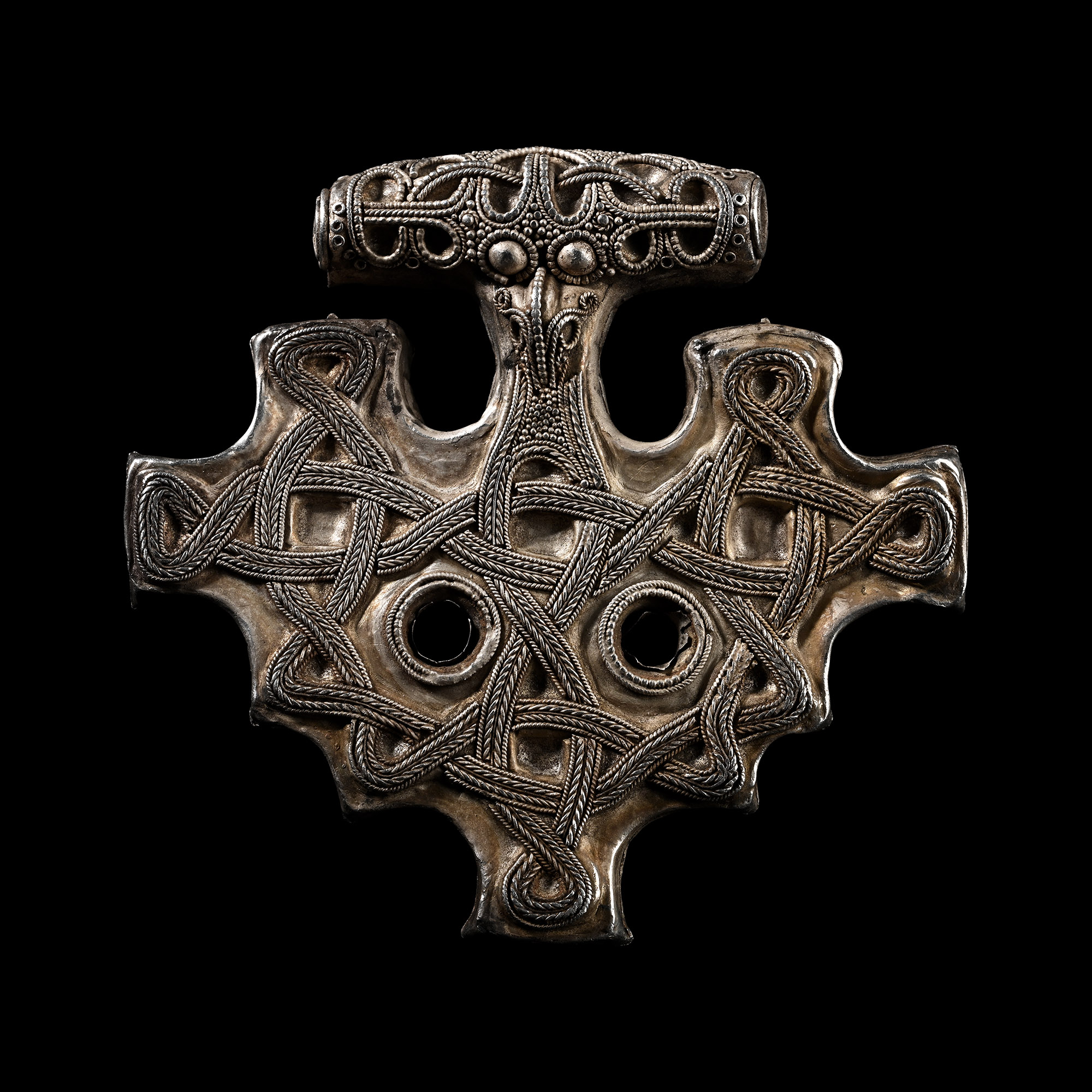
Take the tau cross first. A tau cross is T-shaped, named for the Greek letter, and tied to St Anthony and the Antonine order, which was founded at the end of the eleventh century. It is a High-Medieval form. It is not a Viking one. Jürgen Staecker's corpus of Viking-age cross pendants, digested in Jensen's book, holds variations on the Greek cross, crucifixes and reliquary crosses, and no tau subtype at all; a search of the standard literature for a Viking "tau cross" pendant returns nothing. The single time the word "tau" appears in the whole of Jensen's monograph, it is inside a reading he rejects. "Tau cross" here is a shape-word, a description of the object's outline, dressed up as a category that did not exist when the object was made.
As for the Busdorf hoard, there is no such thing. Busdorf is the modern village that sits on the site of Hedeby, the great Viking trading town in what is now northern Germany. Its known finds are graves and swords, among them the display swords from a wrecked burial of around 900 to 950. There is no documented Busdorf hoard and no documented set of Busdorf "patrices", the stamping-dies of a metalworker; every appearance of that word beside Busdorf in the literature turns out to be an unrelated court title on a neighbouring index line. Hedeby did produce dies, so the cataloguer may be reaching, at several removes, for a genuine Hedeby workshop find. The specific parallel as printed cannot be traced, and should not be repeated.
So the object has to be read without its label, and read that way it is a different thing. It has a barrel-shaped bar at the top to take the cord, then a narrow neck, and at the junction a small animal head with two domed eyes and a nose, above a broad, lobed plaque smothered in filigree interlace and granulation and pierced with two round holes. That anatomy, barrel bar plus beast-head plus broad filigree plaque, is the signature of a particular southern-Scandinavian family of pendants: the filigree work associated with Scania and with the Hiddensee style. Its closest published relative is a silver filigree Thor's hammer from Skåne in the Swedish History Museum, which has the same barrel bar, the same little beast-head with domed eyes at the neck, and the same broad granulated plaque with a central perforation. Set the two photographs together and they are plainly the same class of thing. The catalogue's own phrase, "domed 'eyes' and nose at the junction", is a description of that hammer's beast-head.
Here is what makes the object worth its price as an idea, whatever it makes as a lot. The workshops that produced these filigree pendants produced hammers and crosses alike. The gold "Hiddensee crosses" and the animal-headed Thor's hammers, Jensen notes, may have come from the same hand; dies for the Hiddensee crosses have been found in Hedeby's harbour. The barrel-bar-and-beast-head suspension was a shared fitting, used on the pagan hammer and the Christian cross without distinction. Lot 295 is not a demonstrable cross and not a demonstrable hammer. It is a filigree pendant from exactly the tradition in which the hammer and the cross were the same silversmith's stock, and its nearest surviving cousin happens to be a hammer, while its outline has been read, by the people selling it, as a cross. The honest thing to say is that we can no longer tell which it was meant to be, if it was meant to be either. Set against the moment these things come from, that is not a defect. It is the truest object in the group.
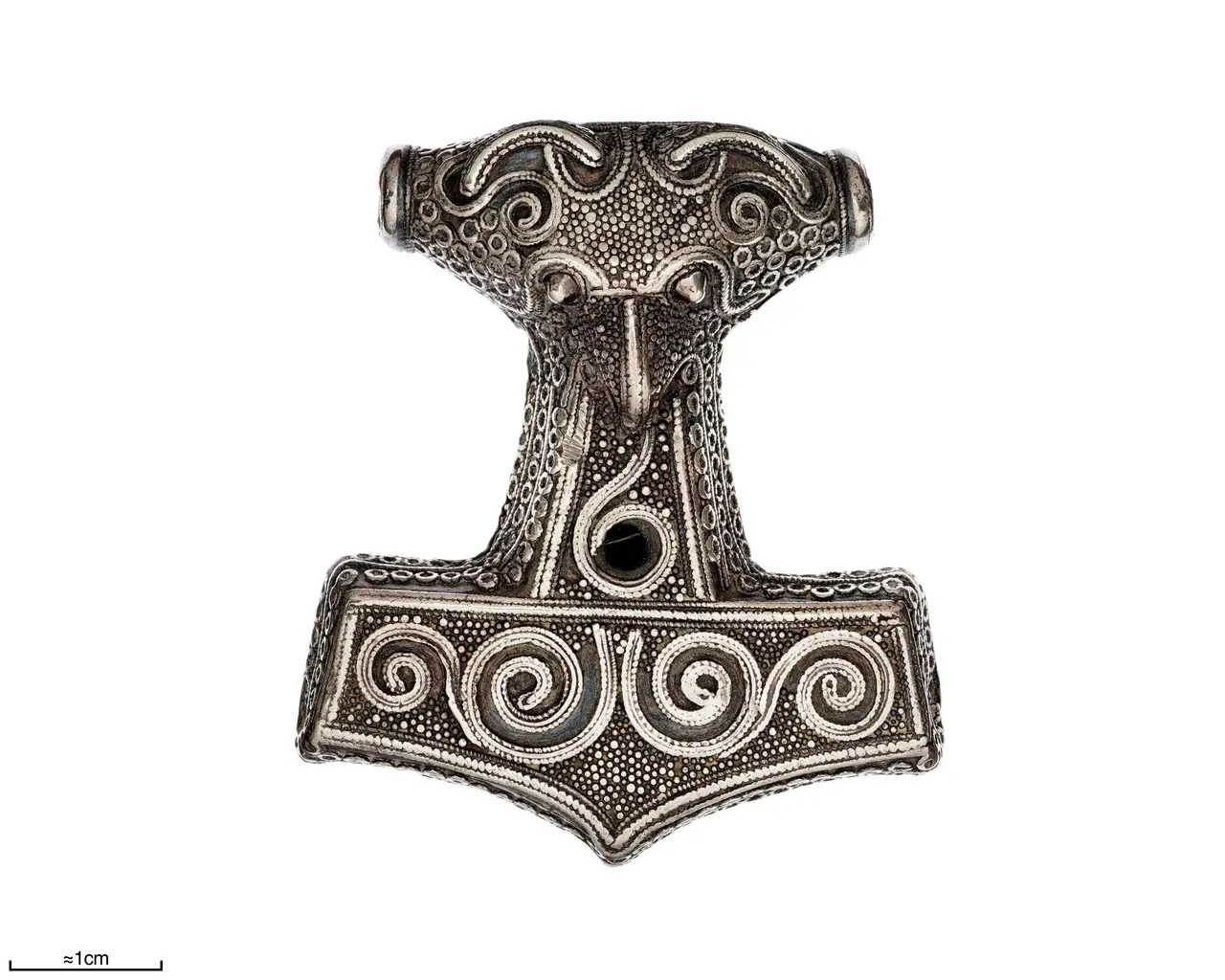 A silver filigree Thor's hammer from Skåne, with the barrel suspension bar, beast-head and granulated plaque of the southern-Scandinavian filigree tradition. Swedish History Museum, SHM 9822:810. Photo: Ola Myrin, Statens historiska museum / SHM, CC BY 4.0, via Wikimedia Commons.
One caution keeps this on the right side of Jensen's line: the ambiguity is ours, and the scholarship's, not a proven intention of the Viking who owned it. The multi-strand braided filigree of the plaque is the Terslev style of interlace, and the object's date-bracket, tenth to twelfth century, is exactly where cross pendants tend to sit, which, as Staecker observed, is mostly later than the official conversion dates in the written sources. Late enough, in other words, to belong to the long aftermath, when the argument had officially been settled and the objects had not yet caught up.
Silver made to catch the light
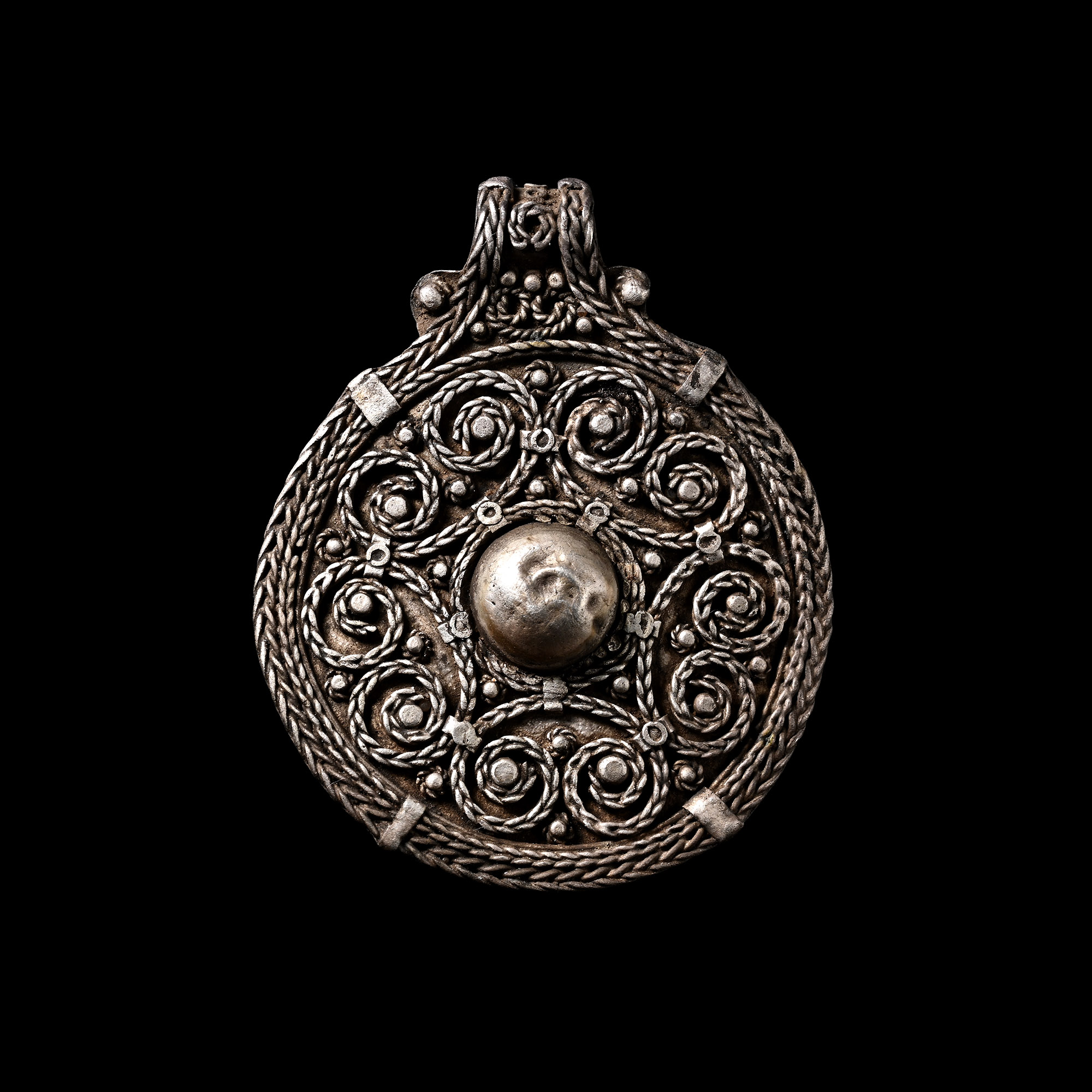
The smallest and plainest-sounding of the four is the one that fits its label exactly, and it is the one that explains how all of them were made. Lot 296 is a silver disc a little over three centimetres across, with a raised hollow boss at the centre, a border of plaited rope-work, and a field of symmetrical scrolls and tiny beads. Every word of that is a diagnostic of a named type, the Terslev style, after a hoard buried in the 900s at Terslev on the Danish island of Zealand. Jane Kershaw defines the style by its symmetrically placed volutes bound into a ring-knot; the scrolls on the disc are those volutes, and the hollow boss is the domed upper sheet these pieces were built from, soldered over a flat backplate. Where the catalogue on lot 295 reaches for a category that does not exist, on lot 296 it lands on precisely the right one.
The disc is a lesson in two techniques whose names collectors trip over. Filigree is patterned wire, plain or beaded, soldered flat to the surface of the metal. Granulation is the harder trick, the one an encyclopaedia of the period singles out for its difficulty: minute spheres of silver or gold, soldered into place one by one without letting them slump or the join flood. Both were possible only in precious metal, both were the work of specialists, and a good filigree pendant might stand for weeks or months of a silversmith's time. The point of the work was light. Wire and grain break a surface into hundreds of small facets, and by a hearth or a lamp, which is the light these things were mostly seen in, they glitter. The disc was made to be worn at the throat of someone standing near a fire.
Behind it stands a whole northern industry. The great filigree workshops sat at the trading centres, Helgö, Birka, Ribe, Hedeby, and the finest work of all, judged by eye, has its roots in the silverwork of the Byzantine and Rus worlds to the east. The high end of the tradition was royal: the Hiddensee gold treasure, found on an island off the German Baltic coast, is a set of filigree pendants and a brooch tied to Harald Bluetooth's court at Jelling, possibly made under royal control and handed out to loyal men as a kind of political currency. A pendant like lot 296 is a small piece of that international economy, dirham silver worked to a Byzantine-descended pattern in a Baltic town.
And it carries no religious sign at all. No cross, no hammer, no beast, nothing to place its owner on either side of the conversion. That is worth stating plainly, because it is easy to forget when the subject is belief: a great deal of what hung on a Viking cord was neither pagan nor Christian, but simply prestige, silver in the international style, worn because it was fine and it caught the firelight. The disc is the neutral ground of the sale, the object that answered to nobody's god.
Not drunk
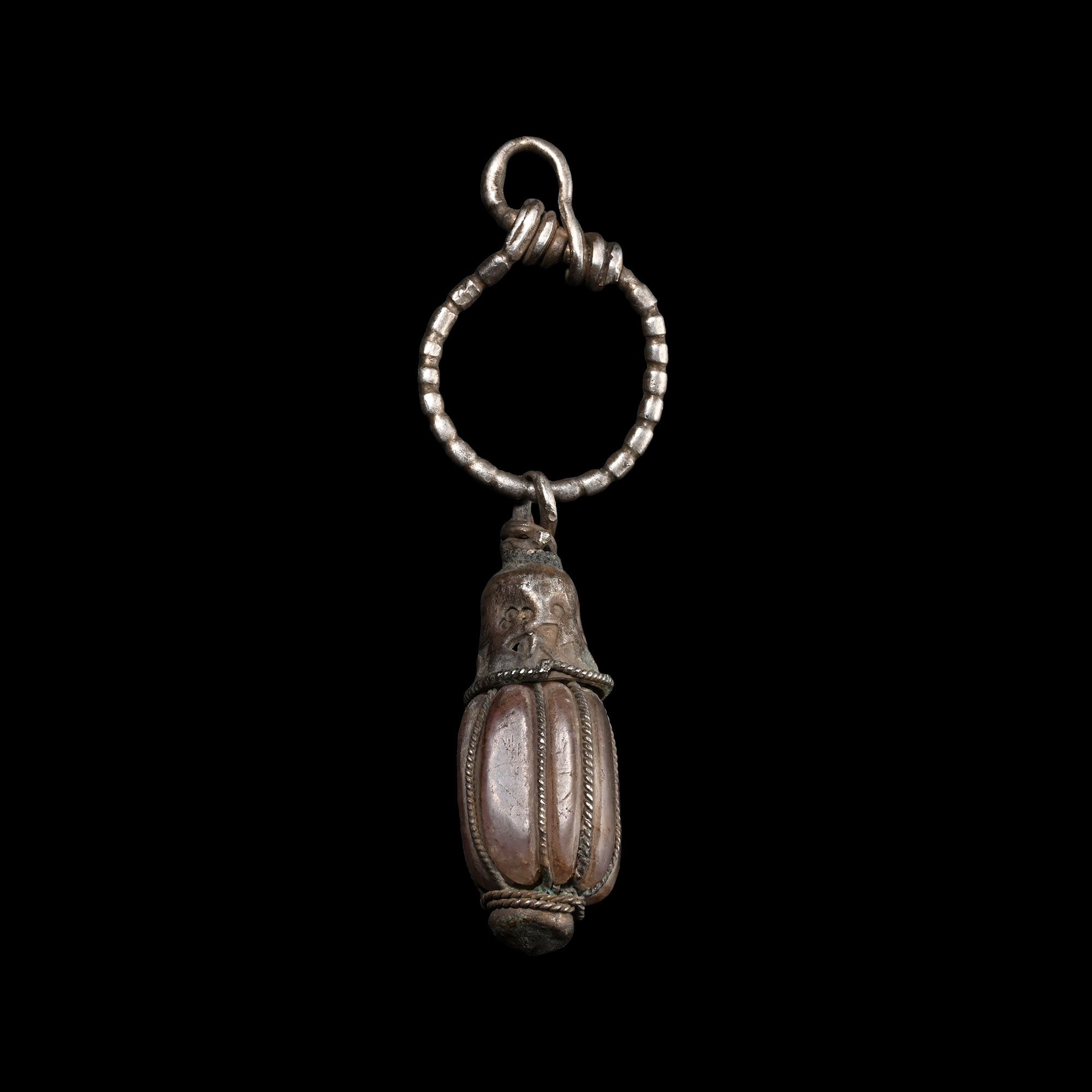
The last of the four is a purple stone in a silver cage: a bead of amethyst, grooved to seat the wires, held in an openwork filigree basket under a bell-shaped cap and hung from a ring of beaded wire. The catalogue calls it a pendant with a magical amethyst gem. The word "magical" points at something real, ancient, and almost certainly unknown to the person who wore the stone.
The Greek name gives the game away. Amethystos means "not drunk", from methy, wine, with the negative a- in front. The stone was believed to keep its wearer sober, and the Greeks set amethysts in the rings and cups they used at drinking parties for exactly that protection. The fullest ancient source on it is Pliny, and Pliny thought it was nonsense. He gives the wine-colour explanation of the name, the stone's purple stopping just short of the colour of wine, and then reports the other claim with open contempt: the Magi, he writes, falsely promise that the amethyst resists drunkenness, and that this is why it is so named, and they set down such things "with a derisive contempt for mankind". The belief that the stone fought wine is genuinely classical. So is the oldest surviving verdict on it, which is that it does not work. The prettier story, that Bacchus wept over a nymph turned to amethyst quartz, is not ancient at all; a French poet invented it in the sixteenth century, and it should not be handed back to the Greeks.
The sober-stone belief did travel through the Middle Ages, but by a road that never reached a Norse pendant. It survived in the Latin lapidaries, the learned stone-books, above all in Marbode of Rennes, whose De lapidibus of about 1090 was copied and translated across Christian Europe; medieval Christian writers even read the amethyst's violet as the wine of the Mass. That is a Mediterranean idea carried in Latin by churchmen. There is no sign it ever became a Norse folk belief, and Jensen's amulet corpus, thick with amber and jet, does not mention amethyst once.
In the Viking north the stone itself was a rarity and an import. Amethyst comes from the eastern Mediterranean and beyond, and its high point in the north fell earlier than the Vikings, in the sixth and seventh centuries, when polished amethyst drops hung at the bottom of the necklaces buried with women in Kent. On a genuine Viking-age pendant, an amethyst is an exotic survival or a fresh import from the east, not stock northern material. What is thoroughly northern about lot 297 is the setting: Scandinavian silversmiths did cage imported hardstones in just this way, wrapping rock crystal and carnelian in filigree straps gathered under a sheet-silver cap. The purple bead is a Mediterranean traveller; the silver basket around it is local work. If the amethyst meant anything to its Norse owner, it will have been some vague, general protection, and not the Greek promise, recorded and mocked by Pliny, that you could drink all night and keep your head.
One cord
Line them up as they might once have hung. A tooth from a dog or a wolf in an engraved silver sleeve, pointing to the animal of Ragnarök and to a charm as old as Pliny, on an object with no close Viking parallel at all. A filigree pendant whose nearest relative says hammer and whose sellers say cross, from the workshops where hammer and cross were the same man's work. A silver disc that took weeks to make and declares for neither god, worn because it shone. A purple stone whose famous magic belonged to a Mediterranean its owner never saw. Four objects, one likely wearer, a woman at the throat, in the decades when the north kept Christ at home and the old gods at sea.
What the group will not give you is the tidy hybrid, the pagan-and-Christian amulet in a single stroke. The coexistence was real, but it lived in the mould that cast both symbols, the grave that mixed them, the law that allowed both, and the man who prayed to whichever suited the weather. The pendants are quieter, and more honest, than that. Three of them wear a name that a close look lifts off, and each is the better for losing it. The most-watched lot in the sale is also the cheapest of the four: a tooth whose animal no one can put a species to, mounted in a way no other Viking object repeats. Fifteen people are waiting for it.
TimeLine Auctions, 11th August 2026